











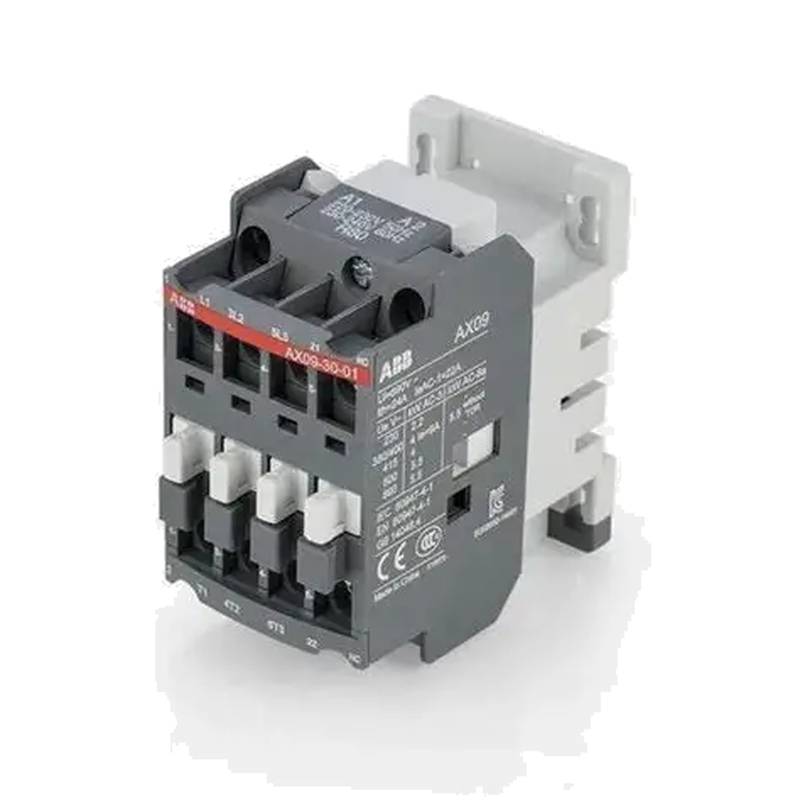
ABB AX09-30-10-80 9A 3P AC Contactor 24V Coil


The ABB AX09-30-10-80 9A 3P AC Contactor with a 24V coil is a robust and reliable component engineered for demanding industrial applications. Its design prioritizes high performance, operational efficiency, and seamless integration into various electrical control systems. Key advantages include its compact footprint, significant electrical endurance, and superior protection features, making it a preferred choice for motor control and power switching tasks across diverse sectors.
Product Specifications
| Feature | Specification |
| :------------------ | :------------------- |
| Contactor Type | AX09 |
| Rated Operational Current (AC-3) | 9 A |
| Number of Poles | 3 |
| Coil Voltage | 24V AC |
| Auxiliary Contacts | 1 NO + 1 NC |
| Mounting Type | DIN Rail or Screw |
| Terminal Type | Screw Terminals |
| IP Rating | IP20 |
| Dimensions (H x W x D) | 86 mm x 45 mm x 77 mm |
| Standards Compliance | IEC/EN 60947-4-1 |
Core Features & Market Positioning
The ABB AX09-30-10-80 stands out in the industrial control market due to its exceptional reliability and longevity, critical factors for minimizing downtime in automated processes. Its robust construction ensures consistent performance even under frequent switching cycles and challenging environmental conditions. The integrated auxiliary contacts (1 NO + 1 NC) provide essential feedback for control circuits, enhancing system monitoring and safety. ABB's reputation for quality and innovation positions this contactor as a dependable solution for original equipment manufacturers (OEMs) and system integrators seeking high-performance components that reduce maintenance burdens and ensure operational continuity. The 24V AC coil voltage is a common and safe voltage standard, facilitating easy integration into many existing control panels and power distribution systems.
Key Application Scenarios
This 3-pole AC contactor is ideally suited for a wide array of industrial applications, primarily focused on the direct control of three-phase motors up to its rated current of 9A under AC-3 utilization category. Common scenarios include HVAC systems, pump control, fan operation, and conveyor belt systems in manufacturing and processing plants. It is also frequently employed in building automation for controlling lighting circuits, heating elements, and other power loads where reliable switching is paramount. Its compact size and versatile mounting options (DIN rail or screw mounting) allow for flexible integration into control panels of varying footprints.
Practical System Integration Guidance
Integrating the ABB AX09-30-10-80 into an electrical control system is straightforward. Power connections for the motor load are made to the main terminals (typically L1, L2, L3 for input and T1, T2, T3 for output). The 24V AC coil is connected to terminals A1 and A2. Ensure the supply voltage precisely matches the coil rating to prevent damage or malfunction. Wiring of the auxiliary contacts (13/14 for NO, 23/24 for NC) should be done according to the control circuit design, often used to signal the contactor's state (energized/de-energized) to a PLC or other control logic. For motor control, it's crucial to pair the contactor with appropriate overload protection, such as an ABB thermal overload relay, to safeguard the motor against overcurrent conditions. Proper torque must be applied to the screw terminals to ensure secure electrical connections and prevent overheating.
Operation and Risk Mitigation
The AX09-30-10-80 operates by energizing its coil, which creates a magnetic field that pulls in an armature, closing the main power contacts. When the coil is de-energized, a spring returns the armature, opening the contacts. Safety during operation and maintenance is critical. Always ensure power is completely isolated and locked out before performing any wiring or maintenance. The IP20 rating indicates protection against solid objects larger than 12.5mm but offers no protection against water; therefore, it must be installed in an enclosure or control panel to prevent accidental contact and environmental ingress. Common troubleshooting involves checking coil voltage, ensuring connections are tight, and verifying that the contacts are not welded or pitted, which can occur after extensive use or under fault conditions. No specific error codes are associated with the contactor itself; fault indication typically comes from the overarching control system or associated protective devices.
Scalability & Long-Term Value
The ABB AX09-30-10-80 is designed for integration within larger, scalable automation architectures. Its compatibility with ABB's broader range of motor control components, such as overload relays and command devices, allows for modular system expansion. For systems moving towards digitalization, this contactor can be incorporated into smart control panels that utilize communication modules for remote monitoring and diagnostics, contributing to IIoT (Industrial Internet of Things) integration. While the contactor itself is a discrete component, its reliability ensures long-term value by minimizing the need for premature replacement, thus lowering the total cost of ownership for the controlled equipment. Its adherence to international standards (IEC/EN 60947-4-1) ensures compatibility with a wide range of control system platforms.
FAQs
Q1: What is the primary function of the ABB AX09-30-10-80 contactor?
This contactor serves as an electrically operated switch designed to interrupt or establish power circuits. It is specifically engineered for controlling three-phase AC motors and other high-power electrical loads in industrial settings. Its robust design ensures reliable operation over many cycles.
Q2: Can this contactor be used for DC applications?
No, the ABB AX09-30-10-80 is explicitly designed for AC (Alternating Current) circuits. Using it in a DC (Direct Current) application can lead to coil overheating, contact welding, and premature failure due to the different arc quenching characteristics of AC and DC. Always match the contactor type to the power system.
Q3: What are the implications of the 24V AC coil voltage?
A 24V AC coil voltage is a common, lower voltage standard often used for control circuits. This enhances safety compared to higher mains voltages and simplifies wiring within control panels. It requires a dedicated 24V AC power source, typically provided by a control transformer.
Q4: How do I wire the auxiliary contacts on the AX09-30-10-80?
The contactor includes one normally open (NO) and one normally closed (NC) auxiliary contact. The NO contact (terminals 13 and 14) closes when the main coil is energized, and the NC contact (terminals 23 and 24) opens. These are typically wired into control logic or signaling circuits.
Q5: What is the maximum motor power this contactor can control?
The AX09-30-10-80 is rated for 9A under AC-3 utilization category. This translates to controlling motors up to approximately 4 kW (5.5 HP) at 400V or 415V. It's crucial to consult motor nameplates and utilization category tables for precise motor matching.
Q6: Is overload protection included with this contactor?
No, the ABB AX09-30-10-80 contactor does not include integrated overload protection. It must be paired with a separate overload relay (e.g., ABB thermal overload relays) or other protective devices to provide overcurrent and thermal protection for the motor.
Q7: What mounting options are available for the AX09-30-10-80?
This contactor offers versatile mounting capabilities. It can be securely mounted directly onto a standard 35mm DIN rail or attached via screw terminals, providing flexibility for different control panel designs and configurations.
Q8: What does the "AC-3" utilization category mean?
AC-3 utilization category signifies that the contactor is suitable for starting squirrel cage motors and for stopping them. This category implies that the contactor must handle the higher inrush current during motor start-up and maintain a reliable break during motor run.
Q9: What is the expected lifespan of this ABB contactor?
The lifespan of the AX09-30-10-80 is measured in electrical switching cycles. Under normal operating conditions and within its rated parameters, it is designed for a high number of operations, ensuring long-term reliability and minimizing maintenance requirements. Specific figures depend on load and switching frequency.
Q10: Can this contactor be integrated into an IIoT or smart factory system?
Yes, while the contactor itself is a foundational component, it can be part of a smart system. By integrating it within intelligent control panels equipped with communication modules, its operational status can be monitored remotely, contributing to IIoT frameworks and advanced factory automation.