











ABB AX95-30-11-84 Contactor 3 Pole 110V AC 95A


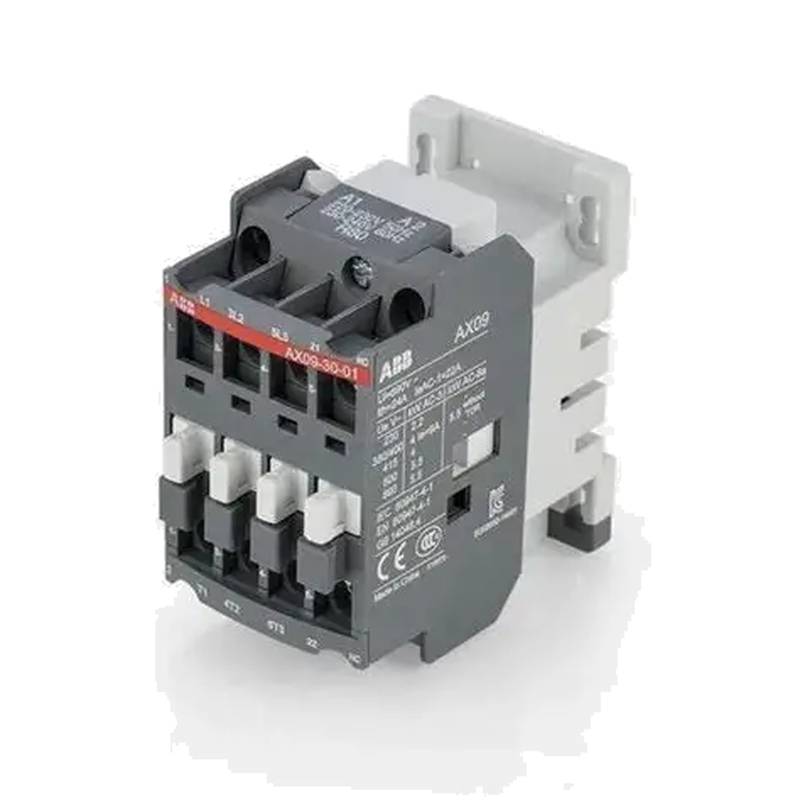
The ABB AX95-30-11-84 contactor is a robust 3-pole, 95A device designed for reliable control of 3-phase motors and power circuits up to 690V AC. This specific model features a 110V AC coil, offering precise operation for a wide array of industrial applications. Its design prioritizes durability and ease of integration, making it a preferred choice for engineers seeking dependable power management solutions. Key advantages include its high AC-3 utilization category rating, ensuring longevity in demanding switching applications, and its compact block design that facilitates efficient panel space utilization. The inclusion of integrated auxiliary contacts (1NO + 1NC) provides immediate signaling capabilities, simplifying control circuit design.
Product Specifications
| Parameter | Value |
| :----------------------------- | :---------------------------------- |
| Product Code | 1SFL431074R8411 |
| Model | AX95-30-11-84 |
| Number of Poles | 3 |
| Rated Operational Current (AC-3) | 96 A |
| Rated Operational Current (AC-1) | 145 A |
| Coil Voltage | 110 V AC (50/60 Hz) |
| Auxiliary Contacts | 1 NO + 1 NC |
| Conventional Thermal Current | 145 A |
| Rated Insulation Voltage (Ui) | 8 kV |
| Rated Impulse Withstand Voltage | 8 kV |
| Rated Operational Power (AC-3) | 45 kW (at 380/400 V) |
| Mechanical Durability | 10 million cycles |
| Max. Electrical Switching Freq.| 300 cycles per hour |
| Max. Mechanical Switching Freq.| 3600 cycles per hour |
| Terminal Type | Cable Clamp |
| Degree of Protection | IP20 (Auxiliary Terminals) |
| Product Net Width | 102 mm |
| Product Net Height | 148 mm |
| Product Net Depth / Length | 123.5 mm |
| Product Net Weight | 1.9 kg |
Core Features & Market Positioning
The ABB AX95-30-11-84 contactor stands out in the industrial control market due to its adherence to rigorous IEC standards, ensuring high performance and reliability. Its primary differentiator lies in its robust construction and ABB's commitment to quality, positioning it as a premium solution for critical motor control and power switching applications. The series utilizes a block-type design, allowing for flexible addition of auxiliary contact blocks and accessories, a feature highly valued in custom automation solutions. Unlike some competitors, ABB's contactors often boast superior mechanical and electrical endurance, translating to longer operational life and reduced maintenance costs for end-users. This focus on long-term value and dependable operation makes the AX95-30-11-84 a preferred component in demanding industrial environments.
Key Application Scenarios
This 3-pole, 95A ABB contactor is engineered for direct control of three-phase induction motors across various industrial sectors, including manufacturing, material handling, and pumping systems. Its 110V AC coil voltage makes it suitable for installations where this specific control voltage is standard. Typical applications involve motor starting and stopping, load shedding, and as a main switching device in power distribution circuits. The AX95-30-11-84 is also well-suited for controlling resistive heating loads and lighting circuits due to its high AC-1 rating of 145A. Its ability to switch power circuits up to 690V AC confirms its versatility in diverse industrial power distribution networks.
Practical System Integration Guidance
Integrating the ABB AX95-30-11-84 contactor into an electrical system is straightforward, benefiting from its standard terminal configurations and ABB's comprehensive documentation. For wiring, ensure the control circuit is correctly connected to the coil terminals (typically A1 and A2) with the specified 110V AC supply. The main power terminals should be wired in series with the load, ensuring proper torque is applied to the cable clamp terminals for secure connections. The auxiliary contacts (1NO and 1NC) can be wired into control logic for feedback signals or interlocking circuits. Given its 3-pole configuration, it's ideal for switching all three phases of a motor simultaneously, preventing phase imbalance. It is crucial to adhere to local electrical codes and standards during installation and commissioning.
Operation and Risk Mitigation
Proper operation of the AX95-30-11-84 contactor relies on ensuring the control voltage accurately matches the 110V AC specification and that the load current does not exceed its rated AC-3 capacity of 96A. Overloading can lead to premature contact wear and failure. Users should be aware that contactors operate by electromagnetically actuating contacts; therefore, regular inspection for signs of arcing or wear on the main contacts is recommended. While specific fault codes are not inherent to the contactor itself, system diagnostics should monitor for coil circuit faults (open or short) or excessive switching times, which could indicate a failing coil or mechanical issue. Adherence to the maximum switching frequency of 300 cycles per hour is vital for maintaining mechanical durability.
Scalability & Long-Term Value
The AX95-30-11-84 contactor is part of ABB's extensive A-series, offering excellent compatibility with other ABB components like overload relays and control devices. This compatibility facilitates system expansion and upgrades. For instance, an ABB overload relay can be easily mounted to provide thermal protection for motors controlled by this contactor. While direct integration with Industrial Internet of Things (IIoT) platforms might require additional interface modules, the inherent reliability and modular design of ABB products lay a strong foundation for future smart factory integration. The substantial mechanical durability of 10 million cycles ensures long-term operational value, minimizing the need for frequent replacements and contributing to a lower total cost of ownership.
Frequently Asked Questions
What is the primary function of the ABB AX95-30-11-84 contactor?
The ABB AX95-30-11-84 contactor primarily serves as a heavy-duty electrical switch. It is used to control high-power circuits, most commonly for starting and stopping three-phase electric motors.
It allows for remote operation and automation of machinery by acting as a control element within a larger electrical system. This ensures safe and efficient power management for industrial equipment.
This contactor is rated for 95A and can handle voltages up to 690V AC, making it suitable for significant industrial loads.
What type of coil voltage does the ABB AX95-30-11-84 contactor use?
The ABB AX95-30-11-84 contactor is equipped with a coil that operates on 110V AC. This is a common control voltage in many industrial settings.
It is important to ensure that the power supply to the coil is stable and within the specified range of 110V AC (50/60 Hz) for reliable operation. Incorrect coil voltage can lead to malfunction or damage.
The coil voltage dictates when the contactor's internal contacts will open or close, thereby controlling the main power circuit.
What are the key technical specifications for the ABB AX95-30-11-84?
This contactor features 3 main poles and is rated for 96A at AC-3 utilization category. It includes 1 normally open (NO) and 1 normally closed (NC) auxiliary contact.
The operational voltage for the main circuit is up to 1000V, with a rated insulation voltage of 8kV. It has a high mechanical durability of 10 million cycles.
Its dimensions are 102mm (width) x 148mm (height) x 123.5mm (depth), with a weight of 1.9kg. The conventional thermal current (Ith) is 145A.
What kind of applications is the AX95-30-11-84 contactor best suited for?
This contactor is ideal for controlling three-phase motors in industrial machinery, such as pumps, fans, and conveyors. Its robust design and high current rating make it suitable for demanding applications.
It can also be used for switching power circuits in applications like motor starting, isolation, or as a bypass in control systems. The AC-1 rating of 145A also allows for use in controlling resistive loads.
The 110V AC coil voltage makes it a direct fit for many standard control panels.
Can the ABB AX95-30-11-84 contactor be used with overload relays?
Yes, the ABB AX95-30-11-84 contactor is designed to be compatible with ABB's range of overload relays. These are typically mounted directly below the contactor.
Overload relays provide essential thermal protection for the motor, preventing damage due to overcurrent conditions. Selecting the correct overload relay is crucial for motor protection.
This pairing ensures a complete and safe motor control solution, combining switching capability with protective functions.
What is the AC-3 rating of the ABB AX95-30-11-84?
The ABB AX95-30-11-84 contactor has an AC-3 rating of 96A. This rating is specific to the control of three-phase squirrel-cage motors.
The AC-3 rating signifies its ability to handle the higher inrush current associated with starting motors and to reliably break the motor current during normal operation.
Using the contactor within its AC-3 limits is critical for ensuring its longevity and preventing contact welding or premature failure.
How is the ABB AX95-30-11-84 contactor installed?
Installation typically involves mounting the contactor onto a DIN rail or panel using screws. Ensure the mounting surface is stable and provides adequate support.
The main power wires are connected to the top and bottom terminals, and the control wires for the 110V AC coil are connected to the coil terminals. Integrated auxiliary contacts can be wired into control circuits.
Always follow electrical safety practices, including lockout/tagout procedures, and ensure compliance with local electrical codes during installation.
What are the typical troubleshooting steps for this contactor?
First, verify the 110V AC coil voltage supply. If the coil is not energized, check the control circuit wiring and the power source.
Inspect the main power terminals for loose connections, which can cause overheating or intermittent operation. Check the auxiliary contacts for proper function if they are part of a control interlock.
If the contactor fails to operate or hums loudly, the coil may be damaged. If contacts are welded or severely pitted, replacement is necessary.
What is the mechanical durability of the ABB AX95-30-11-84?
The ABB AX95-30-11-84 contactor boasts a mechanical durability of 10 million cycles. This indicates the number of times the contactor can be operated without mechanical failure.
This high mechanical rating ensures a long operational lifespan, reducing the frequency of replacements and associated maintenance costs. It is designed for continuous industrial use.
This durability is a key factor in its market positioning as a reliable and long-term investment for industrial control systems.
Does this contactor have built-in auxiliary contacts?
Yes, the ABB AX95-30-11-84 comes with integrated auxiliary contacts, specifically one normally open (NO) and one normally closed (NC) contact. These are often referred to as 1NO + 1NC.
These built-in auxiliary contacts are useful for signaling, interlocking, or creating control logic within the system without needing to add separate auxiliary contact blocks.
Additional auxiliary contacts can often be added to the front or side of the contactor if more are required for complex control schemes.