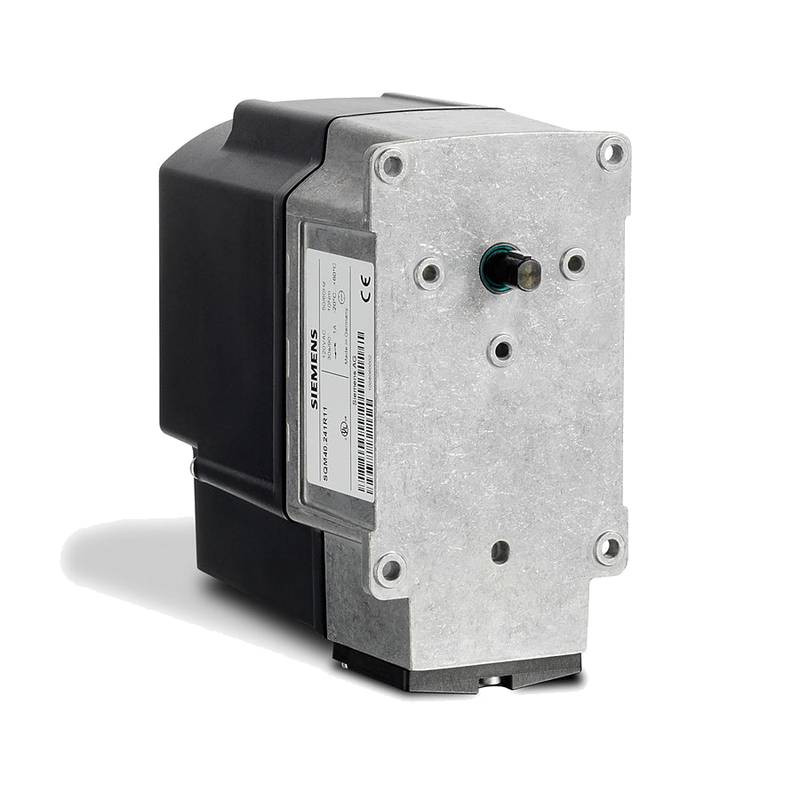
Siemens SQM40.145R11 Damper Actuator


The Siemens SQM40.145R11 damper actuator offers robust and reliable control for HVAC and industrial air handling systems, featuring a high torque output, precise positioning, and a compact design. This actuator is engineered for demanding applications, providing an essential component for maintaining optimal airflow and energy efficiency in commercial and industrial environments. Its advanced design ensures long-term operational stability and ease of integration into complex building management systems.
Product Specifications
| Feature | Specification |
| :---------------------- | :------------------------------------------- |
| Model | SQM40.145R11 |
| Torque | 150 Nm |
| Running Time | 150 s (90°) |
| Angle of Rotation | 90° or 140° (adjustable) |
| Power Supply | AC 230 V |
| Control Signal | 3-point |
| Protection Class | IP54 |
| Ambient Temperature | -20 to +50 °C |
| Mounting | Direct shaft mounting |
| Manual Override | Yes |
| Connection Type | Screw terminals |
| Cable Entry | PG 11 |
Core Features & Market Positioning
The Siemens SQM40.145R11 distinguishes itself with its substantial 150 Nm torque, making it exceptionally suitable for larger dampers where consistent and powerful actuation is critical. Its precise control, achieved through a 3-point signal, ensures that dampers are positioned accurately, leading to optimized airflow and reduced energy waste. Compared to other actuators in its class, the SQM40.145R11 benefits from Siemens' reputation for industrial-grade reliability and longevity, positioning it as a preferred choice for mission-critical HVAC and process control applications. The actuator's robust construction and IP54 protection class further enhance its market appeal for challenging operational environments.
Key Application Scenarios
This damper actuator finds extensive use in industrial ventilation systems, regulating airflow in air handling units (AHUs) and ductwork to maintain desired environmental conditions. It is crucial for controlling combustion air dampers in industrial furnaces and boilers, ensuring efficient fuel-air mixture. Building automation systems frequently deploy the SQM40.145R11 for zone control and VAV box applications, optimizing comfort and energy consumption in commercial buildings. Its versatility also extends to fire and smoke damper control, playing a vital role in building safety systems.
Practical System Integration Guidance
Integrating the Siemens SQM40.145R11 involves direct mounting onto the damper shaft, typically secured with a universal bracket. Wiring is accomplished via screw terminals, accommodating standard control and power supply connections. The actuator accepts a 3-point control signal (Open-Stop-Close), commonly sourced from a Building Management System (BMS) or a dedicated controller. For applications requiring specific positioning, the angle of rotation can be adjusted mechanically between 90° and 140°. Ensure the power supply is stable and within the AC 230 V range, and that the wiring adheres to local electrical codes and safety standards to prevent damage.
Operation and Risk Mitigation
The SQM40.145R11 operates by receiving a 3-point control signal, which translates to precise angular movements of the connected damper. Manual override is available, allowing for direct mechanical adjustment of the damper position during maintenance or emergencies, a critical feature for operational flexibility. While robust, potential risks include over-torqueing if the damper is obstructed, or incorrect wiring leading to malfunction. Always ensure the damper moves freely before initial power-up and verify that the control signals are correctly implemented to prevent actuator overload or unintended damper positions. Regular inspection of the power supply and mechanical linkage is recommended to mitigate operational risks.
Scalability & Long-Term Value
The Siemens SQM40.145R11 integrates seamlessly with a wide array of Siemens' HVAC controls and broader building automation platforms, offering excellent scalability for future system expansions or upgrades. Its compatibility with standard control protocols ensures it can be incorporated into both new installations and retrofits of existing systems, preserving investment in control infrastructure. The robust design and high-quality components inherent in Siemens industrial products contribute to a long operational lifespan, minimizing the total cost of ownership through reduced maintenance and replacement cycles. For facilities looking to embrace digital transformation, the SQM40.145R11 can be part of a connected system that facilitates data acquisition for performance monitoring and optimization within IIoT frameworks.
Frequently Asked Questions
What is the torque rating of the Siemens SQM40.145R11?
The Siemens SQM40.145R11 damper actuator is rated with a significant torque of 150 Nm. This high torque output ensures it can reliably operate larger dampers or those with higher resistance, such as in industrial air handling units. It provides the necessary force to overcome friction and maintain precise positioning even under challenging operational loads.
This robust torque capability makes the actuator suitable for demanding applications where other actuators might falter. It's a key specification for engineers selecting actuators for systems requiring substantial force for damper control. The 150 Nm rating guarantees dependable performance in continuous duty cycles.
The substantial torque is critical for applications requiring accurate and responsive control of airflow. It allows for efficient management of air volume and pressure in complex ventilation systems. This ensures optimal performance and energy efficiency of the overall HVAC or industrial process.
How is the Siemens SQM40.145R11 powered?
The Siemens SQM40.145R11 damper actuator operates on a standard AC 230 V power supply. This common voltage requirement simplifies integration into most industrial and commercial electrical infrastructure. It ensures broad compatibility with existing power systems without the need for specialized transformers.
Ensuring a stable and appropriate AC 230 V power source is crucial for the actuator's reliable operation and longevity. Incorrect voltage can lead to malfunction, reduced performance, or premature failure of the unit. Always verify the power source before connecting the actuator.
The AC 230 V power input is managed internally by the actuator to drive its motor and control its positioning mechanism. This direct connection to mains voltage makes installation straightforward, provided safety precautions are followed. It is a fundamental parameter for system design and installation.
What type of control signal does the Siemens SQM40.145R11 use?
The Siemens SQM40.145R11 damper actuator utilizes a 3-point control signal for its operation. This means it receives three distinct signals: one to open the damper, one to close it, and a signal to maintain its current position (stop). This type of control is common in many automated systems.
This 3-point configuration allows for precise incremental adjustments of the damper's position. It is a widely accepted standard for controlling motorized devices in building automation and industrial control. The signals are typically pulsed, indicating direction and duration of movement.
The 3-point control system ensures that the actuator receives clear commands for each specific action required, facilitating accurate airflow regulation. It's a reliable method for dictating the exact degree to which a damper should be opened or closed, essential for performance optimization.