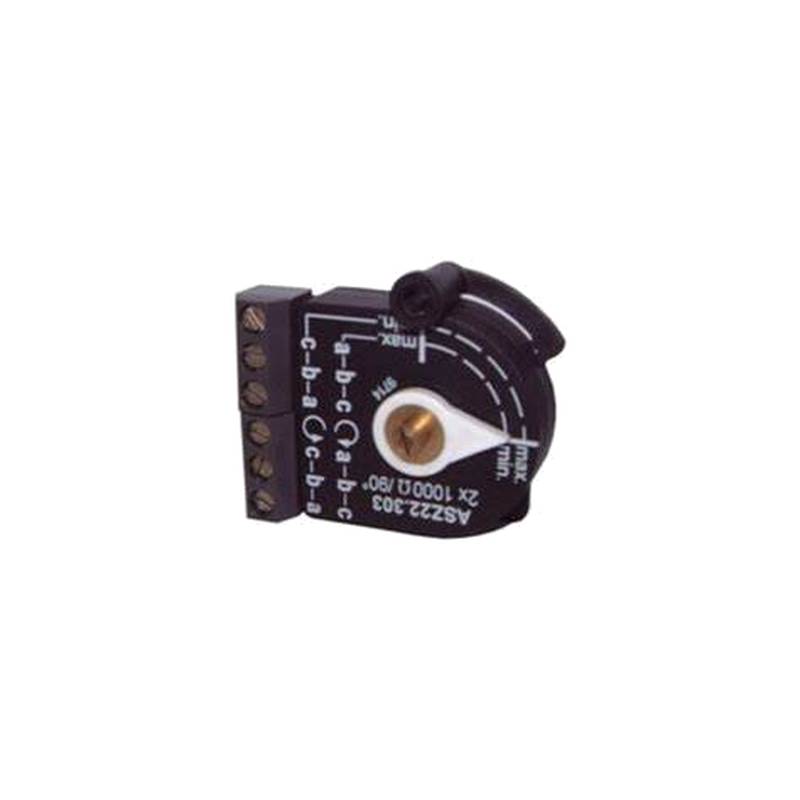
SIEMENS ASZ12.30 Auxiliary Potentiometer for Valve Actuators


The SIEMENS ASZ12.30 Auxiliary Potentiometer for Valve Actuators is a critical component designed to provide precise feedback on valve position to control systems. This device offers significant advantages in terms of accuracy, reliability, and seamless integration within industrial automation architectures. Its core features include robust construction, high electrical and mechanical endurance, and a design optimized for demanding operational environments. Key technical parameters such as its operating temperature range, protection rating, and output signal characteristics are meticulously engineered for superior performance.
Product Specifications
| Parameter | Specification |
| :------------------------ | :------------------------- |
| Product Type | Auxiliary Potentiometer |
| Compatible Actuator Series| Typically GBB, GLB, GWD |
| Output Signal Type | Potentiometric |
| Resistance | Typically 1 kΩ ± 10% |
| Tolerance | ± 10% |
| Operating Temperature | -25°C to +70°C |
| Protection Rating | IP65 |
| Mechanical Life | ≥ 1,000,000 cycles |
| Electrical Life | ≥ 500,000 cycles |
Core Features & Market Positioning
The SIEMENS ASZ12.30 distinguishes itself through its exceptional reliability and precise analog feedback, making it a preferred choice for applications demanding accurate valve position monitoring. Unlike digital encoders, its potentiometric output provides a continuous, stepless signal proportional to the actuator's stroke, which is invaluable for PID control loops and detailed process analysis. Its robust IP65 rating ensures dependable operation even in dusty or wash-down environments, a key differentiator in harsh industrial settings. This component is positioned as a high-quality, dependable solution for users seeking established and proven technology for critical valve control feedback.
Key Application Scenarios
Industrial facilities extensively utilize the SIEMENS ASZ12.30 auxiliary potentiometer in a wide array of applications. It is frequently deployed in process control systems within the chemical and petrochemical industries to ensure precise flow regulation of hazardous or sensitive materials. In the power generation sector, it plays a vital role in controlling steam and water valves, contributing to stable and efficient plant operation. Furthermore, its application extends to building automation for HVAC systems, managing airflow and water circulation with optimal energy efficiency. The ASZ12.30 is also integral to water treatment facilities for precise control of chemical dosing and distribution.
Practical System Integration Guidance
Integrating the SIEMENS ASZ12.30 into an existing control system is straightforward, typically involving direct wiring to the actuator's terminal block and then to the analog input module of a PLC or DCS. The potentiometer's three terminals allow for a simple two-wire connection to provide a variable resistance signal. For optimal performance, it is crucial to ensure proper mechanical linkage between the potentiometer's shaft and the valve stem to accurately reflect the valve's position. Calibration is generally performed within the control system's software, mapping the full resistance range of the potentiometer to the valve's fully closed to fully open positions. Compatibility with SIEMENS actuator series such as GBB, GLB, and GWD ensures seamless integration into their established product ecosystems.
Operation and Risk Mitigation
The ASZ12.30 operates by translating the mechanical movement of the valve actuator into a corresponding change in electrical resistance. This analog signal is then interpreted by the connected control system. To mitigate operational risks, regular inspection of the mechanical linkage for wear or damage is recommended. Ensure that the potentiometer is correctly wired according to the actuator and control system documentation to prevent signal errors. Over-travel or excessive mechanical force on the potentiometer shaft should be avoided, as this can lead to premature failure. While the device is designed for reliability, any indication of erratic or zero output signals should be investigated promptly, potentially requiring a diagnostic check or replacement.
Scalability & Long-Term Value
The long-term value of the SIEMENS ASZ12.30 lies in its robust design and compatibility with a wide range of SIEMENS valve actuators and control platforms. This ensures that systems built around this component can be easily maintained and expanded. Its analog output makes it highly compatible with both legacy and modern control systems, offering flexibility for future upgrades without necessitating a complete overhaul of the feedback mechanism. For facilities moving towards digitalization and the Industrial Internet of Things (IIoT), the consistent and reliable analog data provided by the ASZ12.30 can serve as a foundational input for higher-level data analytics and predictive maintenance strategies, contributing to overall operational intelligence.
Frequently Asked Questions
What is the primary function of the SIEMENS ASZ12.30?
The SIEMENS ASZ12.30 functions as an auxiliary potentiometer that provides continuous analog feedback on the position of a valve actuator. This accurate positional data is crucial for precise process control and monitoring. It translates the mechanical movement of the actuator into a variable electrical resistance signal.
How does the ASZ12.30 contribute to accurate valve positioning?
It directly links to the valve stem or actuator mechanism, ensuring its output resistance precisely mirrors the valve's degree of opening or closing. This real-time, proportional feedback allows control systems to make highly accurate adjustments. Users can reliably interpret the valve's exact state at any given moment.
What technical specifications are important for its application?
Key specifications include its resistance value (typically 1 kΩ), tolerance, operating temperature range (-25°C to +70°C), and protection rating (IP65). Its mechanical and electrical lifespan (e.g., ≥ 1,000,000 cycles) are also vital for assessing its durability in industrial environments.
Can the SIEMENS ASZ12.30 be used with non-SIEMENS actuators?
While primarily designed for SIEMENS actuators, its universal potentiometric output could potentially be adapted for use with other actuator brands. This would require careful consideration of mechanical linkage and electrical compatibility. Compatibility with the specific actuator's stroke and mounting is essential.
What are the typical wiring requirements for the ASZ12.30?
The ASZ12.30 typically uses a three-terminal configuration, with two terminals used to provide the variable resistance output. These are wired to an analog input channel on a PLC or DCS. The third terminal often serves as a common or wiper connection. Always consult the specific wiring diagrams.
What maintenance is recommended for the ASZ12.30?
Regular visual inspection of the mechanical linkage for wear or damage is recommended. Ensure the potentiometer is clean and free from excessive dust or moisture ingress. Periodic checks of the output signal for consistency can also help identify potential issues early.
How is the ASZ12.30 calibrated within a control system?
Calibration involves mapping the potentiometer's full resistance range to the actuator's fully closed and fully open positions within the PLC or DCS software. This ensures that the control system accurately interprets the analog feedback signal. The process typically involves actuating the valve through its full stroke while programming the input signal range.
What are the advantages of potentiometric feedback over other methods?
Potentiometric feedback offers a simple, continuous, and cost-effective analog signal that is directly proportional to the valve position. It provides high resolution and is less susceptible to electromagnetic interference than some other analog sensors. It is a mature and well-understood technology.
What are common issues encountered with potentiometers in valve actuators?
Common issues include mechanical wear leading to intermittent signals or increased resistance, and electrical contact problems within the potentiometer. Environmental factors like dust or moisture can also degrade performance over time. Signal drift can occur with significant aging.
How does the IP65 rating benefit the ASZ12.30 in industrial settings?
The IP65 rating signifies that the device is protected against dust ingress and is resistant to low-pressure water jets. This makes it suitable for installation in demanding industrial environments where cleaning with water is common or where significant dust accumulation is present. It ensures operational reliability in harsh conditions.