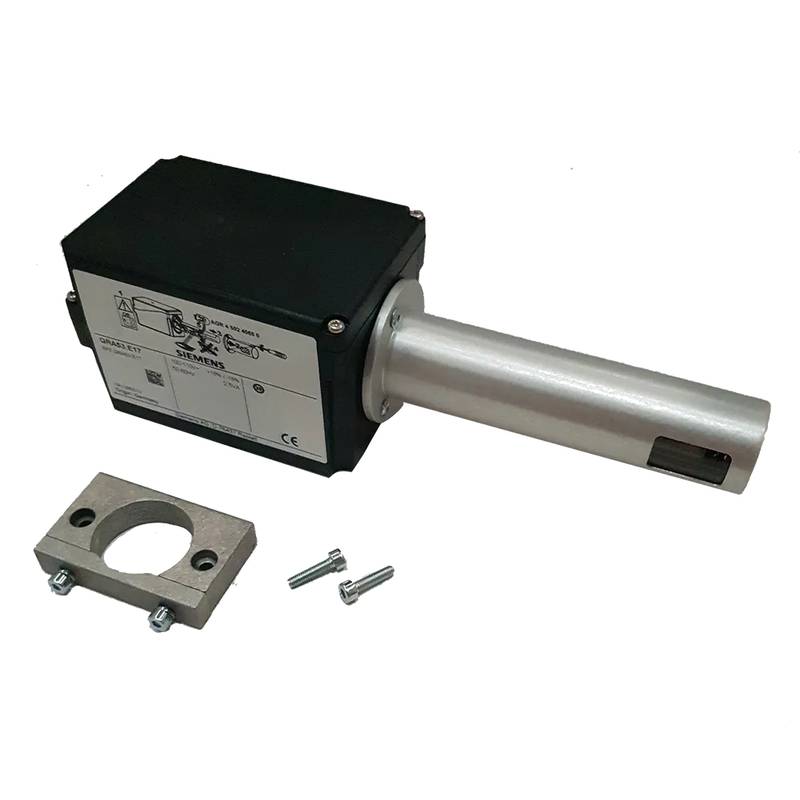
SIEMENS QRA53.G27 Ultraviolet Flame Sensor QRA53


The SIEMENS QRA53.G27 Ultraviolet Flame Sensor is a critical component for ensuring safe and reliable combustion in industrial burners, offering advanced detection capabilities and robust performance. Its core advantages lie in its rapid response time, high sensitivity to UV radiation emitted by flames, and durable construction designed for demanding industrial environments. Key technical parameters include a detection range of 0 to 100% flame signal, an operating temperature range of -40 to +60 °C, and an IP65 degree of protection, ensuring reliable operation even in dusty or humid conditions. The QRA53.G27 is specifically engineered to detect the ultraviolet radiation produced by gas and oil flames, making it indispensable for flame monitoring in power plants, industrial furnaces, and boiler systems.
Product Specifications
| Specification | Value |
| :--------------------------- | :------------------------------------ |
| Detection Principle | Ultraviolet (UV) Radiation |
| Flame Signal Range | 0 to 100% |
| Operating Temperature | -40 to +60 °C (-40 to +140 °F) |
| Degree of Protection | IP65 |
| Connection Type | Screw terminals |
| Housing Material | Die-cast aluminum |
| Mounting Type | Flange |
| Dimensions (H x W x D) | 90 x 78 x 67 mm |
| Weight | Approx. 0.5 kg |
| Power Supply Voltage | 24 V AC/DC |
| Power Consumption | Max. 5 VA |
| Response Time | < 1 second |
| Sensitivity Adjustment | Potentiometer |
| Relay Output | Yes, for burner control |
| Pre-failure Signal | Yes |
| Interference Suppression | Yes |
| Application Area | Gas and oil burners |
| Certification | CE, UL, CSA |
Core Features & Market Positioning
The SIEMENS QRA53.G27 ultraviolet flame sensor distinguishes itself through its sophisticated UV detection technology, which provides a highly reliable means of confirming the presence of a flame. Unlike flame scanners that rely on visible light or infrared, the QRA53.G27's focus on ultraviolet radiation offers superior immunity to nuisance tripping caused by incandescent surfaces or stray light sources. This advanced detection capability positions it as a premium choice for applications where flame failure poses significant safety risks. Its robust die-cast aluminum housing and IP65 rating underscore its suitability for harsh industrial settings, a key differentiator in a competitive market. The integrated relay output for burner control further simplifies system design and installation, adding to its market appeal as a comprehensive flame monitoring solution.
Key Application Scenarios
The SIEMENS QRA53.G27 ultraviolet flame sensor is primarily deployed in industrial combustion systems requiring dependable flame monitoring. Its suitability for both gas and oil flames makes it a versatile component for a wide array of applications. Common scenarios include its use in industrial boilers and furnaces, where continuous flame detection is crucial for maintaining efficient operation and preventing hazardous conditions. Power generation facilities extensively utilize the QRA53.G27 in their combustion processes to ensure the integrity of burner operation and safety protocols. Furthermore, it finds application in the petrochemical industry, incineration plants, and any industrial process involving controlled combustion where a reliable flame signal is paramount for operational safety and process continuity.
Practical System Integration Guidance
Integrating the SIEMENS QRA53.G27 ultraviolet flame sensor into an existing combustion control system involves careful consideration of wiring and physical mounting. The sensor connects via screw terminals, typically to a burner control unit or a dedicated flame amplifier. It requires a 24 V AC/DC power supply. Proper grounding is essential to prevent electrical interference. The sensor should be mounted in a location that provides a clear line of sight to the flame, often via a sight glass or a specially designed flame detector housing. Alignment is critical; the sensor's viewing angle must be directed precisely at the flame zone.
When wiring, ensure that the sensor's output relay contacts are correctly integrated into the burner's safety interlock circuit. This typically involves connecting the relay to the control system's safety input, allowing it to signal the presence or absence of a flame. Consult the specific burner management system's documentation for the correct terminal assignments and safety logic. The QRA53.G27 also provides a pre-failure signal, which can be wired to a diagnostic input on the control system to alert operators to potential issues before a complete failure occurs, enhancing predictive maintenance capabilities.
Commissioning the SIEMENS QRA53.G27 involves adjusting its sensitivity using the onboard potentiometer to optimize flame detection while minimizing susceptibility to background radiation. This adjustment should be performed during actual burner operation. The response time is typically less than one second, ensuring rapid detection of flame loss. Interference suppression features help mitigate false signals, but initial setup should verify optimal performance in the specific operational environment. Regular inspection and cleaning of the sensor's lens are recommended to maintain its effectiveness.
Operation and Risk Mitigation
The SIEMENS QRA53.G27 operates by continuously monitoring the ultraviolet radiation emitted by a flame. When a flame is present, it generates UV radiation within a specific spectrum that the sensor detects. This detection triggers an internal relay, signaling the presence of the flame to the burner control system. If the flame is extinguished, the UV radiation ceases, the relay de-energizes, and the control system initiates a safety shutdown sequence to prevent the accumulation of unburned fuel. The sensor's rapid response time ensures that flame loss is detected almost instantaneously, minimizing safety risks.
Risk mitigation with the SIEMENS QRA53.G27 is multi-faceted. Its robust design and IP65 rating reduce the likelihood of failure due to environmental factors. The pre-failure signal provides an early warning of potential sensor degradation, allowing for proactive maintenance and preventing unexpected shutdowns. Furthermore, the sensor's inherent immunity to nuisance tripping from incandescent surfaces or electrical noise, due to its UV-specific detection, significantly enhances operational reliability and safety. Regular maintenance, including visual inspection and cleaning of the sensor lens, is crucial for sustained performance.
While the QRA53.G27 is designed for reliability, potential issues can arise. Common troubleshooting steps include verifying power supply, checking wiring connections, and ensuring the sensor's lens is clean and unobstructed. If the sensor fails to detect a flame, investigate if the flame is producing sufficient UV radiation or if the sensor's sensitivity needs adjustment. Conversely, if it signals a flame when none is present, interference might be an issue, requiring sensitivity recalibration or checking for external UV sources. Always refer to the manufacturer's detailed troubleshooting guide for specific error codes or fault indications.
Scalability & Long-Term Value
The SIEMENS QRA53.G27 is designed for integration into broader industrial automation platforms, offering significant long-term value. Its compatibility with Siemens' extensive range of burner management systems and PLCs ensures seamless integration into new or existing installations. This interoperability allows for easy expansion of combustion control capabilities as operational needs evolve. The sensor's robust construction and the availability of spare parts contribute to its longevity, reducing the total cost of ownership over its operational life.
As industries increasingly adopt digital transformation and the Industrial Internet of Things (IIoT), the QRA53.G27 provides a foundation for enhanced monitoring and diagnostics. While not inherently an IIoT device, its output signals can be readily fed into SCADA systems or IIoT platforms via appropriate gateways and controllers. This enables remote monitoring of flame status, historical data logging, and advanced predictive maintenance strategies, aligning with modern smart factory initiatives and ensuring the continued relevance of the installed base.
Investing in the SIEMENS QRA53.G27 offers a scalable solution for flame detection. Its modular design and compatibility with various control architectures mean that systems can grow without requiring complete replacement of flame detection hardware. Furthermore, Siemens' commitment to product development and support ensures that users benefit from ongoing advancements in combustion control technology, safeguarding their investment and maintaining compliance with evolving safety and environmental standards.
Frequently Asked Questions
What is the primary function of the SIEMENS QRA53.G27?
The SIEMENS QRA53.G27 is an ultraviolet flame sensor designed for reliable detection of flames in industrial burners. It continuously monitors ultraviolet radiation emitted by gas and oil flames to ensure safe combustion.
It plays a critical role in burner management systems by providing a signal to the control unit confirming the presence or absence of a flame. This immediate feedback is vital for preventing fuel accumulation and potential explosions.
Its primary function is to safeguard industrial combustion processes by providing an accurate and rapid flame signal, thereby enhancing operational safety and preventing hazardous situations.
How does the QRA53.G27 detect flames?
The sensor detects flames by sensing the ultraviolet (UV) radiation they emit. Most combustion processes produce UV light that is distinct from other radiation sources.
It utilizes a UV-sensitive photocell that generates an electrical signal when exposed to specific wavelengths of UV light characteristic of flames. This signal is then processed to confirm a valid flame presence.
This focused UV detection capability helps to prevent nuisance tripping caused by incandescent surfaces or other non-flame-related light sources, ensuring higher operational reliability.
What are the key technical specifications of the QRA53.G27?
Key specifications include an operating temperature range of -40 to +60 °C and an IP65 protection rating, making it suitable for harsh industrial environments. It operates on 24 V AC/DC and has a fast response time of less than 1 second.
The sensor offers a flame signal range of 0 to 100% and is housed in a robust die-cast aluminum casing. Its connection is via screw terminals, and it features an integrated relay output for burner control.
It is designed for gas and oil burners and carries certifications like CE, UL, and CSA, underscoring its adherence to international safety and performance standards.
What types of burners is the QRA53.G27 suitable for?
The SIEMENS QRA53.G27 is suitable for a wide range of industrial gas and oil burners. Its versatility allows for application in various combustion settings.
It is commonly used in industrial boilers, furnaces, and process heaters where consistent and safe flame monitoring is essential for operation.
Its robust design and UV detection principle make it an excellent choice for demanding applications in sectors like power generation, petrochemical, and waste incineration.
What is the typical operating temperature range for this flame sensor?
The QRA53.G27 operates reliably within a wide temperature range from -40 to +60 °C (-40 to +140 °F). This broad range ensures consistent performance in diverse climatic and industrial conditions.
This extended operating temperature capability makes it suitable for installation in environments that experience extreme heat or cold, such as outdoor installations or near high-temperature process equipment.
Ensuring the sensor operates within its specified temperature limits is crucial for its longevity and accurate flame detection performance.
What does the IP65 rating signify for the QRA53.G27?
An IP65 rating means the sensor is dust-tight and protected against water jets. This indicates a high level of protection against environmental ingress.
The "6" in IP65 signifies complete protection against dust, making it ideal for environments with significant particulate matter. The "5" indicates protection against low-pressure water jets from any direction.
This robust protection ensures the QRA53.G27 can be reliably installed in demanding industrial settings where exposure to dust, moisture, or washdowns is common, without compromising its functionality.
How is the SIEMENS QRA53.G27 installed in a system?
Installation involves physically mounting the sensor, typically via a flange, to provide a clear view of the flame, often through a sight glass or adapter. Electrical connections are made via screw terminals to the burner control unit.
Proper alignment is critical; the sensor must be directed precisely at the flame zone to ensure optimal detection. Ensure the power supply of 24 V AC/DC is correctly connected and the sensor is properly grounded.
After physical installation and wiring, the sensor requires commissioning, including sensitivity adjustment, to ensure accurate flame detection and minimize false alarms in its specific operational environment.
Can the sensitivity of the QRA53.G27 be adjusted?
Yes, the sensitivity of the SIEMENS QRA53.G27 can be adjusted using an onboard potentiometer. This adjustment allows for fine-tuning the detection threshold.
Sensitivity adjustment is crucial for optimizing the sensor's performance in different burner types and operating conditions, ensuring it detects the target flame reliably while ignoring potential interference.
This feature is typically performed during system commissioning by qualified personnel to achieve the best balance between responsiveness and immunity to nuisance trips.
What is the response time of the SIEMENS QRA53.G27?
The SIEMENS QRA53.G27 features a rapid response time of less than 1 second. This ensures that flame status changes are detected almost instantaneously.
A quick response time is critical for safety, as it allows the burner control system to react immediately to flame failure, preventing unsafe conditions like unburned fuel buildup.
This fast detection capability is a key feature for ensuring the integrity and safety of continuous industrial combustion processes.
Does the QRA53.G27 offer any diagnostic or pre-failure capabilities?
Yes, the QRA53.G27 is equipped with a pre-failure signal. This signal provides an early warning of potential sensor degradation or impending failure.
This diagnostic feature allows operators to identify issues before they lead to a complete system shutdown, enabling proactive maintenance and minimizing unexpected downtime.
The pre-failure signal can be integrated into the plant's monitoring system, contributing to improved predictive maintenance strategies and overall operational reliability.