











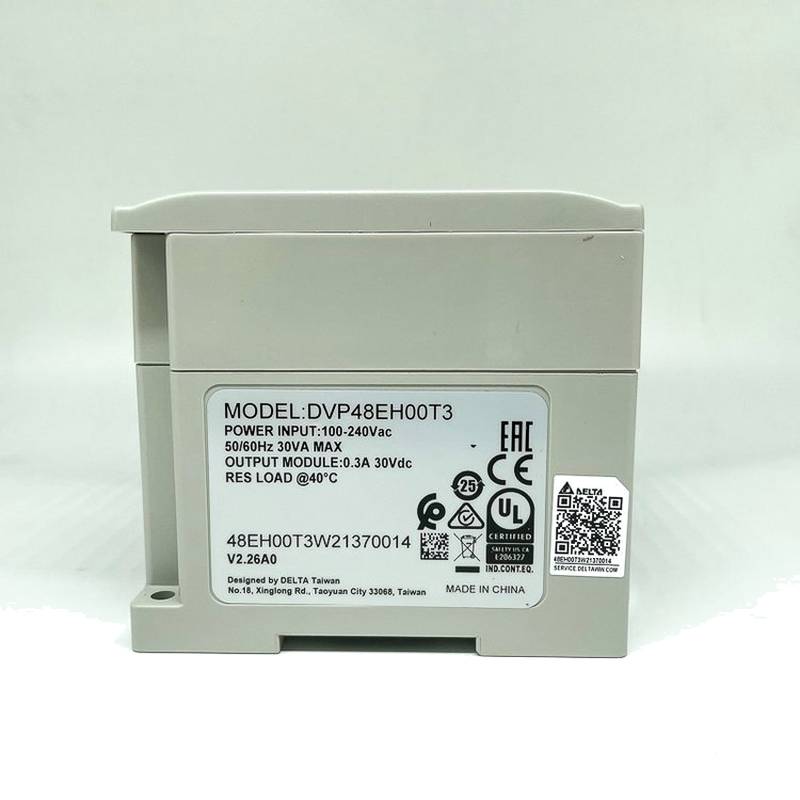
Delta DVP48EH00R3 Large Capacity 48-point Relay Output Control System


The Delta DVP48EH00R3 stands as a robust and highly capable 48-point relay output control system, engineered for demanding industrial automation tasks. Its large capacity and versatile functionality make it an exceptional choice for complex machine control, process automation, and integrated system management. Key advantages include its extensive I/O count, ensuring comprehensive system monitoring and control, and its reliable relay outputs, suitable for switching a wide range of loads. Technical specifications highlight a powerful processor for efficient program execution and a durable design built for harsh industrial environments, making the DVP48EH00R3 a cornerstone for sophisticated automation projects.
Product Specifications
| Feature | Specification |
| :------------------- | :------------------------------------------ |
| Model | DVP48EH00R3 |
| Digital Input Points | 24 |
| Digital Output Points| 24 (Relay Output) |
| Max. I/O Points | 48 |
| Power Supply | 100-240VAC |
| Program Capacity | 16k steps |
| Data Registers | 10k words |
| High-Speed Counters | 6-axis (up to 200kHz) |
| Communication Ports | RS-232, RS-485 (built-in) |
| Expansion Capability | Yes |
| Operating Temperature| 0°C to 50°C |
Core Features & Market Positioning
The Delta DVP48EH00R3 distinguishes itself through its high-density relay output configuration, providing a significant number of switching points within a single, compact unit. This is a critical differentiator for applications requiring control over numerous actuators, motors, or solenoids simultaneously. Its architecture is designed for robust performance, offering enhanced resistance to electrical noise and environmental fluctuations, which are common challenges in industrial settings. Positioned as a premium solution in the Programmable Logic Controller (PLC) market, the DVP48EH00R3 appeals to engineers seeking reliability, extensive I/O, and the flexibility to manage intricate control logic without compromising on processing speed or stability.
Key Application Scenarios
The substantial 48-point relay output capacity of the Delta DVP48EH00R3 makes it ideally suited for complex machine automation, such as packaging machinery, printing presses, and automated assembly lines where multiple distinct operations need precise, independent control. It excels in process automation for industries like water treatment, food and beverage processing, and chemical manufacturing, managing a wide array of pumps, valves, and heating elements. Furthermore, its extensive I/O is beneficial for building management systems, controlling lighting, HVAC, and security features across large facilities.
Practical System Integration Guidance
Integrating the Delta DVP48EH00R3 involves careful wiring of its 24 relay output terminals to the respective loads, ensuring correct voltage and current ratings are observed to prevent damage. For programming, Delta's ISPSoft software provides a comprehensive environment for developing ladder logic, function block diagrams, and structured text programs. Connecting to HMIs or SCADA systems is typically achieved via the built-in RS-485 port using Modbus RTU protocol, enabling seamless data exchange and operator oversight. Careful consideration of power distribution and grounding is essential for reliable operation and signal integrity.
Operation and Risk Mitigation
Safe operation of the DVP48EH00R3 mandates adherence to electrical safety standards, including proper enclosure, lockout/tagout procedures during maintenance, and ensuring that the relay outputs are not overloaded. Users should be aware of potential fault conditions, such as output short circuits or over-temperature situations, which the PLC is designed to detect and report. Regular firmware updates and consistent system diagnostics, accessible through the programming software, can help mitigate risks and ensure continuous, reliable performance in demanding industrial environments.
Scalability & Long-Term Value
The Delta DVP48EH00R3 offers significant long-term value through its inherent scalability. It supports expansion modules, allowing for additional digital or analog I/O to be added as system requirements evolve, thereby protecting the initial investment. Compatibility with other Delta automation products and standard industrial communication protocols ensures seamless integration into existing or future automation architectures, including Industry 4.0 initiatives. This forward-thinking design facilitates the adoption of IIoT capabilities, enabling enhanced data analytics, remote monitoring, and predictive maintenance strategies.
Frequently Asked Questions
What are the main benefits of using the Delta DVP48EH00R3?
This PLC offers a high density of 48 I/O points, ideal for complex control needs. Its robust relay outputs can handle a wide range of industrial loads effectively. The system is designed for reliability in harsh environments.
The DVP48EH00R3 boasts excellent processing power for swift execution of automation logic. It provides ample program memory and data registers for sophisticated applications. Built-in communication ports enhance connectivity options.
Its advanced features and durable construction position it as a cost-effective, long-term solution for various industrial automation challenges. The system supports expansion for future growth.
How do I connect the relay outputs of the Delta DVP48EH00R3?
Wire each relay output terminal to your connected device, such as a motor starter or solenoid valve. Ensure the voltage and current ratings of the connected device do not exceed the relay's capacity. Always follow proper electrical safety guidelines during installation.
Double-check all wiring connections to prevent short circuits or incorrect signaling. Use appropriate gauge wiring for the expected current load. A common wiring scheme involves a shared neutral for all outputs.
Consider using terminal blocks for organized and secure connections. Verify the C (Common) terminal wiring for each group of outputs. This ensures proper switching functionality.
What programming software is used for the Delta DVP48EH00R3?
The DVP48EH00R3 is programmed using Delta's ISPSoft software. This suite supports ladder logic, function block diagrams, and structured text programming languages. It provides tools for simulation, debugging, and online monitoring.
ISPSoft allows engineers to efficiently develop, test, and deploy control programs for the PLC. It facilitates easy configuration of I/O, communication settings, and special function modules. Learning resources are available for users.
Download the latest version of ISPSoft from the official Delta Electronics website. Ensure your PC meets the software's system requirements for optimal performance. Familiarize yourself with the software's interface.
Can the Delta DVP48EH00R3 be expanded with more I/O modules?
Yes, the DVP48EH00R3 is designed for scalability and supports various expansion modules. These modules can add more digital inputs, outputs, or analog I/O capabilities. This allows the system to grow with your application needs.
The expansion mechanism is straightforward, typically involving a bus connection to the main PLC unit. Refer to the product manual for compatible expansion modules and connection procedures. Proper addressing of expansion modules is crucial.
This expansion capability ensures a longer lifespan for your automation investment. It avoids the need to replace the entire PLC when more I/O is required. It offers flexibility for future upgrades.
What communication protocols does the DVP48EH00R3 support?
The DVP48EH00R3 features built-in RS-232 and RS-485 communication ports. These ports commonly support protocols like Modbus RTU, enabling easy integration with HMIs, SCADA systems, and other devices. It facilitates data exchange.
The RS-485 port is particularly useful for multi-drop communication networks, allowing multiple devices to share a single communication bus. This is cost-effective for larger systems. Configuration is done via software.
Ensure correct termination resistors are used on the RS-485 bus to maintain signal integrity. Verify baud rates and communication parameters match between the PLC and connected devices. This is essential for reliable data transfer.
How does the DVP48EH00R3 handle high-speed counting applications?
The DVP48EH00R3 is equipped with high-speed counter inputs, capable of handling up to 6 axes at frequencies up to 200kHz. This makes it suitable for applications requiring precise measurement and tracking of fast-moving objects or events. It enables high-performance motion control.
Specialized instructions within the PLC's programming environment are used to configure and manage these high-speed counters. These functions allow for tasks such as pulse counting, frequency measurement, and position tracking. Software configuration is key.
Proper signal conditioning and wiring for the high-speed inputs are critical to avoid signal degradation or noise interference. Use shielded cables and ensure proper grounding for optimal performance. This ensures accurate data acquisition.
What are common troubleshooting steps for Delta DVP48EH00R3 issues?
Begin by checking power supply stability and wiring integrity, as power fluctuations are a common cause of PLC issues. Review error logs within the ISPSoft software for diagnostic codes or messages that indicate the problem's root. Verify the status of input and output modules.
Inspect the physical wiring for any loose connections, damaged cables, or short circuits. Ensure that the load connected to each relay output is functioning correctly and within specifications. Test individual outputs if possible.
If the issue persists, consider performing a PLC reset or, as a last resort, reloading the program. Consult the product manual for specific troubleshooting guides and fault code explanations. Contacting Delta technical support can provide further assistance.
Is the Delta DVP48EH00R3 suitable for hazardous environments?
While the DVP48EH00R3 is built for industrial durability, it is not inherently an intrinsically safe or explosion-proof device. For hazardous environments, it must be installed within an appropriately rated enclosure that provides the necessary protection against environmental factors and potential ignition sources. Always adhere to local safety regulations and standards.
The standard operating temperature range is 0°C to 50°C. If the ambient temperature exceeds this range, active cooling or a specialized enclosure may be required. Ensure proper ventilation and heat dissipation for reliable operation.
Risk mitigation in hazardous areas involves a comprehensive safety assessment of the entire system, not just the PLC. This includes considering the installation environment, potential for flammable gases or dust, and the requirements of safety certifications.
How can the DVP48EH00R3 integrate with Industry 4.0 solutions?
The DVP48EH00R3 can integrate with Industry 4.0 platforms by leveraging its communication capabilities, such as Modbus RTU over RS-485. Data from the PLC can be collected by an IIoT gateway and then transmitted to cloud-based analytics platforms for monitoring, optimization, and predictive maintenance. The system supports data acquisition.
Utilizing MQTT or OPC UA protocols via an industrial gateway allows for seamless data flow to digital systems. This enables real-time dashboards, remote diagnostics, and integration with enterprise resource planning (ERP) or manufacturing execution systems (MES). Data connectivity is key.
This integration transforms the PLC from a standalone controller into a node within a smart manufacturing ecosystem. It enhances operational visibility, facilitates data-driven decision-making, and unlocks the potential for automation optimization and efficiency gains. Real-time insights are enabled.
What are the key technical specifications to consider before purchasing?
Key specifications include the total number of digital inputs and outputs (24 DI, 24 DO Relay), power supply voltage (100-240VAC), and program capacity (16k steps). Also consider data registers (10k words) and high-speed counter capabilities (6-axis, 200kHz). Compatibility with expansion modules is important.
Ensure the relay output specifications meet your load requirements regarding voltage and current handling. Check the environmental operating conditions (0°C to 50°C) against your installation site's ambient temperature. Communication interfaces (RS-232, RS-485) are vital for integration.
The processor speed and memory size influence the complexity of the programs it can handle efficiently. Evaluate these parameters against the demands of your specific automation task to ensure optimal performance and future scalability. This ensures sufficient processing power.