











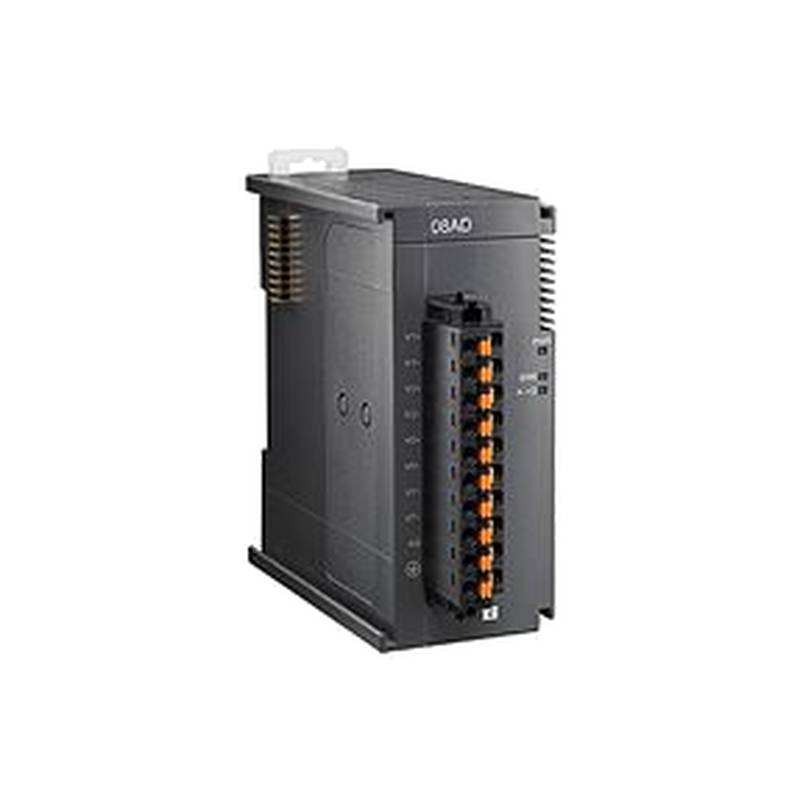
Delta AS06RTD-A 6-channel RTD Temperature Input Module


The Delta AS06RTD-A is a robust 6-channel RTD temperature input module designed for demanding industrial automation applications. Its key advantages include high accuracy, fast response times, and flexible sensor compatibility, making it an ideal solution for precise temperature monitoring and control. Core features include six independent RTD input channels, supporting various RTD types (Pt100, Pt1000, etc.), a wide operating temperature range, and robust industrial communication protocols. Technical parameters such as input resolution, isolation voltage, and power consumption are critical for system designers.
Product Specifications
| Feature | Specification |
| :---------------------- | :------------------------------------------ |
| Module Type | 6-Channel RTD Temperature Input Module |
| Input Channels | 6 (Individually configurable) |
| Supported RTD Types | Pt100, Pt1000 (2-wire, 3-wire, 4-wire) |
| Measurement Range | Varies by RTD type (e.g., -200 to 850°C for Pt100) |
| Accuracy | High precision (e.g., ±0.1°C at 0°C) |
| Resolution | High (e.g., 16-bit or higher) |
| Isolation Voltage | Typically 1500VDC between channels/power |
| Communication Interface | Modbus RTU (RS485) |
| Power Supply | 24VDC |
| Operating Temperature | -20°C to +70°C (typical) |
| Dimensions | Compact industrial form factor |
Core Features & Market Positioning
The Delta AS06RTD-A distinguishes itself through its exceptional accuracy and flexibility in handling multiple RTD types and wiring configurations. This allows for precise temperature measurements across a wide spectrum of industrial processes, from chemical manufacturing to food and beverage production. Its inherent noise immunity and robust construction position it as a reliable component in harsh environments where consistent performance is paramount. The module's integration capabilities, particularly its Modbus RTU support, simplify its adoption into existing SCADA and DCS systems, offering a cost-effective upgrade path for monitoring infrastructure.
Key Application Scenarios
Industries requiring precise temperature control and monitoring widely benefit from the Delta AS06RTD-A. It is frequently employed in process control systems for chemical reactors, ovens, and furnaces where tight temperature tolerances are critical for product quality and safety. In the food and beverage sector, it ensures consistent temperature profiles during pasteurization, sterilization, and storage, maintaining product integrity and shelf life. The module also finds application in HVAC systems for large commercial buildings, enabling efficient energy management and occupant comfort through accurate environmental monitoring. Furthermore, its suitability for power generation facilities, monitoring critical equipment temperatures, underscores its reliability.
Practical System Integration Guidance
Integrating the Delta AS06RTD-A into an industrial control system is streamlined due to its common communication protocols and straightforward wiring. The module typically connects to a master controller (like a PLC or industrial PC) via an RS485 serial interface using the Modbus RTU protocol. For wiring, it's crucial to use appropriate shielded twisted-pair cables for the RS485 communication to minimize electromagnetic interference. RTD sensor connections should be made with care, ensuring correct polarity and a solid connection for 3-wire or 4-wire configurations to maintain measurement accuracy. Configuration usually involves setting the module's Modbus address and baud rate, and then defining the RTD type and measurement units for each channel via the master controller's programming software.
Operation and Risk Mitigation
Safe and effective operation of the Delta AS06RTD-A hinges on adhering to proper installation and configuration procedures. Always ensure the power supply is within the specified voltage range (typically 24VDC) and that wiring polarity is correct to prevent module damage. During operation, monitor for common faults such as open circuits or short circuits in the RTD wiring, which can be indicated by specific error codes or status bits reported by the module. Regular inspection of sensor connections and wiring integrity is a proactive measure against potential downtime. In environments with high electrical noise, employing shielded cables and proper grounding techniques for both the communication lines and sensor inputs is essential for maintaining signal integrity and preventing erroneous readings.
Scalability & Long-Term Value
The Delta AS06RTD-A offers significant long-term value through its compatibility with a broad range of industrial automation platforms and its support for standard communication protocols. Its modular design allows for easy expansion; multiple AS06RTD-A modules can be networked together via the RS485 bus to increase the number of temperature input points as a facility's needs grow. This inherent scalability reduces the need for complete system overhauls when expanding monitoring capabilities. Furthermore, its adherence to Modbus RTU makes it readily integrable with modern Industrial Internet of Things (IIoT) solutions, enabling advanced data analytics, predictive maintenance, and remote diagnostics when paired with appropriate gateways and software platforms.
Frequently Asked Questions (FAQs)
1. What RTD types does the Delta AS06RTD-A support?
The Delta AS06RTD-A module supports common RTD sensor types, primarily Pt100 and Pt1000. This allows for a wide range of temperature sensing applications.
These sensors can be connected using 2-wire, 3-wire, or 4-wire configurations. The 4-wire configuration offers the highest accuracy by compensating for lead wire resistance.
Users can select the specific RTD type and wiring method through the configuration interface of their master control system, such as a PLC or SCADA.
2. How do I wire the Delta AS06RTD-A module?
Wiring involves connecting the power supply (typically 24VDC) to the designated terminals. The RTD sensors are connected to their respective input channels, observing correct polarity and wire count (2, 3, or 4 wires).
The RS485 communication port (A and B terminals) connects to the master controller's serial interface. Use shielded, twisted-pair cables for the RS485 lines to ensure reliable data transmission.
Ensure all connections are secure and follow the wiring diagrams provided in the module's manual to prevent shorts or open circuits that could lead to measurement errors or module damage.
3. What is the typical accuracy of the Delta AS06RTD-A?
The Delta AS06RTD-A provides high-accuracy temperature measurements suitable for critical industrial processes. Specific accuracy figures vary slightly based on the RTD sensor used and ambient conditions.
For a standard Pt100 sensor, typical accuracy can be around ±0.1°C at 0°C. The module's internal circuitry and high-resolution Analog-to-Digital Converter (ADC) contribute to this precision.
Users should refer to the detailed product datasheet for the precise accuracy specifications relevant to the operating temperature range and RTD type being employed.
4. Can the Delta AS06RTD-A be used with different sensor lead wire lengths?
Yes, the module supports 3-wire and 4-wire RTD connections, which are designed to compensate for the resistance of the sensor lead wires.
The 4-wire configuration is ideal for applications where long lead wires are unavoidable, as it precisely measures and cancels out the lead wire resistance effect.
For 3-wire connections, the module can still provide good accuracy, but it's advisable to use lead wires of similar resistance values for the connected wires to minimize errors.
5. What communication protocol does the Delta AS06RTD-A use?
The Delta AS06RTD-A primarily utilizes the Modbus RTU communication protocol. This is a widely adopted standard in industrial automation for device communication.
Modbus RTU operates over serial lines, most commonly RS485, which allows for multi-drop networking of devices. This protocol is robust and well-supported by most PLCs and SCADA systems.
When integrating the module, you will configure its Modbus address and communication parameters (baud rate, parity, stop bits) to match those of the master controller.
6. What is the operating temperature range of the module?
The Delta AS06RTD-A is designed for industrial environments and typically operates within a temperature range of -20°C to +70°C.
This broad operating range ensures reliable performance across various ambient conditions found in factories, processing plants, and other industrial settings.
It is important to ensure the module is installed in a location that stays within these specified limits to maintain its accuracy and prevent premature failure.
7. How many temperature inputs can one Delta AS06RTD-A module handle?
Each Delta AS06RTD-A module is equipped with six independent input channels. This allows for the simultaneous monitoring of six different temperature points.
These channels are individually configurable, meaning you can set up each one for a different RTD type or wiring configuration if needed, offering great flexibility.
For applications requiring more than six temperature inputs, multiple AS06RTD-A modules can be connected to the same communication bus.
8. Does the Delta AS06RTD-A offer electrical isolation?
Yes, the Delta AS06RTD-A module typically features high electrical isolation between input channels, the power supply, and the communication interface.
This isolation, often rated at 1500VDC, is crucial for protecting the control system from voltage transients, ground loops, and electrical noise present in industrial environments.
It enhances system reliability and safety by preventing unwanted electrical interactions between different parts of the automation setup.
9. What are common troubleshooting steps for this module?
Begin by verifying the power supply voltage and polarity are correct. Next, check all sensor and communication wiring for loose connections, proper termination, and any signs of damage.
Review the error codes or status indicators reported by the module through the master controller's software. These codes often pinpoint specific issues like open sensor circuits or communication timeouts.
Consult the module's technical manual for detailed troubleshooting guidance related to specific error messages or operational anomalies.
10. Can this module be used in intrinsically safe (IS) applications?
The standard Delta AS06RTD-A module is generally not intrinsically safe. For hazardous area applications requiring intrinsic safety, specialized barrier devices or IS-rated modules are necessary.
It is crucial to consult the product's specific certifications and ratings to determine its suitability for hazardous zones. Using non-IS rated equipment in such areas poses a significant safety risk.
For IS applications, ensure that any interface equipment, including sensors and barriers, complies with the relevant safety standards for the intended hazardous location classification.