











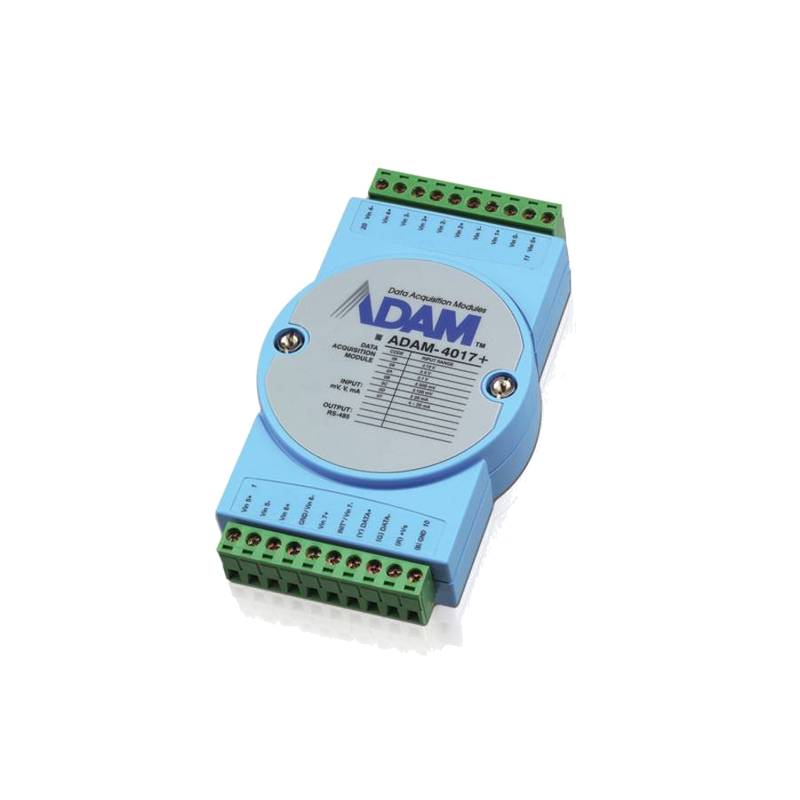
Advantech ADAM-4016-A Strain Gauge Input Measurement Module


The Advantech ADAM-4016-A is a robust, single-channel strain gauge input module designed for precise measurement of physical quantities in demanding industrial environments. Leveraging advanced microprocessor-controlled integrating A/D conversion, it reliably transforms sensor voltage or current signals into accurate digital data. This module is engineered to provide signal conditioning, analog-to-digital conversion, ranging, and RS-485 digital communication, all within a compact and versatile form factor. Key advantages include opto-isolation and up to 3000 VDC transformer-based isolation, safeguarding equipment from ground loops and power surges. The ADAM-4016-A offers flexible input ranges, supporting millivolt and milliamp signals, making it suitable for a wide array of load cell and stress measurement applications. Its operational parameters include a sampling rate of 10 samples/sec and a maximum RS-485 distance of 4000 ft (1200 m), ensuring efficient data acquisition and reliable communication across industrial networks.
Product Specifications
| Feature | Specification |
| :------------------ | :------------------------------------------------------------------------------------ |
| Input Channels | 1 differential strain gauge |
| Input Ranges | ±15 mV, ±50 mV, ±100 mV, ±500 mV, ±20 mA |
| Resolution | 16-bit |
| Sampling Rate | 10 samples/sec |
| Input Impedance | Voltage: 2 MΩ; Current: 125 Ω (user-added) |
| Isolation Voltage | 3000 VDC |
| Communication | RS-485 (2-wire) |
| Baud Rate | 1200, 2400, 4800, 9600, 19.2K, 38.4K bps |
| Max. Distance (RS485)| 4000 ft (1200 m) |
| Power Consumption | 2.2 W @ 24 VDC |
| Watchdog Timer | System (1.6 s) |
| Operating Temp. | -10°C to 70°C (14°F to 158°F) |
| Housing | Rugged industrial-grade ABS plastic |
| Supported Protocols | ASCII command, Modbus/RTU |
Core Features & Market Positioning
The Advantech ADAM-4016-A distinguishes itself in the industrial automation market through its specialized strain gauge input capabilities, robust isolation, and adherence to industry-standard communication protocols. Its design prioritizes reliability and precision in environments where accurate measurement of mechanical stress and load is critical. The module's competitive advantage lies in its ability to provide high-fidelity data conversion coupled with superior protection against electrical disturbances, a crucial factor for operational continuity in industrial settings. Advantech's long-standing reputation for producing dependable industrial hardware further solidifies the ADAM-4016-A's position as a trusted component for demanding applications. The inclusion of both ASCII and Modbus/RTU protocols ensures broad compatibility with various control systems and human-machine interfaces (HMIs).
Key Application Scenarios
The Advantech ADAM-4016-A finds extensive application in industries requiring precise strain and force measurement. This includes manufacturing, where it can monitor machine stress, material testing, and product quality control. In the automotive sector, it's vital for testing vehicle components and structural integrity. The aerospace industry benefits from its accuracy in structural health monitoring and testing. Furthermore, its capabilities are well-suited for civil engineering projects, such as monitoring bridge loads and structural health, and in heavy machinery for monitoring operational forces and preventing equipment failure. It is also a valuable tool in research and development for experimental setups requiring sensitive force or displacement measurements.
Practical System Integration Guidance
Integrating the Advantech ADAM-4016-A into an industrial control system is streamlined due to its modular design and standard communication interfaces. The module utilizes plug-in terminal blocks for easy installation and maintenance, supporting wire gauges from #14 to #22 AWG. For RS-485 communication, ensure proper termination and bus configuration, especially when daisy-chaining multiple modules. Advantech provides utilities like ADAM.EXE for configuration and monitoring, allowing users to set communication parameters such as baud rate and module ID. It is crucial that the host system, communication converters (e.g., ADAM-4520 for RS-232), and the ADAM-4016-A all operate on the same baud rate and network settings. For initial setup or troubleshooting, the module can be placed in an "initial mode" by connecting the INIT* pin to GND, which sets a default baud rate of 9600 bps and N81 data format, facilitating initial configuration.
Operation and Risk Mitigation
Proper operation of the Advantech ADAM-4016-A involves understanding its input configurations and communication protocols. The module supports both voltage (mV) and current (mA) inputs, and the appropriate wiring for strain gauge sensors (e.g., full-bridge, half-bridge) must be followed as per the sensor manufacturer's specifications and the module's documentation. To mitigate operational risks, Advantech emphasizes the importance of using CE-compliant industrial enclosures, especially to protect against Electrostatic Discharge (ESD). The module features a watchdog timer that automatically recovers the system in case of communication loss or internal hangs, enhancing operational stability. High and low alarm limits can be programmed into the module's EEPROM, with digital outputs indicating alarm states, providing an additional layer of operational oversight and risk management.
Scalability & Long-Term Value
The Advantech ADAM-4016-A offers significant scalability and long-term value within an industrial automation framework. As part of the broader ADAM-4000 series, it integrates seamlessly with other Advantech remote I/O modules via the robust RS-485 bus, allowing for expansion of data acquisition and control capabilities as system requirements evolve. The module's support for standard protocols like Modbus/RTU facilitates integration with a wide range of PLCs, SCADA systems, and HMIs, ensuring compatibility with both existing and future platforms. Furthermore, Advantech actively develops solutions for the Industrial Internet of Things (IIoT), with gateways like the ADAM-4570/4571 enabling easy migration of RS-485 data to Ethernet networks, thereby future-proofing investments and enabling advanced data analytics and remote monitoring capabilities.
Frequently Asked Questions
What are the primary applications for the Advantech ADAM-4016-A?
The Advantech ADAM-4016-A is primarily utilized in industrial settings for precise measurement of strain, force, and weight. Its core function involves interfacing with strain gauge-based sensors, such as load cells, to convert minute physical deformations into digital signals. This makes it invaluable in manufacturing for quality control and process monitoring, in engineering for structural testing and stress analysis, and in various sectors for weighing systems and material strength evaluation. Its robust design and isolation capabilities ensure reliable operation even in challenging industrial environments.
How is the ADAM-4016-A installed and configured?
Installation involves connecting the strain gauge sensor to the module's input terminals and then establishing communication via the RS-485 interface to a host computer or PLC. Configuration is typically performed using Advantech's utility software, such as ADAM.EXE, where parameters like input range, communication settings (baud rate, ID), and alarm thresholds are set. For initial setup, the module can be put into an "initial mode" by shorting the INIT* pin to GND, which resets communication settings to default and allows for easier network integration.
What are the key technical specifications for the Advantech ADAM-4016-A?
The ADAM-4016-A features a single differential strain gauge input with selectable ranges (±15 mV, ±50 mV, ±100 mV, ±500 mV, ±20 mA). It boasts a 16-bit resolution and a sampling rate of 10 samples per second. Crucially, it provides 3000 VDC of isolation, protecting against power surges and ground loops. Communication is via RS-485, supporting various baud rates up to 38.4 Kbps over distances up to 1200 meters. It also includes 4 digital outputs and operates on a 10-30 VDC power supply.
What is the role of the watchdog timer in the ADAM-4016-A?
The watchdog timer is a critical safety feature designed to ensure continuous system operation and recovery from communication failures. It comprises two aspects: a system watchdog that reboots the module if it hangs, and a communication watchdog that can re-initialize the RS-485 network if communication is lost for a set period. This functionality enhances the module's reliability by automatically addressing potential issues without manual intervention, crucial for maintaining uninterrupted data acquisition and control in industrial processes.
Can the ADAM-4016-A be integrated into an existing Modbus network?
Yes, the Advantech ADAM-4016-A fully supports the Modbus/RTU protocol, making it straightforward to integrate into existing Modbus networks. This allows it to communicate seamlessly with a wide range of industrial controllers, PLCs, SCADA systems, and HMIs that utilize Modbus. This protocol support simplifies system design and expansion, as it leverages a widely adopted standard in industrial automation, reducing the need for complex custom communication interfaces.
How does the isolation feature protect the system?
The ADAM-4016-A provides 3000 VDC of isolation, achieved through opto-isolation of the A/D input and transformer-based isolation. This feature is vital for preventing damage to sensitive equipment caused by ground loops, voltage spikes, or electrical noise that are common in industrial environments. By electrically separating the input circuitry from the main system ground and power, it safeguards the module, the connected sensors, and the host control system from potentially damaging voltage transients.
What are the supported communication protocols for the ADAM-4016-A?
The ADAM-4016-A supports two primary communication protocols: ASCII command and Modbus/RTU. The ASCII protocol is often used for simpler point-to-point communication or when integrating with legacy systems. Modbus/RTU, a widely adopted serial communication protocol, offers robust and efficient data exchange, making it suitable for multi-drop RS-485 networks and integration with a vast array of industrial automation devices and software platforms.
How are alarm conditions handled by the ADAM-4016-A?
The ADAM-4016-A is equipped with high and low alarm functions that can be remotely configured and downloaded into the module's EEPROM. When an alarm condition is met (i.e., the input signal exceeds or falls below the set thresholds), the module can trigger its digital outputs. Typically, two digital output channels are used to signal these alarm states, allowing connected devices like relays or indicator lights to alert operators or initiate automated responses, thereby enhancing process safety and monitoring.
What is the maximum distance for RS-485 communication with the ADAM-4016-A?
The RS-485 interface of the ADAM-4016-A supports communication over distances of up to 4000 feet (approximately 1200 meters). This extended range is critical for industrial applications where sensors and control panels may be located significant distances apart within a plant or facility. The RS-485 standard's differential signaling also provides inherent noise immunity, further ensuring reliable data transmission over these longer distances.
How does the Advantech ADAM-4016-A contribute to IIoT integration?
The ADAM-4016-A serves as a foundational component for Industrial IoT (IIoT) integration by providing reliable field-level data acquisition. Its RS-485 interface can be extended to Ethernet networks through Advantech's communication modules (e.g., ADAM-4570/4571) or industrial gateways. This allows sensor data to be transmitted to cloud platforms for analysis, remote monitoring, and integration with other smart industrial systems, enabling predictive maintenance, process optimization, and advanced data-driven decision-making.