











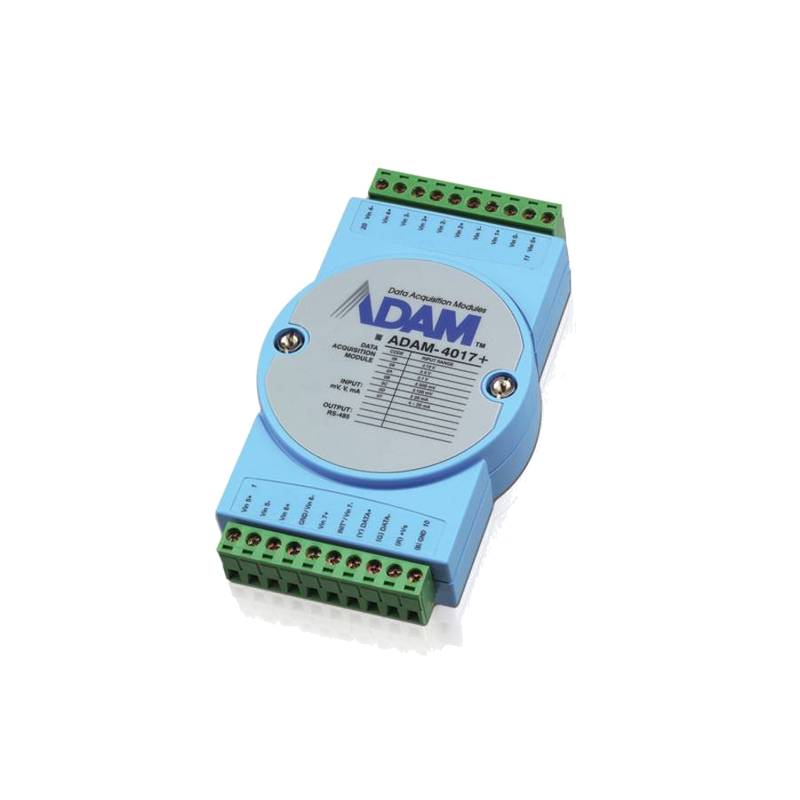
Advantech ADAM-6017-D 8-Channel Ethernet Analog Input Module


The Advantech ADAM-6017-D stands as a robust 8-channel Ethernet analog input module, engineered for demanding industrial automation environments. This module excels by providing reliable data acquisition across multiple analog signals, seamlessly integrating into existing networks via its Ethernet interface. Its key advantages include high-precision measurement capabilities, wide operating temperature range, and rugged construction, ensuring consistent performance in challenging conditions. The ADAM-6017-D is designed for efficient data logging, remote monitoring, and control applications across various industrial sectors.
| Feature | Specification |
| :---------------------- | :----------------------------------------------- |
| Analog Input Channels | 8 |
| Input Type | Voltage, Current, Thermocouple, RTD |
| Resolution | 16-bit |
| Sampling Rate | Configurable (up to 100 SPS per channel) |
| Communication Interface | 10/100 Mbps Ethernet |
| Protocol | Modbus TCP, UDP |
| Power Consumption | Typically 2.4 W |
| Operating Temperature | -25°C to +70°C (-13°F to +158°F) |
| Isolation Voltage | 3000 VDC |
| Dimensions | 70 mm x 120 mm x 33 mm (2.76" x 4.72" x 1.30") |
| Mounting | DIN-rail, Wall-mount |
Core Features & Market Positioning
The ADAM-6017-D differentiates itself through its versatility in handling diverse analog input types, including voltage, current, thermocouples, and RTDs, within a single unit. This broad compatibility reduces the need for multiple specialized modules, offering a cost-effective solution for system integrators. Its 16-bit resolution ensures high accuracy in data capture, critical for applications demanding precise monitoring of process variables. The module's robust design, featuring high voltage isolation and a wide operating temperature range, positions it as a reliable choice for harsh industrial settings where standard components might fail. This combination of flexibility, accuracy, and durability makes the ADAM-6017-D a preferred option for SCADA systems and industrial IoT deployments.
Key Application Scenarios
This 8-channel analog input module is ideally suited for a wide array of industrial applications. In manufacturing, it is frequently employed for monitoring machine performance, process temperatures, and fluid levels, contributing to efficient production and predictive maintenance. Environmental monitoring systems benefit from its ability to capture data from sensors measuring air quality, water flow, and pressure across distributed locations. The oil and gas industry utilizes the ADAM-6017-D for remote monitoring of wellheads and pipeline integrity, leveraging its Ethernet connectivity for long-distance data transmission. Furthermore, building automation systems can integrate this module to manage HVAC systems, energy consumption, and occupancy sensing, optimizing operational efficiency and comfort.
Practical System Integration Guidance
Integrating the Advantech ADAM-6017-D into an industrial control system is straightforward, primarily leveraging its Modbus TCP/IP or UDP protocol over an Ethernet connection. For wiring, ensure the power supply is within the module's specified voltage range (typically 12-48 VDC). Connect analog input signals to the designated terminals, paying close attention to the jumper settings for voltage or current input selection and the configuration for thermocouple or RTD types. Initial configuration often involves accessing the module's web server interface via its default IP address or using Advantech's utility software to assign a static IP address suitable for the local network. Once networked, devices like PLCs, SCADA systems, or data loggers can communicate with the ADAM-6017-D using standard Modbus read/write commands to poll input values or configure settings.
Operation and Risk Mitigation
Operating the ADAM-6017-D requires adherence to standard industrial electrical safety practices. Always ensure power is disconnected before making any wiring changes. The module's high voltage isolation (3000 VDC) provides a significant safety buffer against ground loops and electrical surges, but proper grounding of the system remains essential for optimal performance and safety. Common troubleshooting involves checking network connectivity, verifying correct IP addressing, and ensuring the input signal wiring matches the module's configured input type. Fault indicators, if present, or error logs accessed via the web interface or Modbus communication can help diagnose issues. Over-voltage protection on input channels is not standard; therefore, ensure input signal levels do not exceed the module's rated limits.
Scalability & Long-Term Value
The ADAM-6017-D offers excellent scalability, allowing users to expand their data acquisition capabilities by adding more modules to the network. Its Ethernet-based communication is inherently scalable and supports integration with distributed architectures. This module aligns well with the principles of Industrial Internet of Things (IIoT) and Industry 4.0, providing a foundational element for smart factory initiatives. Compatibility with various SCADA software platforms and PLC systems ensures it can be seamlessly incorporated into existing infrastructure or serve as a future-proof component for new deployments. Advantech's commitment to industrial automation ensures ongoing support and potential for future firmware updates that enhance functionality or security.
Frequently Asked Questions (FAQs)
1. What are the primary advantages of using the Advantech ADAM-6017-D?
The ADAM-6017-D offers versatile analog input handling for multiple signal types. It provides high-resolution 16-bit data acquisition for precise measurements. Its robust construction ensures reliable operation in harsh industrial environments.
This module features Ethernet connectivity, simplifying network integration and remote monitoring capabilities. It boasts wide operating temperature tolerance and high voltage isolation for enhanced safety and longevity.
The product's modular design allows for easy scalability and cost-effective system expansion. Its adherence to standard protocols ensures broad compatibility with existing automation platforms.
2. How do I physically install the ADAM-6017-D module?
Mount the module securely on a standard 35mm DIN rail or a suitable wall surface. Ensure adequate ventilation around the module to prevent overheating during operation.
Connect the required power supply (12-48 VDC) to the designated power terminals, observing correct polarity. Then, wire the analog input signals to the appropriate input terminals.
Verify all connections are secure before applying power. Refer to the installation manual for detailed wiring diagrams specific to input types like voltage, current, thermocouples, or RTDs.
3. Can the ADAM-6017-D module measure thermocouple inputs?
Yes, the ADAM-6017-D is capable of measuring thermocouple inputs directly. It supports various common thermocouple types, requiring specific configuration.
Ensure the appropriate jumper settings are selected for thermocouple input mode. Correct wiring of the thermocouple to the designated terminals is crucial for accurate readings.
Refer to the product manual for the specific supported thermocouple types (e.g., J, K, T, E, R, S, B) and the necessary cold-junction compensation adjustments for optimal performance.
4. What communication protocols does the ADAM-6017-D support?
The ADAM-6017-D primarily utilizes Modbus TCP and Modbus UDP protocols for communication over Ethernet. This allows for easy integration with a wide range of industrial automation devices.
These standard protocols enable seamless data exchange with PLCs, SCADA systems, HMIs, and other network-enabled control devices. Configuration of the protocol settings is typically done via the module's web interface.
Utilizing Modbus TCP/IP simplifies network setup and reduces the need for specialized communication hardware, making it a versatile choice for modern industrial networks.
5. How do I configure the IP address for the ADAM-6017-D?
The module can be configured via its built-in web server interface upon initial connection. It often ships with a default IP address that can be accessed from a PC on the same subnet.
Alternatively, Advantech provides utility software that can discover modules on the network and assist in assigning a static IP address. This is recommended for permanent installations.
Ensure the chosen IP address is unique and falls within your network's addressing scheme to avoid conflicts and ensure reliable communication.
6. What are the electrical specifications for the analog inputs?
The ADAM-6017-D supports both voltage and current inputs, with configurable ranges. It also accommodates thermocouple and RTD inputs, offering significant flexibility.
The module provides a 16-bit resolution, translating analog signals into digital values with high precision. The maximum sampling rate per channel is configurable, typically up to 100 samples per second.
Always consult the product datasheet for the precise input ranges (e.g., 0-10V, 4-20mA) and specific configurations for different sensor types to ensure compatibility and prevent damage.
7. How does the ADAM-6017-D handle overloads or signal faults?
The ADAM-6017-D is designed with industrial robustness but does not typically include built-in over-voltage protection on the input channels themselves. External protection should be considered if input signal levels might exceed module specifications.
Signal faults, such as open circuits or out-of-range values, can usually be detected through software monitoring of the acquired data. The module might report specific status bits or values indicating a fault condition.
Proper wiring and sensor selection are critical to prevent signal faults. Implementing alarm logic in the control system based on input values can help mitigate risks associated with signal anomalies.
8. What is the power requirement for the ADAM-6017-D module?
The ADAM-6017-D typically operates on a DC power supply ranging from 12 to 48 volts. The exact voltage range and current consumption (typically low, around 2.4W) are detailed in the product specifications.
Ensure the power supply used is stable and adequately rated to handle the module's power draw, especially when multiple modules are powered from the same source. Use appropriate gauge wiring for the power connections.
Always verify the power supply polarity before connecting. Incorrect polarity can damage the module. Consider using a redundant power supply for critical applications to enhance system reliability.
9. Is the ADAM-6017-D suitable for remote monitoring applications?
Yes, the Ethernet interface makes the ADAM-6017-D highly suitable for remote monitoring. It can transmit data over standard TCP/IP networks, including the internet.
This allows users to access sensor data from virtually anywhere, provided network connectivity and security measures are in place. The Modbus TCP protocol is well-suited for long-distance communication.
Combine the module with VPNs or other secure network solutions for safe and reliable remote access to your industrial process data.
10. What is the operating temperature range of the ADAM-6017-D?
The ADAM-6017-D is built to withstand demanding industrial conditions, operating reliably within a wide temperature range. This typically spans from -25°C to +70°C (-13°F to +158°F).
This broad operational window ensures the module's performance is not compromised by extreme ambient temperatures commonly found in factory floors, outdoor enclosures, or control cabinets.
Always ensure that the module is installed in a location where it can dissipate heat effectively, even within its specified operating range, to guarantee longevity and consistent accuracy.