











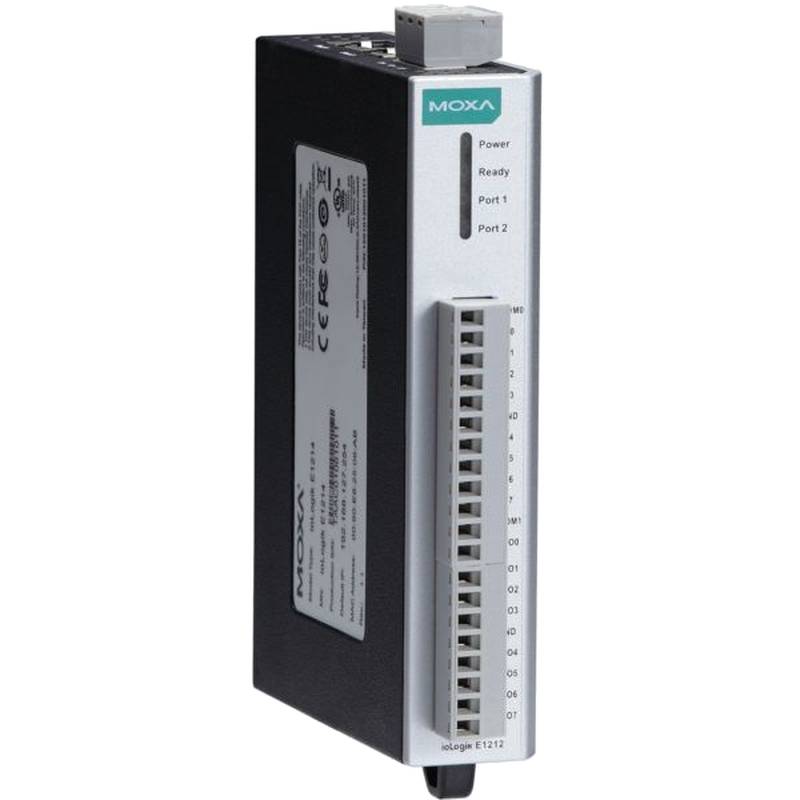
Module d'E/S à distance Moxa ioLogik E1212


Le Moxa ioLogik E1212 est un module d'E/S distantes robuste conçu pour les applications d'automatisation industrielle exigeantes, offrant une fiabilité et une flexibilité inégalées. Ses avantages remarquables incluent une acquisition de données à grande vitesse, des capacités d'E/S numériques étendues et un format compact adapté aux environnements restreints en espace. Le module bénéficie d'un indice de protection IP30 impressionnant, garantissant un fonctionnement dans des environnements industriels difficiles. Avec 8 entrées numériques et 4 sorties numériques, le E1212 offre une connectivité polyvalente pour une large gamme d'appareils. Sa plage de températures de fonctionnement de -40 à 85°C souligne son adéquation aux conditions extrêmes.
Spécifications du produit
| Fonctionnalité | Spécification |
| :------------------- | :----------------------------------------------- |
| Entrées numériques | 8 (Récepteur/Source configurable) |
| Sorties numériques | 4 (Sorties relais) |
| Plage de tension d'entrée | 0-30 VCC |
| Charge de sortie | 5A à 30 VCC ; 5 A à 125/250 V CA |
| Tension d'isolement | 2 kV |
| Interface de communication | RS-485 (2 fils) |
| Débit en bauds | 2 400 bps à 115 200 bps |
| Prise en charge du protocole | Modbus/RTU, Moxa |
| Puissance absorbée | 12-36 VCC |
| Consommation d'énergie | Généralement < 2 W |
| Température de fonctionnement| -40 à 85°C |
| Dimensions | 31,5 x 104 x 77 mm |
| Montage | Rail DIN |
| Indice de protection | IP30 |
Caractéristiques principales et positionnement sur le marché
The Moxa ioLogik E1212 distinguishes itself through its exceptional value proposition in the remote I/O market. Its core strength lies in the seamless integration of a high density of digital inputs and outputs within a single, cost-effective unit. This module directly addresses the industry's need for reliable data acquisition and control in distributed systems, positioning it as a top choice for system integrators and automation engineers. Unlike less integrated solutions, the E1212 simplifies wiring and reduces the overall footprint of control panels, leading to significant cost savings in installation and maintenance. Its robust build quality and wide operating temperature range further solidify its market position as a dependable component for mission-critical operations.
Scénarios d'application clés
La polyvalence du Moxa ioLogik E1212 en fait une solution idéale pour de nombreux scénarios industriels. Il excelle dans l'automatisation des bâtiments, la surveillance et le contrôle de l'éclairage, des systèmes CVC et des capteurs de sécurité. Dans l'automatisation industrielle, il gère efficacement l'état de la machine, le contrôle des actionneurs et la signalisation d'alarme, contribuant ainsi à améliorer l'efficacité opérationnelle. Le module est également bien adapté aux applications d'énergie et de services publics, permettant la surveillance à distance des sous-stations, de l'état des appareillages de commutation et des données sur la qualité de l'énergie. De plus, sa conception robuste en fait un choix fiable pour la surveillance environnementale, la collecte de données provenant de capteurs et le contrôle d'équipements à distance dans des conditions extérieures difficiles.
Guide pratique d’intégration du système
Integrating the Moxa ioLogik E1212 into existing industrial networks is a straightforward process, primarily leveraging its RS-485 communication interface and Modbus/RTU protocol support. For physical connections, the module features screw terminals for power and I/O wiring. The digital inputs can be configured as either sink or source type, requiring careful consideration of the connected sensor's output to ensure proper signal reception. The relay outputs are suitable for switching higher voltage or current loads, and appropriate wiring practices for AC and DC circuits must be followed to ensure safety and reliability. When configuring the module for a Modbus network, setting the correct communication parameters (baud rate, data bits, parity, stop bits) on both the E1212 and the master controller is crucial for establishing communication. Moxa's ioFACET software or common SCADA systems can be used to poll the module's registers, allowing for real-time data acquisition and control command issuance.
Opération et atténuation des risques
Operating the Moxa ioLogik E1212 requires adherence to standard industrial safety protocols, particularly concerning the wiring of power and output circuits. While the module itself is designed for high reliability, improper installation or connection to incompatible loads can lead to malfunctions. It is essential to ensure that the voltage and current ratings of the connected devices do not exceed the specifications of the E1212's relay outputs to prevent damage. Overvoltage protection on the power input is recommended, especially in environments with unstable power grids. Regular inspection of wiring for signs of wear or damage, and ensuring proper grounding, are vital steps in mitigating operational risks. In the event of communication loss, typical troubleshooting involves verifying the RS-485 wiring polarity and termination, checking the communication settings on both the master and slave devices, and confirming that the E1212 is powered correctly.
Évolutivité et valeur à long terme
The Moxa ioLogik E1212 offers significant scalability and long-term value within an industrial automation architecture. Its modular design allows for easy expansion of I/O points by simply adding more ioLogik modules to the RS-485 network, enabling systems to grow alongside operational demands without requiring a complete overhaul of the control infrastructure. Compatibility with the widely adopted Modbus/RTU protocol ensures seamless integration with a vast array of existing SCADA systems, PLCs, and other industrial devices from various manufacturers, providing flexibility and avoiding vendor lock-in. Furthermore, the E1212's robust construction and Moxa's commitment to product longevity mean it can reliably serve in an industrial environment for many years, making it a sound investment for long-term operational efficiency and the gradual transition towards Industrial Internet of Things (IIoT) enabled solutions.
Questions fréquemment posées
Quelle est la tension maximale pour les entrées numériques du Moxa ioLogik E1212 ?
The Moxa ioLogik E1212 supports digital inputs with a voltage range of 0-30 VDC. This wide range allows for flexibility in connecting various types of digital sensors and switches common in industrial settings. It is crucial to ensure that the sensor's output voltage does not exceed this specified limit to prevent damage to the module's input circuitry.
The 0-30 VDC range accommodates both 12V and 24V digital signals, which are prevalent in industrial automation systems. Proper wiring and grounding are essential for accurate signal acquisition and to avoid electrical noise interference. Always consult the sensor's datasheet to confirm its voltage output characteristics before connecting it to the E1212.
En offrant une large tolérance de tension d'entrée, l'ioLogik E1212 simplifie la sélection et l'intégration du capteur. Cette fonctionnalité améliore sa convivialité dans diverses applications où différents niveaux de tension peuvent être rencontrés.
Comment câbler les sorties relais du Moxa ioLogik E1212 ?
The Moxa ioLogik E1212 features four relay outputs, each capable of handling significant loads up to 5A. For DC loads, the maximum is 5A at 30 VDC, and for AC loads, it's 5A at 125/250 VAC. When wiring, ensure the common terminal of the relay is connected to the appropriate power source (positive for DC, line for AC) and the normally open (NO) or normally closed (NC) terminal is connected to the load.
Il est essentiel de respecter les normes de sécurité électrique lors du câblage, en particulier lorsqu'il s'agit d'alimentation secteur. Utilisez des fils de calibre approprié et assurez-vous que toutes les connexions sont sécurisées pour éviter les courts-circuits ou les contacts desserrés. Pensez à utiliser une protection par fusible sur les circuits de sortie pour plus de sécurité et pour éviter d'endommager le module ou l'équipement connecté en cas de défaut.
Des pratiques de câblage appropriées garantiront la longévité et le fonctionnement fiable des sorties relais. Vérifiez toujours la configuration du câblage par rapport à la logique du circuit prévue avant de mettre sous tension afin d'éviter un fonctionnement incorrect ou des dommages potentiels à l'équipement.
Quel protocole de communication le Moxa ioLogik E1212 utilise-t-il pour l'acquisition de données à distance ?
Le Moxa ioLogik E1212 utilise principalement le protocole Modbus/RTU pour sa communication via l'interface RS-485. Il s'agit d'une norme de communication série largement adoptée dans l'automatisation industrielle, garantissant une large compatibilité avec divers appareils maîtres tels que les automates, les panneaux IHM et les systèmes SCADA. Le module agit comme un appareil esclave Modbus.
In addition to Modbus/RTU, the E1212 also supports Moxa's proprietary protocol. This can offer enhanced features or performance when communicating with other Moxa devices or software platforms. Selecting the appropriate protocol depends on the existing infrastructure and desired system capabilities.
La configuration des paramètres de communication, notamment le débit en bauds, la parité, les bits de données et les bits d'arrêt, est essentielle pour établir une connexion stable. Cette configuration doit être cohérente entre le module E1212 et le contrôleur maître pour permettre un échange de données et un contrôle à distance réussis.