











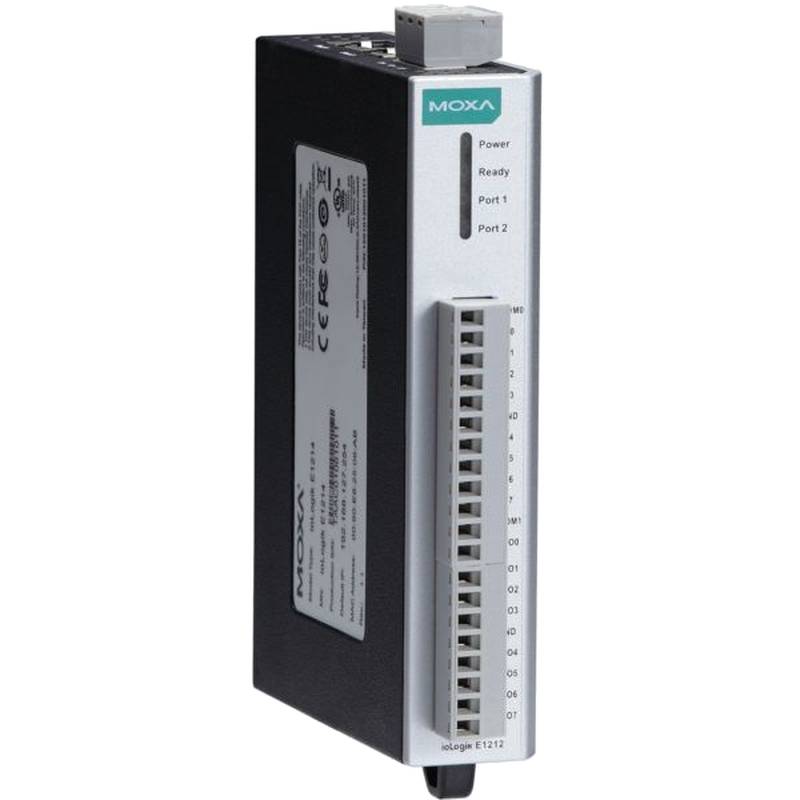
Module distant d'E/S numérique Moxa ioLogik E1214 à 4 canaux


The Moxa ioLogik E1214 is a robust 4-channel digital I/O remote module designed for demanding industrial automation applications. It offers a combination of 6 digital inputs and 6 relay outputs, integrated within a compact, DIN-rail mountable unit. Key advantages include its dual-port Ethernet switch, enabling efficient daisy-chain topologies that reduce cabling costs and complexity. This module supports a wide array of industrial protocols, including Modbus TCP, EtherNet/IP, and Moxa's own AOPC, alongside IT protocols like SNMP and RESTful API, facilitating seamless integration into both Operational Technology (OT) and Information Technology (IT) environments. With a focus on reliability, the ioLogik E1214 features a wide operating temperature range and robust certifications for industrial use.
Spécifications du produit
| Spécification | Détails |
| :------------------------ | :--------------------------------------------------------- |
| Canaux d'entrée numérique | 6 |
| Canaux de relais | 6 |
| Ports Ethernet | 2 x 10/100BaseT(X) avec connecteur RJ45, 1 adresse MAC (bypass Ethernet) |
| Contournement Ethernet | Oui |
| Isolation magnétique | 1,5 kV (intégré) |
| Tension d'entrée | 12 à 36 VCC |
| Consommation électrique | 188 mA à 24 VCC |
| Température de fonctionnement | -10 à 60°C (14 à 140°F) ou -40 à 75°C (-40 à 167°F) pour une température large. modèles |
| Température de stockage | -40 à 85°C (-40 à 185°F) |
| Humidité relative ambiante | 5 à 95 % (sans condensation) |
| Dimensions | 27,8 x 124 x 84 mm (1,09 x 4,88 x 3,31 pouces) |
| Poids | 200 g (0,44 lb) |
| Montage | Rail DIN, montage mural |
| Connecteur d'entrée numérique | Borne Euroblock à visser |
| Connecteur de sortie relais | Borne Euroblock à visser |
| Type de capteur d'entrée numérique | Contact sec, contact humide (NPN ou PNP) |
| Mode E/S d'entrée numérique | DI ou compteur d'événements |
| Points d'entrée numérique par COM | 6 canaux |
| Type de sortie relais | Relais de puissance de forme A (N.O.) |
| Courant nominal du contact du relais | 5 A à 30 VCC, 250 VCA, 110 VCA |
| Endurance mécanique du relais | 5 000 000 d'opérations |
| Endurance électrique du relais | 100 000 opérations à une charge résistive de 5 A |
| Isolement | 3 000 VCC ou 2 000 Vrms |
Caractéristiques principales et positionnement sur le marché
The Moxa ioLogik E1214 distinguishes itself in the industrial Ethernet remote I/O market through its versatile protocol support and integrated hardware features designed for efficiency and ease of deployment. Its ability to simultaneously communicate using both OT (Modbus TCP, EtherNet/IP) and IT (SNMP, RESTful API) protocols positions it as a bridge between traditional industrial control systems and modern IIoT platforms. The inclusion of a built-in 2-port Ethernet switch is a significant differentiator, enabling daisy-chain configurations that drastically reduce the need for external switches, thereby lowering installation costs and simplifying network architecture. Furthermore, Moxa's proprietary "Click&Go" control logic and Active OPC Server technology enhance its appeal by simplifying configuration and providing faster, more efficient data reporting compared to traditional polling methods. This combination of robust hardware, flexible communication, and user-friendly features makes the ioLogik E1214 a compelling choice for applications requiring reliable remote data acquisition and control in challenging industrial environments.
Scénarios d'application clés
The Moxa ioLogik E1214 is exceptionally well-suited for a broad spectrum of industrial applications where reliable remote monitoring and control are paramount. Its robust design and connectivity options make it ideal for factory automation, enabling the collection of data from production lines, machine status monitoring, and the control of actuators and alarms. In security and surveillance systems, it can be used to monitor sensors, trigger alarms, and control access points remotely. The module's daisy-chain capabilities are particularly beneficial for building multidrop I/O networks over standard Ethernet cables, reducing infrastructure costs in large facilities. This also extends to applications like tunnel monitoring and other tunneled connections where extending network reach efficiently is crucial. Furthermore, its support for IIoT applications positions it for use in energy monitoring and facility monitoring scenarios, aligning with the growing trend of digital transformation in industrial sectors.
Guide pratique d’intégration du système
L'intégration du Moxa ioLogik E1214 dans un système existant ou nouveau est rationalisée grâce à sa conception conviviale et à ses outils de support complets. L'appareil peut être monté sur un rail DIN standard ou directement sur un mur, offrant une flexibilité d'installation. Le câblage est réalisé à l'aide de bornes Euroblock à visser pour les connexions d'E/S et d'alimentation, pouvant accueillir des câbles d'E/S de 16 à 26 AWG et des câbles d'alimentation de 12 à 24 AWG. Pour l'installation initiale et la configuration réseau, Moxa fournit l'utilitaire ioSearch, qui simplifie la découverte des appareils et le déploiement de masse. La configuration peut également être effectuée via un navigateur Web ou la bibliothèque MXIO, disponible pour les plateformes Windows et Linux, permettant aux ingénieurs de gérer efficacement les points d'E/S. L'unité prend en charge l'adressage esclave Modbus TCP défini par l'utilisateur, ce qui facilite considérablement l'intégration dans les réseaux Modbus existants en évitant les conflits avec les adresses fixes. La communication peer-to-peer est une autre fonctionnalité clé, permettant un transfert direct de données entre les modules ioLogik, simplifiant ainsi le câblage et réduisant le besoin d'une logique centrale complexe pour certaines tâches.
Opération et atténuation des risques
Operating the Moxa ioLogik E1214 involves leveraging its digital inputs and relay outputs for various control and monitoring tasks. The six digital inputs support both dry contact and wet contact (NPN/PNP) sensors, with configurable digital filtering to prevent false triggers. The six relay outputs are Form A (Normally Open) with a contact rating of 5A, suitable for switching a variety of loads. It's important to note that the relays have a limited lifespan, and products using them are covered by a 2-year warranty. To mitigate operational risks, the device operates within a specified humidity range (5-95% non-condensing) and can malfunction in high condensation environments below 0°C. While standard models operate from -10 to 60°C, wide-temperature variants are available for harsher environments (-40 to 75°C). The unit is also protected by built-in magnetic isolation (1.5 kV) for Ethernet ports, safeguarding against electrical surges. Over-voltage and over-current protections are also incorporated within the relay outputs to prevent damage from electrical anomalies.
Évolutivité et valeur à long terme
The Moxa ioLogik E1214 offers significant long-term value through its inherent scalability and compatibility with evolving industrial communication standards. The embedded 2-port Ethernet switch is central to its scalability, enabling straightforward daisy-chain configurations that allow for the expansion of I/O networks without the need for additional, costly Ethernet switches. This modular approach allows users to add more ioLogik units or other Ethernet devices as their operational needs grow, creating increasingly complex and distributed control systems. The device's support for RESTful API aligns with the growing adoption of Industrial Internet of Things (IIoT) solutions, making it future-proof for integration into smart factory initiatives and cloud-based data analytics platforms. Furthermore, the availability of the MXIO library for Windows and Linux facilitates integration into custom applications and supports ongoing development and maintenance, ensuring the module remains a valuable component in a company's automation infrastructure for years to come.
Questions fréquemment posées
Q1 : Quels sont les principaux avantages de l’utilisation du Moxa ioLogik E1214 ?
L'ioLogik E1214 offre des avantages significatifs, notamment des commutateurs Ethernet à double port intégrés qui permettent une connexion en série rentable des appareils, réduisant ainsi les dépenses de câblage et de matériel. Sa prise en charge de plusieurs protocoles industriels et informatiques tels que Modbus TCP, EtherNet/IP, SNMP et RESTful API garantit une large compatibilité avec divers systèmes de contrôle et plates-formes IIoT. De plus, des fonctionnalités telles que l'adressage Modbus TCP définissable par l'utilisateur et la communication peer-to-peer simplifient l'intégration et le déploiement.
Q2 : Comment la capacité de connexion en série du ioLogik E1214 réduit-elle les coûts ?
Le chaînage en série élimine le besoin de nombreux commutateurs Ethernet individuels dans les configurations d'E/S distribuées. En connectant plusieurs modules ioLogik de manière séquentielle à l'aide de leurs ports Ethernet intégrés, les coûts d'infrastructure réseau sont considérablement réduits. Cela conduit également à des économies significatives en termes de câblage, de main d'œuvre d'installation et d'espace dans l'armoire, ce qui en fait une solution très économique pour étendre les réseaux d'E/S.
Q3 : Quels protocoles industriels le Moxa ioLogik E1214 prend-il en charge ?
The ioLogik E1214 supports key industrial protocols essential for automation. This includes Modbus TCP, which is widely used for SCADA and PLC communication, and EtherNet/IP, a prevalent standard in manufacturing automation. It also supports Moxa's proprietary AOPC protocol, which enables active communication for faster data updates.
Q4 : L'ioLogik E1214 peut-il être intégré aux réseaux informatiques ou aux applications IIoT ?
Oui, l'ioLogik E1214 est conçu pour une intégration transparente dans les environnements OT et IT. Il prend en charge les protocoles informatiques tels que SNMP pour la gestion du réseau et l'API RESTful, ce qui le rend adapté aux applications IIoT modernes. Cette prise en charge de double protocole permet aux ingénieurs informatiques et opérationnels d'accéder sans effort aux données du même appareil.
Q5 : Quelles sont les spécifications électriques des entrées numériques et des sorties relais ?
Le module dispose de 6 entrées numériques qui prennent en charge les configurations de contact sec et de contact humide (NPN/PNP). Il fournit également 6 sorties relais de forme A (normalement ouvertes), chacune évaluée à 5 A à 30 V CC, 250 V CA ou 110 V CA. Ces relais ont une endurance mécanique de 5 millions d'opérations et une endurance électrique de 100 000 opérations sous une charge résistive de 5 A.
Q6 : Quelle est la plage de température de fonctionnement du Moxa ioLogik E1214 ?
La plage de températures de fonctionnement standard du ioLogik E1214 est de -10 à 60 °C (14 à 140 °F). Pour les applications nécessitant un fonctionnement dans des conditions plus extrêmes, des modèles à large température sont disponibles et peuvent fonctionner dans une plage de -40 à 75°C (-40 à 167°F).
Q7 : Comment le ioLogik E1214 est-il configuré et géré ?
La configuration et la gestion peuvent être réalisées via plusieurs méthodes. Les utilisateurs peuvent utiliser l'interface de configuration Web, l'utilitaire ioSearch pour un déploiement de masse ou la bibliothèque MXIO pour une programmation personnalisée sur les plates-formes Windows ou Linux. Cette flexibilité répond à diverses préférences d’ingénierie et exigences système.
Q8 : Quels types de certifications le ioLogik E1214 détient-il ?
L'ioLogik E1214 possède d'importantes certifications industrielles, notamment la conformité UL, CE et FCC, garantissant la sécurité et la compatibilité électromagnétique. Des modèles spécifiques peuvent également être certifiés pour les environnements dangereux, tels que ATEX Zone 2 et Classe I Division 2, ce qui les rend adaptés à une utilisation dans des atmosphères potentiellement explosives.
Q9 : Qu'est-ce que la « communication peer-to-peer » dans le contexte de l'ioLogik E1214 ?
La communication peer-to-peer permet aux valeurs d'entrée d'un module ioLogik d'être directement transférées vers les canaux de sortie d'un autre module ioLogik sans avoir besoin d'un contrôleur central ou d'un système SCADA. Cela simplifie considérablement le câblage et la logique pour certaines tâches de contrôle distribué.
Q10 : Quelle est la période de garantie du Moxa ioLogik E1214 ?
The general warranty period for Moxa products is typically five years. However, due to the limited operational lifetime of power relays, the specific warranty for the relay outputs on the ioLogik E1214 is generally two years. It's advisable to confirm the exact warranty terms with the product documentation or supplier.