











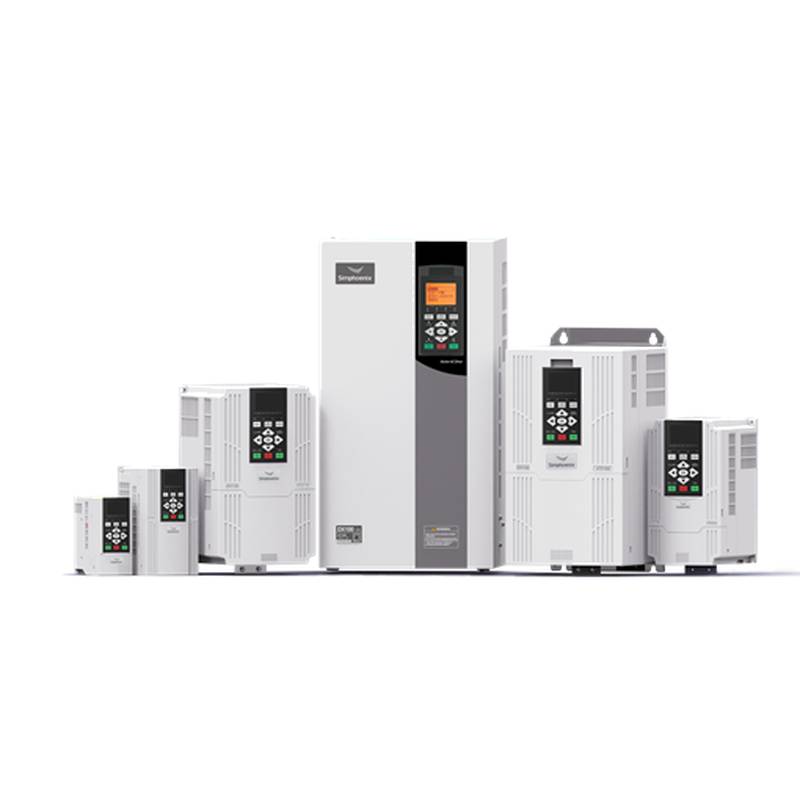
SIMPHOENIX DX100-4T0011 Three Phase 1.1kW Compact Frequency Converter 1.1kW


The SIMPHOENIX DX100-4T0011, a 1.1kW three-phase compact frequency converter, emerges as a robust solution for precise motor speed control across diverse industrial applications. This unit distinguishes itself through its compact design, high efficiency, and advanced control algorithms, making it an ideal choice for machinery requiring reliable and adaptable power. Key technical parameters include an output power of 1.1kW, a 3-phase input voltage range of 380-440V, and an output frequency range of 0-400Hz, ensuring versatility for various motor types and operational demands. Its sophisticated Vector Control and V/f control methods provide superior performance and energy savings.
Product Specifications
| Feature | Specification |
| :------------------- | :------------------------------------------ |
| Model | SIMPHOENIX DX100-4T0011 |
| Output Power | 1.1 kW |
| Input Voltage (3-Phase) | 380-440V |
| Output Voltage | 380V |
| Output Frequency | 0-400 Hz |
| Control Method | Vector Control, V/f Control |
| Mounting Type | DIN Rail or Screw Mount |
| Protection Class | IP20 |
| Dimensions (H x W x D) | 180mm x 110mm x 150mm (approximate) |
| Ambient Temperature | -10°C to +40°C (derating may apply) |
| Overload Capacity | 150% for 60 seconds, 180% for 3 seconds |
Core Features & Market Positioning
The SIMPHOENIX DX100-4T0011 is engineered for demanding industrial environments, positioning itself as a high-performance, cost-effective alternative to larger, more complex VFDs. Its compact form factor is a significant advantage, allowing for easy integration into control cabinets with limited space, a common challenge in machine retrofits and compact automation systems. The dual control modes, Vector Control and V/f Control, offer a flexible approach to motor management, catering to applications that require precise torque control and dynamic response (Vector Control) as well as those benefiting from simpler, energy-saving speed regulation (V/f Control). This dual capability broadens its appeal across a wider spectrum of industrial machinery, from pumps and fans to conveyors and processing equipment. The unit's robust overload capacity ensures reliable operation under transient load conditions, a critical factor for uptime in manufacturing settings.
Key Application Scenarios
This 1.1kW three-phase frequency converter finds extensive use in a variety of industrial sectors. It is exceptionally well-suited for variable speed drive applications in the food and beverage industry, controlling the speed of conveyor belts, mixers, and packaging machinery where precise flow rates and handling speeds are paramount. In the textile industry, the DX100-4T0011 can manage the rotational speeds of spinning machines and looms, ensuring consistent product quality. For water treatment facilities, its application in controlling pump and fan speeds optimizes energy consumption and maintains required flow and pressure levels. Furthermore, its compact size makes it ideal for integrating into OEM equipment, such as machine tools and printing presses, where space is at a premium but precise motor control is essential for operational accuracy.
Practical System Integration Guidance
Integrating the SIMPHOENIX DX100-4T0011 into an existing system is streamlined due to its user-friendly design. For wiring, ensure a stable three-phase power supply connects to the input terminals (L1, L2, L3) and the motor is correctly wired to the output terminals (U, V, W). Grounding is critical; connect the protective earth (PE) terminal to the system ground. The unit supports both DIN rail and screw mounting, offering flexibility in cabinet installation. Basic parameter configuration for motor identification and desired speed range can be accessed through the intuitive keypad and display. For advanced control, such as external speed referencing via analog inputs or digital I/O, consult the detailed programming manual to map specific functions to terminal inputs.
Operation and Risk Mitigation
Operating the SIMPHOENIX DX100-4T0011 requires adherence to safety protocols. Always ensure power is disconnected before making any wiring changes or performing maintenance. The frequency converter is equipped with overload protection, but persistent overloads may indicate an undersized unit or a mechanical issue within the driven equipment. Common fault codes, such as "Overcurrent" (OC) or "Overvoltage" (OV), typically signal immediate issues requiring investigation into motor load, wiring integrity, or input power quality. Referencing the product manual for specific fault code explanations and troubleshooting steps is crucial for minimizing downtime and preventing equipment damage. Proper ventilation around the unit is essential to maintain optimal operating temperatures and prevent thermal faults.
Scalability & Long-Term Value
The SIMPHOENIX DX100-4T0011 offers significant long-term value through its robust design and compatibility with modern industrial automation trends. While this specific 1.1kW model is designed for individual machine control, its integration capabilities with programmable logic controllers (PLCs) and supervisory control and data acquisition (SCADA) systems allow for centralized monitoring and control. This facilitates data logging for performance analysis and predictive maintenance, aligning with Industrial Internet of Things (IIoT) strategies. For applications requiring higher power ratings, SIMPHOENIX offers a range of VFDs in their DX series, ensuring compatibility in terms of communication protocols and programming logic, thus enabling seamless scalability as operational demands increase.
Frequently Asked Questions (FAQs)
Q1: What is the primary function of the SIMPHOENIX DX100-4T0011?
It acts as a frequency converter, precisely controlling motor speed.
It enables variable speed drives for machinery, optimizing performance.
This improves energy efficiency and extends equipment lifespan significantly.
Q2: Can this frequency converter be used with single-phase motors?
No, it is designed strictly for three-phase motors.
Input power must also be a stable three-phase supply.
Using it with single-phase motors will cause damage and system failure.
Q3: What are the advantages of Vector Control on the DX100-4T0011?
Vector control provides highly accurate torque regulation.
It allows for excellent dynamic response to load changes.
This is ideal for applications needing precise motor positioning.
Q4: How do I connect the motor to the SIMPHOENIX DX100-4T0011?
Connect motor phases to output terminals U, V, and W.
Ensure correct phase sequencing for proper motor rotation.
Always verify connections with power off to prevent shorts.
Q5: What is the overload capacity of this unit?
It can handle 150% of rated current for 60 seconds.
It also withstands 180% for short bursts of 3 seconds.
This ensures reliable operation under sudden load increases.
Q6: Is the DX100-4T0011 suitable for outdoor use?
No, its IP20 rating means it is for indoor, dry environments.
Protection against dust and low-pressure water jets is minimal.
Outdoor installation requires an appropriate enclosure.
Q7: How can I adjust the output frequency?
Use the front panel keypad and display for manual setting.
External control signals via analog or digital inputs are possible.
Programming parameters define the frequency control methods.
Q8: What causes an "Overcurrent" fault (OC) on this device?
Excessive motor load is the most common reason.
Wiring issues or motor winding faults can also trigger it.
Sudden acceleration ramps may require parameter tuning.
Q9: Does this frequency converter support communication protocols?
Basic models may have limited communication options.
Advanced versions often support Modbus RTU or others.
Check specific product documentation for protocol support.
Q10: How does the compact size benefit installation?
It saves valuable space in control cabinets.
This simplifies retrofitting into existing equipment.
Multiple units can be densely mounted if spaced correctly.