











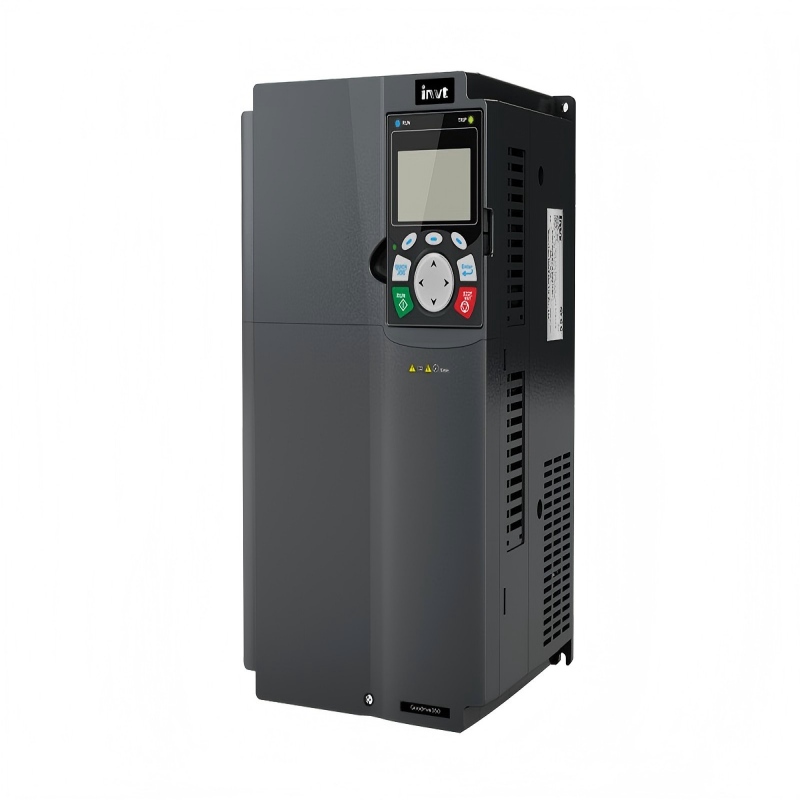
INVT GD350-045G/055P-45-AS Goodrive350 AS Series Book Size Inverter 45kW to 55kW Heavy Load


The INVT GD350-045G/055P-45-AS Goodrive350 AS Series Book Size Inverter, a robust 45kW to 55kW heavy-load solution, redefines industrial automation with its advanced Vector Control technology, exceptional overload capacity, and comprehensive protection features. This inverter is engineered for demanding applications, offering precise motor control, high starting torque, and superior energy efficiency. Its compact book-style design facilitates easy installation in space-constrained environments, making it an ideal choice for various heavy-duty industrial processes. The GD350-45AS series supports both asynchronous (Induction) and synchronous (Permanent Magnet) motors, expanding its versatility across a wide range of machinery.
Product Specifications
| Feature | Specification |
| :------------------- | :------------------------------------------- |
| Model | GD350-045G/055P-45-AS |
| Power Range | 45kW (045G) to 55kW (055P) |
| Input Voltage | 3-Phase, 380V-460V, 50/60Hz |
| Output Voltage | 0-380V/460V |
| Control Method | Vector Control (SVC, FOC), V/f Control |
| Overload Capacity | 150% rated current for 60s, 180% for 30s |
| Starting Torque | 150% at 0.5Hz (SVC) |
| Frequency Accuracy | ±0.02% of maximum output frequency |
| Frequency Resolution | 0.01Hz |
| Protection Features | Over-voltage, Under-voltage, Over-current, Overload, Overtemperature, Short circuit, etc. |
| Communication | Optional communication modules (Modbus, Profibus, CANopen, EtherNet/IP) |
| Mounting | Book-style, Wall/Panel Mount |
| Dimensions (H x W x D) | 500mm x 215mm x 232mm (for 45kW model) |
| Operating Temperature| -10°C to +40°C (derating above +40°C) |
Core Features & Market Positioning
The INVT Goodrive350 AS Series stands out in the heavy-load inverter market due to its sophisticated Field-Oriented Control (FOC) and Sensorless Vector Control (SVC) capabilities. This advanced control ensures exceptionally precise speed and torque regulation, even under fluctuating load conditions, a critical factor in applications like cranes, extruders, and presses. The inverter's robust overload capability, allowing for 150% of rated current for up to 60 seconds, provides the necessary headroom for high-inertia startups and transient overloads. Positioned as a high-performance, reliable, and cost-effective solution, the GD350-45AS series offers features typically found in premium-tier products, making it a compelling choice for industries seeking enhanced productivity and operational efficiency without compromising on durability. Its dual support for both asynchronous and synchronous permanent magnet motors further enhances its market appeal, offering flexibility for users to leverage different motor technologies based on specific application needs and energy efficiency targets.
Key Application Scenarios
The INVT GD350-045G/055P-45-AS Goodrive350 AS Series is ideally suited for a multitude of heavy-duty industrial applications where precise control, high torque, and reliability are paramount. Common use cases include:
Material Handling: Elevators, escalators, cranes, hoists, and conveyor systems benefit from the inverter's smooth acceleration/deceleration and precise positioning capabilities. Extrusion and Plastic Machinery: Extruders, injection molding machines, and film blowing lines require consistent speed and torque control to maintain product quality and efficiency. Metalworking Machinery: Presses, stamping machines, and metal cutting equipment demand high starting torque and the ability to handle shock loads. Pumps and Fans: Variable torque applications like large industrial fans, water pumps, and HVAC systems can achieve significant energy savings through precise flow and pressure control. Textile Machinery: Spinning machines, weaving looms, and dyeing equipment require stable speed and precise motion control. Mining and Cement Industries: Crushers, mills, and heavy-duty conveyors operating in harsh environments benefit from the inverter's robust design and overload capacity.
Practical System Integration Guidance
Integrating the INVT GD350-45AS series into existing industrial systems is streamlined by its user-friendly design and comprehensive parameter settings. For optimal performance, proper wiring is crucial. Ensure that the power input terminals (L1, L2, L3) are connected to a stable 3-phase AC power supply, and the motor output terminals (T1, T2, T3) are correctly wired to the motor. Grounding should be robust, connecting the earth terminal to a reliable earth ground. When connecting control signals (e.g., digital inputs for start/stop, direction, fault reset, or analog inputs for speed reference), refer to the terminal diagram in the user manual to ensure correct connections to the appropriate terminals (e.g., DI1-DI6, AI1-AI2). Parameter configuration for heavy-load applications typically involves setting motor parameters (rated voltage, current, frequency, poles) accurately, adjusting acceleration/deceleration times, and configuring overload protection settings according to the motor's nameplate and application requirements. For SVC or FOC operation, auto-tuning the motor parameters is a critical step for achieving optimal performance. The inverter supports standard communication protocols like Modbus RTU via RS485, enabling seamless integration into SCADA systems and PLCs for remote monitoring and control.
Operation and Risk Mitigation
Operating the INVT GD350-45AS series requires adherence to safety protocols to prevent equipment damage and ensure personnel safety. Before powering on, always verify that all wiring is secure and that the installation environment meets the specified conditions (temperature, humidity, ventilation). During commissioning, it's advisable to start with low speeds and gradually increase, closely monitoring motor temperature and inverter status. Common troubleshooting involves checking error codes displayed on the inverter. For instance, an "OC" (Overcurrent) fault might indicate a need to adjust acceleration times, check motor load, or verify motor parameters. An "OV" (Overvoltage) or "UV" (Undervoltage) fault typically points to issues with the power supply stability or braking resistor configuration (if used). An "OH" (Overtemperature) fault suggests inadequate ventilation or an ambient temperature exceeding the operational limits. Regular maintenance, including cleaning ventilation fans and checking electrical connections, is essential for long-term reliability and preventing potential operational disruptions.
Scalability & Long-Term Value
The INVT GD350-45AS series is designed with scalability and long-term value in mind. Its modular design allows for the addition of optional communication cards, such as Profibus, CANopen, or EtherNet/IP, enabling seamless integration into advanced industrial networks and supporting Industry 4.0 initiatives. This compatibility with various fieldbus systems ensures that the inverter can be easily incorporated into existing or future automation architectures, facilitating centralized control and data acquisition. Furthermore, the inverter's ability to control both asynchronous and synchronous permanent magnet motors provides future flexibility, allowing users to upgrade to more energy-efficient motor technologies as needed without requiring a complete inverter replacement. The robust build quality and comprehensive protection features contribute to a longer operational lifespan, reducing total cost of ownership. INVT's commitment to continuous product development also means that firmware updates are often available, further enhancing performance and adding new functionalities over time, thereby maximizing the long-term value of the investment.
Frequently Asked Questions
What are the primary advantages of the INVT GD350-45AS series?
This inverter offers advanced vector control for precise motor performance. It boasts excellent overload capability, crucial for heavy-duty starts and operations. Its book-size design simplifies installation in confined spaces.
The GD350-45AS series supports both asynchronous and synchronous motors, increasing application flexibility. It provides comprehensive protection features, safeguarding against common electrical faults and ensuring operational reliability.
Key benefits include enhanced energy efficiency, improved process control, and reduced maintenance needs due to its robust construction and reliable operation.
How do I select the correct power rating for my application?
Consider the continuous running current of your motor and its peak current requirements during startup and operation. The 45kW and 55kW ratings refer to the output power, with corresponding current ratings.
For heavy-load applications, it's recommended to check the motor's service factor and ensure the inverter's overload capacity (e.g., 150% for 60s) comfortably exceeds the motor's transient demands.
Consult the motor's nameplate and application details; if in doubt, always err on the side of a slightly higher inverter rating to ensure longevity and performance.
What are the typical installation requirements for this inverter?
Install the INVT GD350-45AS in a clean, dry, and well-ventilated environment, away from direct sunlight and excessive dust or corrosive fumes. Ensure adequate clearance around the unit for heat dissipation, typically specified in the user manual.
Mount the inverter vertically on a stable surface using the provided mounting holes. Avoid installing it in locations subject to excessive vibration. Follow all local electrical codes and regulations for power and motor wiring.
Proper grounding is essential for safety and to prevent electromagnetic interference. Connect the earth terminal to a reliable grounding point. Ensure the ambient temperature remains within the specified operating range of -10°C to +40°C.
Can this inverter be used with a single-phase motor?
No, the INVT GD350-45AS series is designed for 3-phase AC motors only. It requires a 3-phase power supply input (380V-460V) and outputs a 3-phase voltage to drive a 3-phase motor.
Using this inverter with a single-phase motor is not possible without a phase converter, which is generally not recommended and can lead to performance issues and potential damage. The inverter's control algorithms are specifically designed for 3-phase motor operation.
For applications requiring a 3-phase motor but only having a single-phase supply, consider using a single-phase to 3-phase converter in conjunction with the inverter, or choose an inverter model specifically designed for single-phase input if available.
What communication protocols does the GD350-45AS support?
The standard configuration of the GD350-45AS series typically includes Modbus RTU communication via RS485. This allows for basic data exchange with PLCs and HMI panels.
For advanced integration into industrial networks, optional communication modules are available, supporting protocols like Profibus DP, CANopen, and EtherNet/IP. These modules enable higher-speed data transfer and wider network compatibility.
The choice of communication protocol will depend on the existing automation infrastructure and the specific requirements for remote monitoring, control, and diagnostics within the plant.
How do I perform motor auto-tuning on this inverter?
Motor auto-tuning is a crucial step for optimizing sensorless vector control (SVC) and Field-Oriented Control (FOC) performance. Ensure the motor is connected and the inverter is powered, but not running.
Access the auto-tuning function through the inverter's parameter menu. Follow the on-screen prompts, which typically involve initiating a static or dynamic tuning process. The inverter will then measure motor characteristics.
After successful auto-tuning, save the motor parameters. This process calibrates the inverter to the specific motor, ensuring accurate speed and torque control under varying load conditions.
What is the meaning of the "heavy load" designation for this inverter?
The "heavy load" designation signifies that the inverter is engineered to handle applications with high inertia, frequent starts/stops, and sustained high torque demands. This includes machinery like cranes, presses, and extruders.
These inverters typically offer a higher overload capability, meaning they can output a current significantly exceeding their rated continuous current for a specified duration. This is essential for overcoming static friction and accelerating heavy loads.
Heavy-load inverters also feature robust thermal management and protection mechanisms to withstand prolonged operation under stressful conditions, ensuring reliability and longevity in demanding industrial environments.
How can I connect external braking resistors?
For applications with significant regenerative energy or requiring rapid deceleration, external braking resistors can be connected to the inverter's braking unit terminals (PB+, PB-). This dissipates excess energy as heat.
Ensure the braking resistor's resistance and power rating are compatible with the inverter model and the application's braking duty cycle. Over-specifying the resistor is generally safer than under-specifying.
Follow the wiring diagram precisely as shown in the user manual. Incorrect wiring can lead to resistor damage or inverter faults. The inverter parameters must also be configured to enable and optimize the braking function.
What are common fault codes and how can I resolve them?
Common fault codes include OC (Overcurrent), OV (Overvoltage), UV (Undervoltage), OH (Overtemperature), and OL (Overload). These indicate specific issues that need addressing.
OC faults may require adjusting acceleration times, reducing motor load, or checking motor parameters. OV/UV faults usually point to power supply issues or braking resistor configuration. OH/OL indicates potential overheating due to poor ventilation or excessive load.
Always consult the INVT GD350 series user manual for a complete list of fault codes and their specific troubleshooting steps. Ensure all parameters are correctly set and the installation environment is suitable before resetting the fault.
Is the INVT GD350-45AS series compatible with IIoT platforms?
Yes, the INVT GD350-45AS series can be integrated with IIoT platforms, especially when equipped with optional communication modules like EtherNet/IP or Profinet. These modules allow for network connectivity and data exchange.
Through these protocols, the inverter can transmit operational data such as speed, torque, current, voltage, and fault status to a central IIoT platform for real-time monitoring, analysis, and predictive maintenance.
This integration enables smart manufacturing capabilities, allowing for remote diagnostics, performance optimization, and proactive management of industrial processes, contributing to greater efficiency and reduced downtime.