











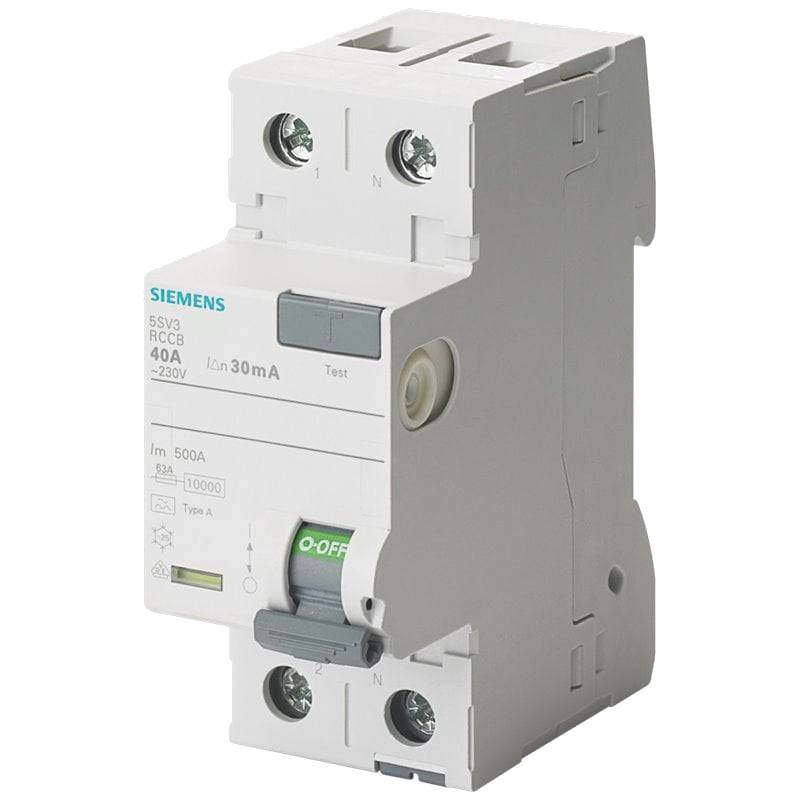
Siemens 5SV3311-6 Industrial Earth Leakage RCBO 2P 16A 30mA


The Siemens 5SV3311-6 Industrial Earth Leakage RCBO is a pivotal component for ensuring electrical safety and operational continuity in demanding industrial environments. This 2-pole, 16A, 30mA residual current circuit breaker with overcurrent protection offers robust defense against electrical faults, delivering enhanced protection for personnel and sensitive equipment. Its core advantages lie in its integrated function, combining circuit breaking, overload, and earth leakage protection into a single, reliable unit, thereby simplifying installation and reducing panel space. Key technical parameters include its 2-pole configuration, a rated current of 16A, and a rated residual operating current of 30mA, making it suitable for a wide range of applications where rapid detection and interruption of earth faults are critical.
Product Specifications
| Feature | Specification |
| :-------------------------- | :------------------------------------------- |
| Product Type | Residual Current Circuit Breaker with Overcurrent Protection (RCBO) |
| Pole Configuration | 2-pole |
| Rated Current (In) | 16 A |
| Rated Residual Operating Current (IΔn) | 30 mA |
| Rated Voltage (Un) | 230/240 V |
| Rated Breaking Capacity (Icn) | 6 kA |
| Frequency | 50/60 Hz |
| Tripping Type | Type AC |
| Protection Against Electric Shock | Automatic disconnection of supply |
| Short Circuit Withstand | High |
| Mounting Type | DIN rail |
| Operating Temperature | -25 to +45 °C |
| Compliance | IEC/EN 61009-1, IEC/EN 60898-1 |
Core Features & Market Positioning
The Siemens 5SV3311-6 stands out in the industrial market due to its inherent Siemens quality and advanced protection capabilities. It integrates the functions of an RCD (Residual Current Device) and a miniature circuit breaker (MCB) into a single, compact module, a significant differentiator that streamlines electrical panel design and installation. This integration minimizes wiring complexity and reduces the overall footprint, translating to cost savings and improved space utilization within control cabinets. Its Type AC tripping characteristic signifies its effectiveness in detecting sinusoidal AC residual currents, which are common in many industrial settings. The high breaking capacity of 6 kA ensures it can safely interrupt fault currents, providing a robust safety barrier. In the competitive landscape of industrial protection devices, the 5SV3311-6 is positioned as a reliable, high-performance solution for applications demanding stringent safety standards and dependable operation.
Key Application Scenarios
The Siemens 5SV3311-6 RCBO is ideally suited for protecting circuits in various industrial sectors where the risk of electrical shock or fire due to earth faults is a primary concern. It is commonly deployed in manufacturing plants to safeguard machinery circuits, ensuring that production lines are not disrupted by nuisance tripping while maintaining personnel safety. In building services and commercial installations, it provides essential protection for lighting and power circuits, particularly in areas with higher moisture levels or conductive surfaces. Furthermore, its application extends to renewable energy systems, such as solar installations, where it can protect inverter outputs and distribution boards from earth leakage faults. The 30mA sensitivity is specifically designed to offer personal protection, interrupting power swiftly in the event of an indirect contact.
Practical System Integration Guidance
Integrating the Siemens 5SV3311-6 into an industrial electrical system is straightforward due to its standard DIN rail mounting and clear terminal designations. For installation, ensure the main power supply is de-energized. The incoming live and neutral conductors from the supply are connected to the respective line terminals, while the outgoing conductors feeding the protected circuit are connected to the load terminals. The earth connection from the supply should be properly terminated at the distribution board's earth bar, and the circuit's earth conductor connected to the load side earth terminal of the RCBO if required by the specific wiring configuration and local regulations for supplementary protective bonding. Proper torque must be applied to the terminals to ensure a secure connection and prevent overheating. Commissioning involves performing a functional test using the integrated test button (often labeled "T") to verify that the RCBO trips correctly when simulating an earth fault. This test should be performed periodically as part of a routine maintenance schedule to ensure continued operational integrity.
Operation and Risk Mitigation
The Siemens 5SV3311-6 operates by continuously monitoring the balance of current flowing through the live and neutral conductors of a circuit. Should an imbalance occur, indicative of current leaking to earth, the RCBO's internal sensing mechanism detects this deviation. When the leakage current exceeds the rated residual operating current of 30mA, the RCBO rapidly trips, interrupting the circuit and disconnecting the power supply. This action significantly mitigates the risk of electric shock to individuals who may come into contact with a faulty appliance or wiring. It also reduces the risk of fire caused by persistent earth leakage currents that could overheat wiring. To mitigate risks, regular testing of the RCBO's tripping function using its test button is paramount. Furthermore, ensuring that the RCBO is correctly rated for the circuit's load and that the system is properly earthed according to standards are critical steps in risk management.
Scalability & Long-Term Value
The Siemens 5SV3311-6 RCBO offers excellent long-term value due to its robust construction and compatibility with Siemens' extensive range of electrical components. While the 5SV3311-6 itself is a specific unit, its integration into larger Siemens electrical systems allows for scalability. For instance, in a control panel, multiple 5SV3311-6 units can be installed alongside other Siemens circuit breakers and contactors, facilitating the expansion of protected circuits as system requirements grow. Its adherence to international standards ensures compatibility with components from other reputable manufacturers, offering flexibility in system design. For integration with IIoT and digital solutions, while this particular model does not have built-in smart communication, it can be part of a system where intelligent monitoring devices are installed upstream or downstream, or within a connected power distribution unit, providing data on circuit status and enabling remote diagnostics and predictive maintenance strategies.
FAQs
What is the primary function of the Siemens 5SV3311-6 RCBO?
It provides essential overcurrent and earth leakage protection. It safeguards against electrical shocks and potential fires. This combined protection simplifies installations significantly.
This device integrates MCB and RCD functions. It ensures personnel safety during faults. Its tripping ensures quick power interruption.
The 5SV3311-6 protects circuits effectively. It is vital for industrial environments. It ensures operational reliability and safety.
How do I correctly install the Siemens 5SV3311-6 RCBO?
Ensure the power supply is off before installation. Connect line and neutral conductors to the input terminals. Connect load conductors to the output terminals.
Terminals are clearly marked for correct wiring. Use appropriate torque for secure connections. Verify earth continuity in the circuit.
Mount the RCBO securely on a standard DIN rail. Follow local electrical codes and regulations. Proper installation ensures optimal performance.
What are the key technical specifications of the 5SV3311-6?
It is a 2-pole device with a 16A rated current. The residual operating current is 30mA. It has a 6kA breaking capacity.
The operating voltage is typically 230/240V AC. It operates at 50/60Hz frequency. It complies with IEC/EN standards.
Its tripping type is AC. It is designed for DIN rail mounting. It withstands harsh industrial conditions.
Can the Siemens 5SV3311-6 be used in residential applications?
Yes, it offers personal protection for homes. Its 30mA sensitivity is ideal for dwellings. It enhances safety in living spaces.
It can protect specific circuits like kitchens. It is suitable for areas with higher risk. Consult local electrical codes for use.
While designed for industrial use, it meets residential safety needs. It provides reliable fault detection. It ensures occupant safety.
What is the significance of the 30mA tripping current?
30mA is the standard for personal protection. It is sensitive enough to prevent serious injury. It interrupts faults before they become dangerous.
This current level is crucial for safety. It minimizes the risk of electrocution. It ensures rapid disconnection of power.
It detects smaller leakage currents. This prevents prolonged exposure to hazardous voltages. It provides a vital safety margin.
How often should the test button on the RCBO be used?
Regular testing is crucial for functionality. Test the RCBO monthly or quarterly. Always follow manufacturer recommendations.
Pressing the test button simulates a fault. It verifies the tripping mechanism works. It confirms protection is active.
Ensure power is on when testing. A tripped RCBO must be reset manually. If it fails to trip, replace it.
What causes an RCBO to trip unexpectedly?
Faulty wiring or damaged insulation can cause trips. Water ingress can create leakage paths. Appliance malfunctions are a common cause.
Overload conditions can also trigger it. Ensure the connected load doesn't exceed 16A. Check for faulty equipment.
Persistent moisture or corrosion can lead to trips. Test the unit to confirm it's not a false trip. Investigate the circuit for anomalies.
Is the Siemens 5SV3311-6 compatible with other brands' components?
It is generally compatible with standard DIN rail systems. Siemens products adhere to international standards. This ensures broad interoperability.
For full system integration, using Siemens components is recommended. This guarantees optimal performance. Check component datasheets for specifics.
Compatibility depends on voltage and current ratings. Consult system design documentation. Use reputable brands for safety.
What is the breaking capacity of the 5SV3311-6?
The breaking capacity is 6 kA. This indicates its ability to safely interrupt fault currents. It is suitable for many industrial circuits.
This rating ensures safety during short circuits. It prevents damage to the device. It protects downstream equipment.
A higher breaking capacity means greater protection. 6 kA is standard for many applications. Ensure it matches fault current levels.
How does this RCBO contribute to IIoT integration?
This specific model lacks direct IIoT connectivity. It can be monitored indirectly through system integration. Smart meters or gateways can add data capabilities.
By embedding it in a larger Siemens system, data can be collected. This enables remote monitoring and analytics. It supports predictive maintenance strategies.
Future Siemens products may offer direct IIoT features. Its reliability makes it a foundational component. It contributes to overall system safety and efficiency.