











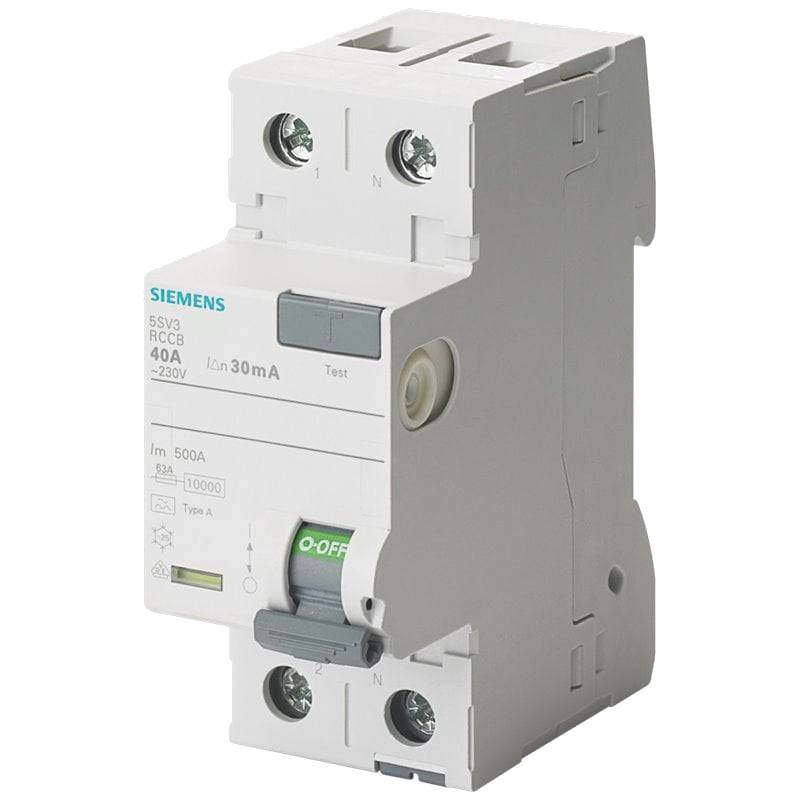
Siemens 5SV3312-6 High Breaking Capacity Earth Leakage RCBO 2P 25A 30mA


The Siemens 5SV3312-6 RCBO is a vital component for robust electrical protection, offering combined overcurrent and earth leakage fault detection in a compact 2P, 25A, 30mA configuration. This device excels in preventing electrical fires and mitigating shock hazards, making it indispensable for safeguarding personnel and equipment. Its high breaking capacity ensures reliable interruption of fault currents, a critical parameter for industrial and commercial installations.
| Parameter | Specification |
| :------------------------ | :-------------------------------------- |
| Product Type | Residual Current Circuit Breaker with Overcurrent Protection (RCBO) |
| Poles | 2 |
| Rated Current (In) | 25 A |
| Rated Residual Current (IΔn) | 30 mA |
| Breaking Capacity (Icn) | High |
| Voltage Rating | 230/400 V |
| Frequency | 50/60 Hz |
| Tripping Characteristic | Type AC |
| Protection Class | IP20 |
| Mounting Type | DIN rail |
| Compliance Standards | IEC/EN 61009-1, IEC/EN 60898-1 |
Core Features & Market Positioning
The Siemens 5SV3312-6 distinguishes itself through its superior reliability and comprehensive safety features, aligning with Siemens' reputation for engineering excellence in electrical distribution and protection. Its high breaking capacity (often rated at 6kA or higher, though specific Icn is application-dependent and requires verification from detailed datasheets) provides a significant safety margin in environments prone to high fault currents. This RCBO integrates the functions of a miniature circuit breaker (MCB) and a residual current device (RCD) into a single unit, optimizing panel space and simplifying installation. Market positioning favors this product in applications demanding stringent safety compliance and dependable fault interruption, such as in commercial buildings, industrial facilities, and demanding residential settings. The Type AC tripping characteristic signifies sensitivity to pulsating AC residual currents, a common requirement for general-purpose protection.
Key Application Scenarios
This Siemens 5SV3312-6 RCBO is ideally suited for protecting individual circuits from overcurrents and earth faults. Common applications include branch circuits for lighting, socket outlets, and specific equipment in commercial and industrial buildings where personal safety and fire prevention are paramount. Its 30mA sensitivity makes it effective for protecting against indirect contact in areas with increased electrical risk, such as workshops, kitchens, and bathrooms within residential or hotel applications. Furthermore, it is a standard choice for machine control panels and distribution boards in light manufacturing and processing plants, ensuring operational continuity by isolating faulty sections swiftly.
Practical System Integration Guidance
Integrating the Siemens 5SV3312-6 is straightforward due to its standard DIN rail mounting and familiar terminal configurations. Ensure the incoming live and neutral conductors are connected to the line terminals, and the outgoing conductors to the load terminals, observing correct polarity. Grounding of the protected circuit's equipment must be established through the main earthing system. For systems requiring multiple RCBOs, ensure adequate busbar connectivity and consider proper phase rotation if applicable in multi-phase installations. Always refer to the specific installation manual for detailed wiring diagrams and torque specifications to ensure secure connections, preventing overheating and potential failures.
Operation and Risk Mitigation
The 5SV3312-6 RCBO operates by continuously monitoring the balance of current flowing through the live and neutral conductors. If an imbalance, indicating leakage to earth (e.g., through a person or faulty insulation), exceeds 30mA, the device will trip, rapidly disconnecting the power supply. This fast action is crucial for preventing severe electric shock and mitigating the risk of fire caused by persistent earth faults. Regular testing using the integrated test button is essential to verify the operational integrity of the residual current detection function. In the event of a persistent trip, professional diagnosis of the protected circuit is required to identify and rectify the underlying fault before resetting the RCBO.
Scalability & Long-Term Value
Siemens electrical components are designed for interoperability within their robust electrical distribution systems. The 5SV3312-6 RCBO integrates seamlessly with other Siemens products, such as busbars, distribution boards, and complementary protective devices, facilitating system expansion. While RCBOs themselves are not typically "scaled" in the traditional sense, their inclusion in a well-designed electrical infrastructure ensures future-proofing against evolving safety standards and increasing power demands. Compatibility with Siemens' broader range of industrial automation and control solutions further enhances its long-term value, especially in facilities embracing digital transformation and IIoT integration.
Frequently Asked Questions
What is the breaking capacity of the Siemens 5SV3312-6 RCBO?
The Siemens 5SV3312-6 RCBO features a high breaking capacity, typically rated at 6kA, designed to safely interrupt significant fault currents. This rating ensures protection against short circuits in demanding environments. It is crucial for preventing catastrophic electrical failures and ensuring personnel safety.
What type of earth leakage is the 5SV3312-6 sensitive to?
This RCBO is designed with a Type AC tripping characteristic, meaning it is sensitive to pulsating AC residual currents. These are common in many AC electrical circuits. It reliably detects leakage currents that vary sinusoidally with the power frequency.
Can the 5SV3312-6 be used for DC leakage currents?
No, the Siemens 5SV3312-6, being a Type AC device, is not designed to detect pure DC residual currents. For applications involving DC components or potential DC leakage, a Type A or Type B RCBO would be required. Always confirm the electrical system's characteristics.
How often should the test button on the 5SV3312-6 be used?
It is recommended to test the functionality of the 5SV3312-6 RCBO using its integrated test button monthly. This simple test verifies the tripping mechanism and residual current detection. Consistent testing ensures the device remains operational for fault conditions.
What is the main advantage of using an RCBO over separate RCD and MCB?
An RCBO combines the functions of an RCD and MCB into a single unit, saving panel space and simplifying wiring. This integration reduces installation time and complexity. It provides both overcurrent and earth leakage protection from one device.
What are the implications of a 30mA residual current rating?
A 30mA rating signifies that the device will trip when a leakage current of 30 milliamperes or more is detected. This level is considered the threshold for preventing serious electric shock and protecting against fire hazards. It is a common standard for personal protection.
What is the pole configuration of the Siemens 5SV3312-6?
The Siemens 5SV3312-6 is a 2-pole (2P) device, meaning it interrupts both the live and neutral conductors simultaneously. This ensures complete isolation of the circuit during a fault. It is suitable for single-phase installations.
Does the 5SV3312-6 offer surge protection?
No, the 5SV3312-6 RCBO is primarily designed for overcurrent and earth leakage protection. It does not inherently provide surge protection against transient overvoltages. Separate surge protective devices (SPDs) are required for such applications.
What is the typical voltage rating for the Siemens 5SV3312-6?
The Siemens 5SV3312-6 is typically rated for use in circuits operating at 230V AC for single-phase applications, or up to 400V AC in certain configurations or compatible systems. Always verify the specific voltage rating against your installation requirements.
How does the 5SV3312-6 differentiate from a standard MCB?
A standard MCB only protects against overcurrents (overloads and short circuits). The 5SV3312-6 RCBO adds the critical function of detecting and interrupting earth leakage currents, providing enhanced safety against electric shock. It offers a dual layer of protection.