











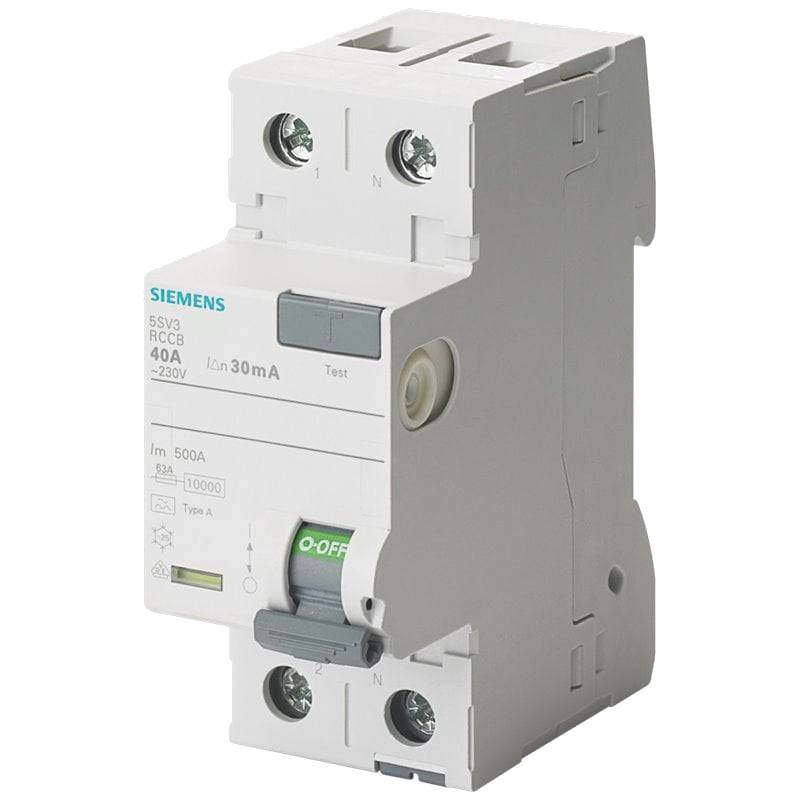
Siemens 5SV3312-6KK01 RCD Earth Leakage Protection Module 2P 25A 30mA


The Siemens 5SV3312-6KK01 RCD Earth Leakage Protection Module is a vital component for ensuring electrical safety in a wide range of industrial and commercial applications. This 2-pole, 25A, 30mA residual current device (RCD) offers advanced protection against indirect contact, fire hazards, and the risk of electric shock. Its robust design and adherence to stringent international standards make it a reliable choice for safeguarding personnel and equipment. Key advantages include its high breaking capacity, enhanced immunity to transient surges, and user-friendly installation features. Essential technical parameters include its rated voltage of 230/400V AC, rated frequency of 50/60 Hz, and a tripping current sensitivity of 30mA, designed to quickly detect and interrupt dangerous earth leakage currents.
Product Specifications
| Specification | Value |
| :--------------------- | :-------------------- |
| Product Type | RCD Earth Leakage Protection Module |
| Model Number | 5SV3312-6KK01 |
| Poles | 2 |
| Rated Current (In) | 25A |
| Rated Residual Current | 30mA |
| Rated Voltage (Ue) | 230/400V AC |
| Rated Frequency | 50/60 Hz |
| Breaking Capacity (Icn)| 6kA |
| Tripping Characteristic| Type AC |
| Protection Class | IP20 (enclosure) |
| Mounting Type | DIN Rail |
| Ambient Temperature | -25°C to +45°C |
| Standards Compliance | IEC/EN 61008-1 |
Core Features & Market Positioning
The Siemens 5SV3312-6KK01 distinguishes itself through its superior reliability and built-in surge immunity, a critical factor in environments prone to electrical disturbances. Its Type AC tripping characteristic ensures effective protection against sinusoidal alternating residual currents, a common fault type in industrial settings. Siemens' reputation for quality engineering and adherence to the rigorous IEC/EN 61008-1 standard places this RCD module at a high market position for safety-critical installations. The device's compact 2-pole design optimizes space within electrical panels, making it a practical choice for engineers prioritizing efficiency and performance.
Key Application Scenarios
This RCD module is ideally suited for protecting individual circuits in commercial buildings, manufacturing plants, and data centers. It is frequently specified for circuits supplying machinery, lighting systems, and sensitive electronic equipment where even minor earth leakage can pose a significant risk. In residential settings, it serves as a crucial safety device for circuits supplying bathrooms, kitchens, and outdoor power outlets, mitigating the increased risk of electric shock in wet environments. Its 30mA sensitivity is the standard for personal protection, ensuring rapid disconnection upon detection of potentially hazardous leakage currents.
Practical System Integration Guidance
Integrating the Siemens 5SV3312-6KK01 into existing electrical systems is straightforward due to its standard DIN rail mounting and clearly marked terminals. Wiring involves connecting the line and neutral conductors to the appropriate input terminals and routing the protected circuit to the output terminals. Proper earthing of the entire system remains paramount for effective RCD operation. Ensure that the incoming power supply voltage and frequency match the device's specifications (230/400V AC, 50/60 Hz). For multi-phase systems, appropriate RCD configurations or upstream protection should be considered.
Operation and Risk Mitigation
The primary function of the 5SV3312-6KK01 is to continuously monitor the balance of current flowing in the live and neutral conductors. If an imbalance occurs, indicating current is leaking to earth (e.g., through faulty insulation or accidental contact), the RCD rapidly trips, disconnecting the power supply. This immediate disconnection minimizes the duration and severity of electric shock, preventing serious injury or fatality. Regular testing via the integrated test button is crucial to ensure the RCD remains operational. If the RCD trips repeatedly, it indicates a persistent earth fault that requires immediate investigation and rectification to prevent fire hazards and equipment damage.
Scalability & Long-Term Value
While the 5SV3312-6KK01 is a standalone protection device, its compatibility with Siemens' broader range of SIVACON distribution boards and industrial switchgear ensures seamless integration into larger electrical infrastructure. This modularity allows for easy expansion of protection schemes as facility requirements evolve. The inherent robustness and high-quality manufacturing associated with Siemens products ensure a long service life, minimizing the need for premature replacement and contributing to the overall long-term value of the electrical installation. Its compliance with current international standards also future-proofs installations against evolving safety regulations.
Frequently Asked Questions
What is the primary function of the Siemens 5SV3312-6KK01 RCD?
This RCD module provides essential earth leakage protection. It safeguards against indirect electric shock hazards. It also protects against potential fire risks from insulation faults.
It continuously monitors current flow for imbalances. A significant imbalance triggers rapid power disconnection. This prevents dangerous currents from reaching people or equipment.
The device is designed for AC sinusoidal residual currents. Its 30mA sensitivity is standard for personal safety. It ensures quick intervention in fault scenarios.
What are the key technical specifications of this RCD?
This is a 2-pole device for single-phase circuits. It has a rated current of 25A. The rated residual operating current is 30mA.
Its rated voltage is 230/400V AC. The rated frequency is 50/60 Hz. It features a high breaking capacity of 6kA.
The tripping characteristic is Type AC. It mounts on a standard DIN rail. Protection class is IP20 for the enclosure.
Where is the Siemens 5SV3312-6KK01 typically installed?
It is commonly used in industrial and commercial electrical panels. It protects individual circuits for machinery and equipment. It is also suitable for lighting circuits in these environments.
In residential applications, it protects high-risk areas. Examples include bathrooms and kitchens. It also secures outdoor power outlets and circuits.
The 30mA sensitivity makes it ideal for personnel protection. It fulfills safety requirements for preventing electric shock. It is a crucial safety component for many applications.
How does this RCD protect against electric shock?
It detects imbalances in current flow. If current leaks to earth, it signifies a fault. This could be due to damaged insulation or contact.
When a leakage is detected, the RCD trips. It disconnects the power supply almost instantaneously. This rapid interruption prevents prolonged exposure to hazardous current.
The 30mA tripping threshold is set to be sensitive enough. It activates before a dangerous level of current can cause harm. It is a vital safety interlock.
What does "2P 25A 30mA" signify on the product?
"2P" denotes that it is a 2-pole device. This means it interrupts both the live and neutral conductors. It is suitable for single-phase systems.
"25A" is the rated current. This is the maximum continuous current the device can handle. It dictates the circuit size it can protect.
"30mA" is the rated residual operating current. This is the leakage current sensitivity. It is the value at which the RCD will trip.
Is this RCD suitable for high inrush current applications?
The 5SV3312-6KK01 is a Type AC RCD. These are sensitive to sinusoidal AC residual currents. They can sometimes be prone to nuisance tripping with high DC components.
For applications with significant DC leakage or high inrush currents that might include DC components, a Type A or Type F RCD might be more appropriate. Consult the specific application requirements.
However, for standard industrial and residential AC loads, this Type AC RCD offers robust protection. Its surge immunity helps mitigate some transient issues.
What are the installation requirements for this module?
Installation requires a standard 35mm DIN rail. The live and neutral conductors of the protected circuit connect to the input terminals. The load is then connected to the output terminals.
Ensure the incoming power supply matches the device's voltage and frequency ratings. Proper grounding of the entire electrical system is essential. Follow local electrical codes and regulations.
The terminals are clearly marked for correct connection. It is designed for easy integration into existing or new distribution boards.
How do I test the functionality of the Siemens 5SV3312-6KK01?
Each RCD module is equipped with a test button, usually marked "T". Pressing this button simulates an earth fault condition. This should cause the RCD to trip, disconnecting the power.
Regular testing, typically monthly, is recommended to ensure the RCD is operational. If the device does not trip during the test, it may be faulty and requires replacement.
Always ensure the circuit is re-energized safely after testing. If you are unsure about the testing procedure, consult a qualified electrician.
What is the breaking capacity of this RCD, and why is it important?
The breaking capacity (Icn) of this RCD is 6kA. This indicates the maximum fault current it can safely interrupt without sustaining damage. It is crucial for protecting the device and the electrical system during short-circuit events.
A higher breaking capacity ensures the RCD can handle potential fault currents in the installation. This prevents catastrophic failure of the RCD. It contributes to overall system safety and reliability.
The 6kA rating is standard for many residential and light industrial applications. It is important to ensure this rating is adequate for the specific installation's fault current potential.
Can this RCD be used in DC circuits?
No, the Siemens 5SV3312-6KK01 is designed for AC circuits only. Specifically, it is a Type AC RCD, meaning it responds to sinusoidal alternating residual currents.
It is not designed to detect or respond to pure DC leakage currents. Using it in DC circuits can lead to unpredictable behavior and failure to provide protection.
For applications involving DC components or pure DC circuits, specific DC-compatible RCDs or protective devices are required. Always ensure the RCD type matches the circuit's current characteristics.