











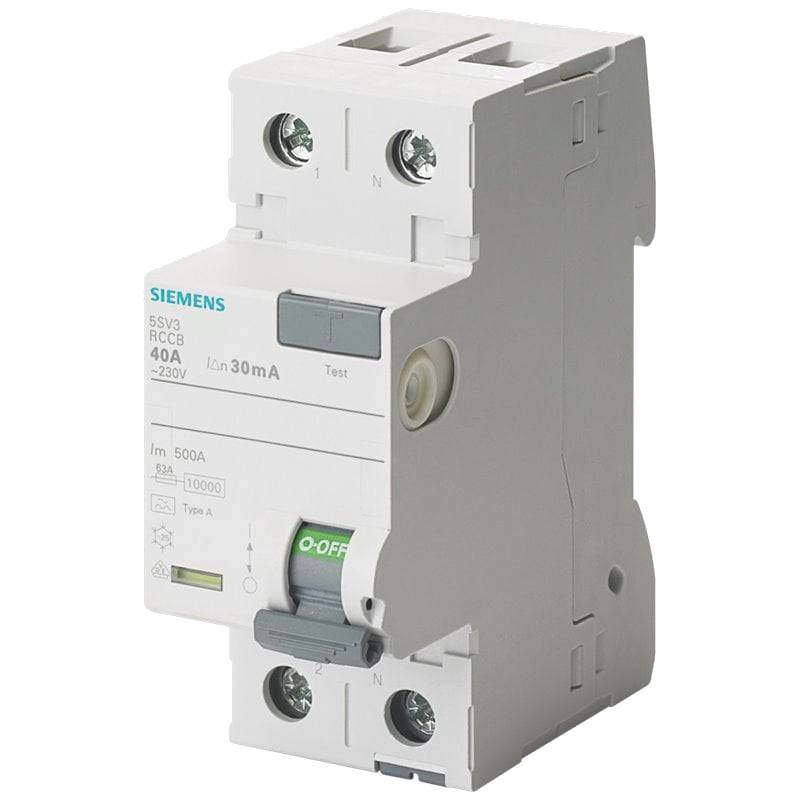
Siemens 5SV3321-4 Industrial Earth Leakage RCBO Isolator 2P 16A 30mA


The Siemens 5SV3321-4 is a robust 2-pole, 16A, 30mA Earth Leakage RCBO (Residual Current Breaker with Overcurrent Protection) designed for superior electrical safety and reliable circuit protection in demanding industrial environments. Its primary advantage lies in its dual functionality, integrating residual current detection and overcurrent protection into a single, space-saving unit. This RCBO offers a tripping sensitivity of 30mA, making it highly effective in preventing electric shock hazards and mitigating fire risks caused by earth faults. Key technical parameters include a rated voltage of 230/240V AC and a breaking capacity of 6kA, ensuring it can safely interrupt fault currents.
Product Specifications
| Feature | Specification |
| :-------------------------- | :------------------------------------------------- |
| Product Type | Residual Current Circuit Breaker with Overcurrent Protection (RCBO) |
| Manufacturer | Siemens |
| Model Number | 5SV3321-4 |
| Number of Poles | 2 |
| Rated Current (In) | 16A |
| Rated Residual Operating Current (IΔn) | 30mA |
| Rated Voltage (Ue) | 230/240V AC |
| Rated Breaking Capacity (Icn) | 6kA |
| Tripping Type | Type AC |
| Mounting Type | DIN Rail |
| Frequency | 50/60 Hz |
| Protection Class | IP20 |
| Operating Temperature | -25°C to +45°C |
Core Features & Market Positioning
The Siemens 5SV3321-4 distinguishes itself through its high-quality construction and adherence to stringent international safety standards, a hallmark of Siemens industrial products. This RCBO is positioned as a critical component for ensuring personnel safety and equipment protection in a wide array of electrical installations. Its integrated design reduces complexity and installation time compared to separate RCDs and MCBs, offering a cost-effective and space-efficient solution. The Type AC tripping characteristic is standard for detecting sinusoidal AC residual currents, suitable for most general industrial applications.
Key Application Scenarios
This Siemens RCBO is ideal for protecting individual circuits where personnel are at risk of electric shock, such as in machine tool circuits, control panels, and general lighting and power distribution in workshops, manufacturing plants, and commercial buildings. It is particularly valuable in areas with increased risk of earth faults, like damp environments or where conductive materials are prevalent. The 16A rating makes it suitable for circuits with moderate power requirements, ensuring reliable operation without nuisance tripping under normal load conditions.
Practical System Integration Guidance
Installation of the Siemens 5SV3321-4 RCBO follows standard DIN rail mounting procedures. Ensure the incoming power supply (line and neutral) is correctly connected to the respective terminals, and the outgoing load connections are made to the downstream terminals. Proper earthing of the circuit being protected is paramount for the RCBO's effective operation. For optimal performance and safety, always adhere to local electrical codes and regulations during installation.
Operation and Risk Mitigation
The RCBO operates by continuously monitoring the balance of current flowing in the line and neutral conductors. If an imbalance exceeding 30mA occurs, indicating current leaking to earth, the device rapidly trips, disconnecting the circuit and preventing potential harm. This rapid tripping mechanism is crucial for mitigating risks of electric shock, fires caused by arcing faults, and damage to sensitive equipment. In the event of a fault, the toggle will move to the OFF position, clearly indicating a trip has occurred.
Scalability & Long-Term Value
While the 5SV3321-4 is a single-unit protection device, its integration into a larger Siemens electrical distribution system offers inherent scalability. It is compatible with other Siemens circuit protection devices and switchgear, allowing for expansion and modification of electrical installations as needs evolve. Its robust design ensures long-term reliability and performance, minimizing downtime and maintenance costs, thereby providing excellent long-term value in industrial settings.
Frequently Asked Questions
1. What is the primary function of the Siemens 5SV3321-4 RCBO?
This RCBO provides combined protection against overcurrents and earth leakage faults. It safeguards personnel from electric shock hazards by detecting residual currents.
It also protects electrical equipment and installations from damage caused by overloads and short circuits. The device ensures circuit integrity and operational safety.
The Siemens 5SV3321-4 offers a compact, two-pole solution for efficient panel building and simplified wiring.
2. Can the Siemens 5SV3321-4 be used for AC and DC fault currents?
The 5SV3321-4 is specifically designed as a Type AC residual current device. This means it is intended for detecting sinusoidal AC residual currents.
It is not designed to detect or protect against pulsating DC residual currents or pure DC residual currents. Using it in such scenarios may lead to ineffective protection.
For applications requiring detection of DC components, specific types of RCDs or RCBOs (e.g., Type A or Type B) would be necessary.
3. What is the significance of the 30mA tripping sensitivity on this RCBO?
A 30mA residual current is generally considered the threshold for preventing severe electric shock to humans. This sensitivity level provides crucial protection against potentially lethal currents.
This tripping value is standard for personal protection and is often a requirement in many electrical installation standards and regulations worldwide. It ensures rapid disconnection upon fault detection.
It also helps to mitigate fire risks originating from persistent earth faults, which might not be detected by overcurrent protection alone.
4. How does the 6kA breaking capacity benefit industrial applications?
The 6kA breaking capacity indicates the maximum fault current the RCBO can safely interrupt without being destroyed. This is crucial for industrial settings where fault currents can be high.
This specification ensures the device can withstand and safely clear short-circuit faults, preventing widespread damage to the electrical system and potential hazards to personnel.
It guarantees that the device will operate as intended during a fault, providing reliable protection and maintaining the overall safety of the installation.
5. What wiring configurations are supported by the 2-pole design?
The 2-pole design means it protects and switches both the line (phase) and neutral conductors simultaneously. This is essential for effective protection against earth faults.
This configuration is suitable for single-phase AC circuits commonly found in industrial and commercial power distribution systems. It ensures complete disconnection of the circuit.
Proper connection of both line and neutral is critical for the residual current detection function to operate correctly and safely.
6. How does an RCBO differ from a standard MCB (Miniature Circuit Breaker)?
A standard MCB primarily offers protection against overcurrents (overloads and short circuits). It does not detect or react to earth leakage faults.
An RCBO, like the Siemens 5SV3321-4, integrates the functions of an MCB and an RCD (Residual Current Device). It provides both overcurrent and earth leakage protection.
This dual functionality makes RCBOs a more comprehensive safety solution, especially in applications where personnel safety from electric shock is a primary concern.
7. What is the recommended operating temperature range for this Siemens RCBO?
The Siemens 5SV3321-4 is rated for operation within an ambient temperature range of -25°C to +45°C. Adhering to this range ensures optimal performance and longevity.
Operating outside this specified temperature range can affect the tripping characteristics and lifespan of the device, potentially leading to nuisance tripping or failure to trip.
Ensuring adequate ventilation around the installed RCBOs is crucial, especially in enclosed distribution boards, to maintain the temperature within the specified limits.
8. Can the Siemens 5SV3321-4 be used for load shedding or remote switching?
No, the Siemens 5SV3321-4 is a mechanical switching device designed for fault protection only. It does not have integrated capabilities for remote operation or automated load shedding.
Its operation is purely automatic in response to overcurrent or earth leakage faults, and manual operation via the toggle switch is the only form of user control.
For applications requiring remote control or intelligent load management, separate control systems or smart devices would need to be integrated into the electrical infrastructure.
9. What does "Type AC" tripping mean for the 5SV3321-4?
"Type AC" signifies that this RCBO is designed to detect alternating current (AC) residual currents that have a sinusoidal waveform. This is the most common type of residual current.
It may not reliably detect residual currents with a DC component, such as those that can occur with certain types of electronic equipment or rectifiers.
For enhanced protection against pulsating DC residual currents, Type A devices are available, and for pure DC detection, Type B would be required.
10. How do I reset the Siemens 5SV3321-4 after it has tripped?
After the RCBO has tripped due to an earth leakage or overcurrent fault, the toggle switch will be in the 'OFF' position.
To reset, first ensure the fault condition has been identified and rectified. Then, firmly move the toggle switch to the 'ON' position.
If the RCBO trips again immediately after resetting, it indicates that the fault condition still persists and requires further investigation by a qualified electrician.