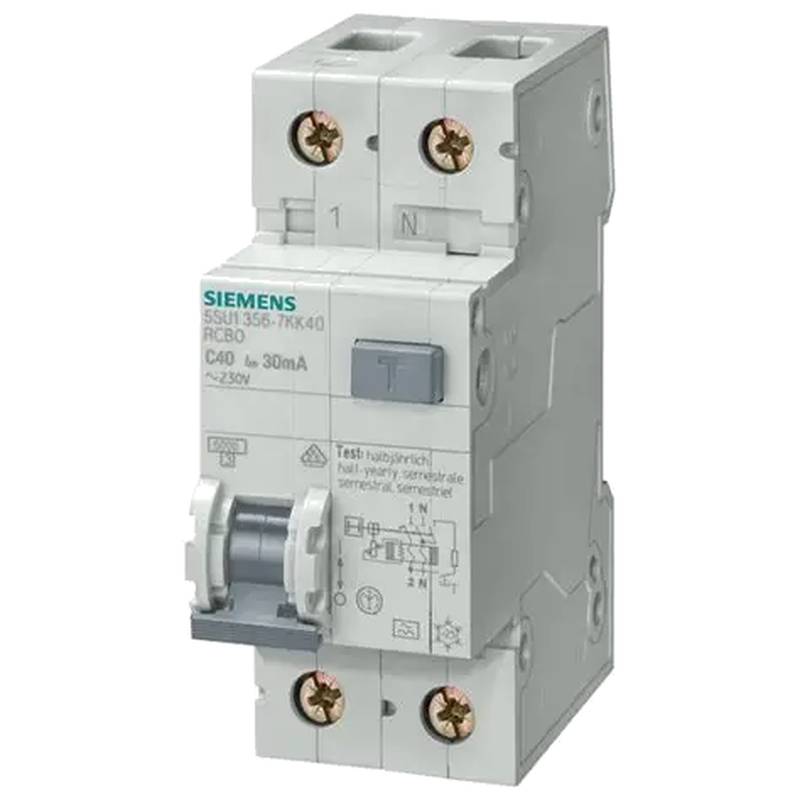












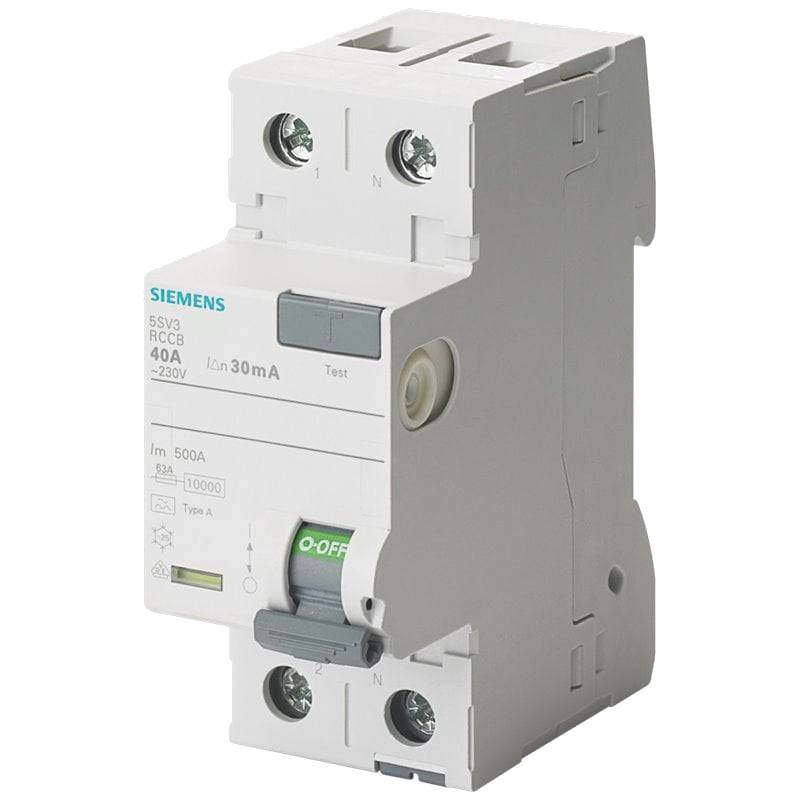
Siemens 5SV3617-6KK01 RCBO with Overcurrent Protection 2P 80A 300mA


The Siemens 5SV3617-6KK01 RCBO is a critical component for safeguarding electrical installations against overcurrents and residual currents. This 2-pole, 80A, 300mA device combines the functions of a Miniature Circuit Breaker (MCB) and a Residual Current Device (RCD) in a single unit, offering enhanced safety, space savings, and simplified wiring. Its robust design and adherence to stringent industry standards make it a reliable choice for protecting both personnel and equipment from electrical hazards.
Product Specifications
| Feature | Specification |
| :----------------------- | :-------------------------------- |
| Product Type | RCBO (Residual Current Circuit Breaker with Overcurrent Protection) |
| Manufacturer | Siemens |
| Model Number | 5SV3617-6KK01 |
| Number of Poles | 2 |
| Rated Current (In) | 80A |
| Rated Residual Current (IΔn) | 300mA |
| Breaking Capacity (Icn) | 6 kA |
| Tripping Characteristic | Type A |
| Frequency | 50/60 Hz |
| Voltage Rating (Ue) | 230/400V AC |
| Mounting Type | DIN Rail |
| Compliance Standards | IEC/EN 61009-1, IEC/EN 60898-1 |
Core Features & Market Positioning
The Siemens 5SV3617-6KK01 distinguishes itself through its high breaking capacity of 6 kA, ensuring it can safely interrupt fault currents even in demanding industrial environments. As a Type A device, it offers protection against AC and pulsating DC residual currents, which are common in modern electronic equipment. Its combined MCB and RCD functionality in a single pole pair simplifies panel design and reduces installation time and cost compared to using separate devices. This integrated approach positions the 5SV3617-6KK01 as a cost-effective and efficient solution for critical circuit protection where both overcurrent and earth leakage faults need to be addressed. Its global recognition and adherence to IEC/EN standards further solidify its market standing as a dependable and internationally accepted protective device.
Key Application Scenarios
This RCBO is ideally suited for a wide array of industrial and commercial applications where reliable protection is paramount. It is commonly employed in distribution boards for safeguarding circuits supplying machinery, control panels, and lighting systems in manufacturing plants, workshops, and data centers. Its 300mA sensitivity is appropriate for general circuit protection, preventing fires and providing protection against indirect contact in areas with higher risk. Applications include protecting circuits in areas with increased risk of fire, such as those with combustible materials, and as a secondary protection for circuits where personal protection is a primary concern. Furthermore, it is valuable in installations requiring compliance with specific electrical safety regulations for industrial facilities.
Practical System Integration Guidance
Integrating the Siemens 5SV3617-6KK01 RCBO into existing or new electrical systems is straightforward due to its standard DIN rail mounting. Ensure the main power supply conductors are connected to the line terminals and the outgoing circuit conductors are connected to the load terminals. The neutral conductor should be connected to the designated neutral terminal. It is crucial to observe correct polarity to ensure proper functionality of both overcurrent and residual current protection. For systems requiring specific coordination with upstream or downstream protective devices, consult the relevant load flow diagrams and selectivity tables provided by Siemens to ensure reliable fault discrimination. Always verify that the incoming power supply voltage and frequency are within the specified operating range of the RCBO.
Operation and Risk Mitigation
The Siemens 5SV3617-6KK01 operates by continuously monitoring the current flowing through its live conductors. If an imbalance occurs, indicating a leakage current to earth exceeding the 300mA threshold, the device will rapidly trip, interrupting the power supply. Similarly, if the current exceeds the rated 80A due to an overload or short circuit, the overcurrent protection mechanism will activate and trip. To mitigate risks, ensure proper installation by qualified electricians, regular testing of the RCD function (typically via the "T" or "Test" button), and avoid overloading circuits beyond the device's rated capacity. Understanding common fault scenarios, such as insulation degradation or equipment failure, will help in diagnosing potential issues and preventing recurrences.
Scalability & Long-Term Value
The Siemens 5SV3617-6KK01 RCBO offers robust long-term value through its compatibility with the broader Siemens SENTRON protection device portfolio. This ensures seamless integration with other Siemens components, facilitating future system expansions or upgrades. Its modular design allows for easy replacement if required, minimizing downtime. While not directly programmable for IIoT integration, its reliable performance contributes to the overall stability of connected smart systems. Its durable construction and adherence to international standards mean it will remain a compliant and effective protective device for many years, offering a reliable foundation for evolving electrical infrastructure requirements.
FAQs
What is the primary function of the Siemens 5SV3617-6KK01 RCBO?
This RCBO provides combined protection against overcurrents and earth leakage faults. It acts as both an MCB and an RCD.
It safeguards electrical circuits from damaging overloads and short circuits. It also detects and interrupts dangerous residual currents, preventing electric shock.
This dual functionality enhances safety and simplifies electrical panel design and installation.
Can the Siemens 5SV3617-6KK01 be used in residential applications?
While rated for industrial use, its 300mA sensitivity is also suitable for certain residential circuits. It's ideal for main distribution boards.
It offers enhanced safety, especially for circuits with increased risk of fire or shock. Check local codes for specific residential requirements.
The 2-pole configuration makes it suitable for single-phase circuits common in homes.
What is the significance of the 300mA residual current rating?
The 300mA rating indicates the leakage current level that triggers the device. This is a common sensitivity for fire protection.
It is designed to prevent fires caused by persistent earth faults. It also provides protection against indirect contact.
This value is higher than personal protection RCDs (typically 30mA) but suitable for general circuit protection.
What does the "2P" designation mean for this Siemens RCBO?
"2P" signifies that the RCBO has two poles, meaning it switches both the live and neutral conductors. This is crucial for complete circuit isolation.
It ensures that when the device trips, both the live and neutral lines are disconnected, enhancing safety during maintenance.
This configuration is standard for circuits that require a neutral disconnection, unlike single-pole devices.
How does the 6 kA breaking capacity benefit an electrical installation?
A 6 kA breaking capacity means the RCBO can safely interrupt fault currents up to 6000 Amperes. This prevents severe damage during short circuits.
This high breaking capacity is essential for installations where high fault currents are possible, such as in industrial settings.
It ensures the device operates reliably and safely when faced with major electrical faults, protecting equipment and personnel.
What type of overcurrent protection does the Siemens 5SV3617-6KK01 offer?
It provides protection against both overload and short-circuit conditions. This is indicated by its MCB function.
The tripping characteristic (e.g., B, C, D) determines how quickly it responds to overcurrents. The 5SV3617-6KK01 has a Type A tripping characteristic.
This ensures that the circuit is protected from excessive current that could cause overheating and fire hazards.
How is the Siemens 5SV3617-6KK01 installed on a DIN rail?
Installation involves snapping the RCBO onto a standard 35mm DIN rail within an electrical enclosure. Ensure the rail is securely mounted.
Connect the incoming power supply to the line terminals and the outgoing load to the load terminals. Observe correct polarity for live and neutral connections.
Proper torque should be applied to the terminals to ensure a secure and reliable connection, preventing overheating.
What is the meaning of "Type A" for this RCBO?
"Type A" refers to the RCBO's sensitivity to different types of residual currents. It detects AC and pulsating DC residual currents.
This makes it suitable for modern installations with electronic equipment that can generate pulsating DC leakage.
It offers broader protection than Type AC devices, which only detect AC residual currents.
Where are Siemens RCBOs commonly used in industrial environments?
They are widely used in main distribution boards and sub-distribution boards in factories and plants. They protect individual circuits feeding machinery.
These devices are essential for safeguarding control cabinets, lighting circuits, and power outlets in commercial buildings.
Their combination of overcurrent and residual current protection makes them suitable for areas with higher fire risk or where personnel safety is critical.
Does the Siemens 5SV3617-6KK01 require regular testing?
Yes, it is crucial to test the residual current function regularly using the built-in test button. This ensures the RCD mechanism is operational.
Follow manufacturer recommendations for test frequency, typically monthly. This is a vital safety check.
Testing confirms that the device will trip correctly in the event of an earth leakage fault, maintaining protection.