











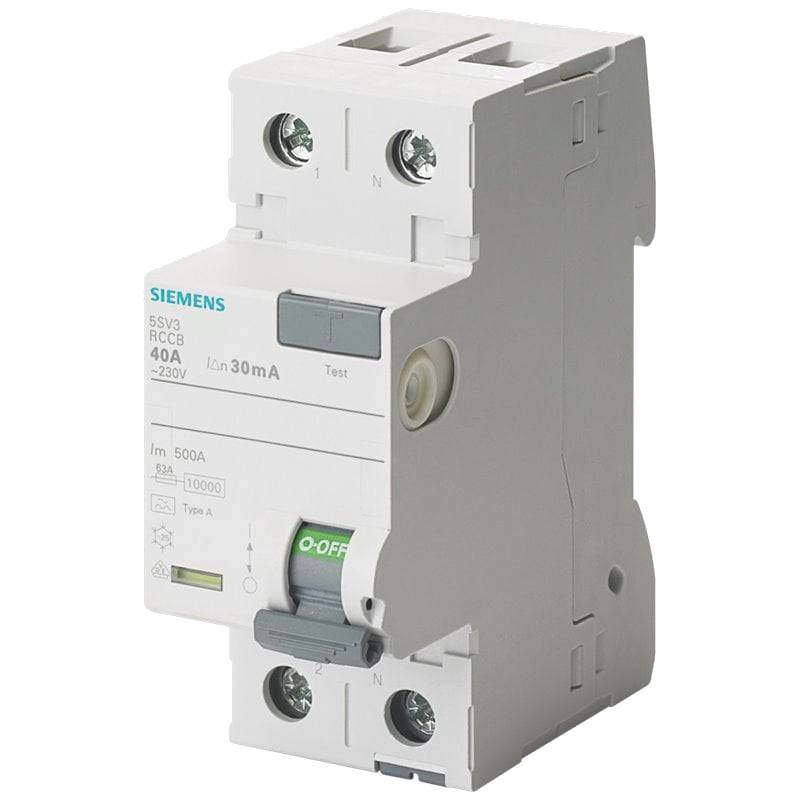
Siemens 5SV4311-0 Residual Current Earth Leakage Circuit Breaker 2P 16A 30mA


The Siemens 5SV4311-0 is a 2-pole, 16A residual current circuit breaker (RCCB) with a 30mA sensitivity, designed to provide crucial protection against electric shock and fire hazards caused by earth faults. This advanced device integrates seamlessly into modern electrical installations, offering enhanced safety and reliability. Its core advantages lie in its robust construction, precise tripping characteristics, and compliance with stringent international safety standards. Key technical parameters include a rated current of 16A, a rated residual operating current of 30mA, and a 2-pole configuration, making it suitable for a wide range of residential and commercial applications.
Product Specifications
| Feature | Specification |
| :---------------------------- | :------------------------------------------- |
| Product Type | Residual Current Circuit Breaker (RCCB) |
| Manufacturer | Siemens |
| Model Number | 5SV4311-0 |
| Number of Poles | 2 |
| Rated Current (In) | 16 A |
| Rated Residual Operating Current (IΔn) | 30 mA |
| Rated Voltage (Un) | 230/400 V |
| Rated Frequency | 50/60 Hz |
| Tripping Characteristic | Type AC |
| Breaking Capacity (Icn) | 6 kA |
| Protection Class | IP20 (device), IP40 (enclosure) |
| Mounting Type | DIN rail |
| Standard | IEC/EN 61008-1 |
Core Features & Market Positioning
The Siemens 5SV4311-0 stands out in the market due to its exceptional reliability and adherence to superior manufacturing standards synonymous with the Siemens brand. Its Type AC tripping characteristic ensures effective detection of sinusoidal alternating residual currents, a common fault type in many electrical systems. The compact design allows for space-saving installation within distribution boards, while the high breaking capacity of 6 kA provides robust protection against short-circuit currents. This combination of features positions the 5SV4311-0 as a premium, cost-effective solution for safeguarding personnel and property against electrical hazards, making it a preferred choice for electricians and system designers prioritizing safety and performance.
Key Application Scenarios
This 2P 16A 30mA RCCB is extensively deployed in residential buildings for protecting circuits supplying lighting, sockets, and small appliances where the risk of electric shock is a primary concern. In commercial settings, it is vital for protecting individual circuits in offices, retail spaces, and hotels, ensuring compliance with electrical safety regulations and minimizing downtime. Furthermore, the Siemens 5SV4311-0 finds application in industrial environments for specific localized protection tasks, such as safeguarding equipment in control panels or protecting circuits in areas with higher moisture levels, where its 30mA sensitivity offers an essential layer of personal protection.
Practical System Integration Guidance
Integrating the Siemens 5SV4311-0 into existing electrical systems is straightforward due to its standard DIN rail mounting and familiar terminal configuration. For a 2-pole unit, the line (L) and neutral (N) conductors must be connected to the designated input terminals, typically on the left side, while the output terminals on the right feed the protected circuit. Ensuring the neutral conductor is correctly routed is critical for proper operation; it must be connected to the breaker and not bypassed. A proper ground (earth) connection to the distribution board's grounding busbar is essential for the overall safety of the installation, though the RCCB itself does not directly interrupt the earth connection but rather monitors the imbalance current.
Operation and Risk Mitigation
The primary function of the Siemens 5SV4311-0 is to detect earth leakage currents exceeding 30mA and rapidly disconnect the power supply, thereby preventing dangerous situations such as electric shock and fires. In the event of an earth fault, the breaker compares the current flowing in the line conductor with that flowing in the neutral conductor. If a difference (leakage current) is detected, the internal tripping mechanism is activated, opening the circuit. Common troubleshooting involves checking for faulty appliances or wiring that may be causing the leakage. If nuisance tripping occurs without an apparent fault, it may indicate a sensitive circuit or a need for a higher rated residual current device if permitted by local regulations and system design.
Scalability & Long-Term Value
While the Siemens 5SV4311-0 is a standalone protection device, its value is enhanced through compatibility with the broader Siemens SENTRON portfolio. This allows for seamless integration into comprehensive electrical distribution systems, ensuring consistent protection and operational efficiency. For future-proofing, installations utilizing this RCCB can readily accommodate upgrades to more advanced protection devices or smart monitoring systems that leverage communication protocols if the distribution board and connected infrastructure support it. Its robust design and adherence to international standards ensure long-term reliability, minimizing the need for premature replacements and contributing to the overall stability of the electrical infrastructure.
FAQs
What is the main purpose of the Siemens 5SV4311-0?
The Siemens 5SV4311-0 is designed to protect electrical circuits from earth leakage faults. It detects imbalances in current flow. This prevents electric shock hazards to people.
It acts as a critical safety device in electrical installations. It provides protection against fire caused by insulation failures. Its 30mA sensitivity is ideal for personal protection.
This residual current circuit breaker ensures compliance with safety standards. It safeguards both individuals and property from electrical dangers. It is a fundamental component of modern safe electrical systems.
How does the 30mA sensitivity of the 5SV4311-0 protect users?
A 30mA residual current is the maximum level considered safe for human contact. The breaker trips rapidly if leakage exceeds this threshold. This minimizes the duration and severity of electric shock.
This sensitivity is crucial for preventing serious injury or fatality from electrocution. It is particularly important for circuits in wet areas like bathrooms. It provides an essential layer of personal safety.
By interrupting the circuit within milliseconds, it significantly reduces the risk of muscle contractions. This allows a person to let go of a live object. It is a life-saving feature.
Can the Siemens 5SV4311-0 be used for overload protection?
No, the 5SV4311-0 is specifically a residual current circuit breaker. It primarily protects against earth leakage. It does not offer overcurrent or short-circuit protection.
For combined overcurrent and earth leakage protection, a residual current circuit breaker with overcurrent protection (RCBO) is required. This device integrates both functions in a single unit. Always select the correct device for the required protection.
Overload and short-circuit protection are typically provided by a miniature circuit breaker (MCB) or a fuse. The 5SV4311-0 works in conjunction with these devices for full electrical safety.
What is the correct wiring method for the Siemens 5SV4311-0?
The line (L) and neutral (N) conductors are connected to the input terminals, usually on the left side. The protected circuit's L and N conductors are then connected to the output terminals on the right. Always follow local wiring regulations.
Ensure the neutral conductor is correctly routed through the breaker. Bypassing the neutral connection will render the device ineffective. The device is designed for AC circuits only.
Proper grounding of the entire installation is paramount for safety. Connect the distribution board to the main earthing terminal. The RCCB monitors current imbalance; it does not protect the ground path itself.
What does "2P" signify on the Siemens 5SV4311-0?
"2P" denotes that the circuit breaker has two poles. These poles are for the live (line) and neutral conductors. It is designed to interrupt both conductors simultaneously.
This two-pole configuration ensures complete isolation of the circuit. It is essential for safety in single-phase systems. It prevents dangerous situations with floating neutral conductors.
Single-pole RCCBs are not common in many regions for this type of protection. The 2P design is standard for domestic and light commercial applications. It provides robust switching of single-phase circuits.
What is the significance of "16A" for this breaker?
"16A" indicates the rated current carrying capacity of the breaker. It means the circuit can handle a continuous load of up to 16 amperes. Do not exceed this current rating for the protected circuit.
Exceeding 16A can cause overheating and potential damage. It may also lead to nuisance tripping if the load is consistently high. Select the breaker's rating based on the circuit's expected maximum load.
This rating ensures the breaker itself is protected from damage. It also contributes to the overall safety of the circuit. Ensure all connected devices' power consumption is within this limit.
What is a "Type AC" tripping characteristic, and is it suitable for all applications?
Type AC tripping characteristics detect sinusoidal alternating residual currents. These are commonly encountered in standard AC power systems. It is the most basic and widely used type for general applications.
This type is suitable for most residential and commercial lighting and socket circuits. It effectively protects against shocks from alternating current faults. However, it may not be ideal for all electronic equipment.
For circuits with sensitive electronic devices or DC residual currents, Type A or Type F breakers may be more appropriate. Always consult electrical codes and equipment manufacturer recommendations for specific needs.
How do I reset the Siemens 5SV4311-0 after it trips?
After a trip, identify and rectify the cause of the earth leakage fault. Once the fault is cleared, the breaker can be reset by firmly pushing the switch lever upwards. Ensure the lever clicks into the ON position.
If the breaker trips again immediately after resetting, do not force it. This indicates the fault is still present and needs further investigation. Consult a qualified electrician if the cause is not apparent.
Always ensure your hands are dry and you are in a safe, non-conductive position before attempting to reset any circuit breaker. Safety should always be the top priority.
What are the installation requirements for the Siemens 5SV4311-0?
The 5SV4311-0 is designed for mounting on a standard 35mm DIN rail within an electrical distribution board. Ensure adequate ventilation around the device. It is rated for indoor use and protected against solid objects greater than 1mm.
The ambient temperature range for operation is typically between -25°C and +45°C. Follow the manufacturer's guidelines for proper terminal torque settings. Improper installation can compromise safety and performance.
Ensure the incoming live and neutral conductors are connected to the correct terminals. The breaker must be installed by a qualified electrician. Adherence to local electrical codes and standards is mandatory.
Where can I find replacement parts or accessories for the Siemens 5SV4311-0?
Replacement parts for the 5SV4311-0 are typically available through authorized Siemens distributors and electrical wholesalers. Specific replacement components for RCCBs are rare; usually, the entire unit is replaced if faulty. You can also find compatible busbars and enclosures from Siemens.
Check with your local electrical supply store or online retailers specializing in Siemens industrial components. Provide the exact model number when inquiring about availability. They can guide you to the correct product.
Accessories like labeling tags or auxiliary contacts (if compatible with the series) can enhance functionality. Always ensure any accessory is certified for use with this specific Siemens breaker model.