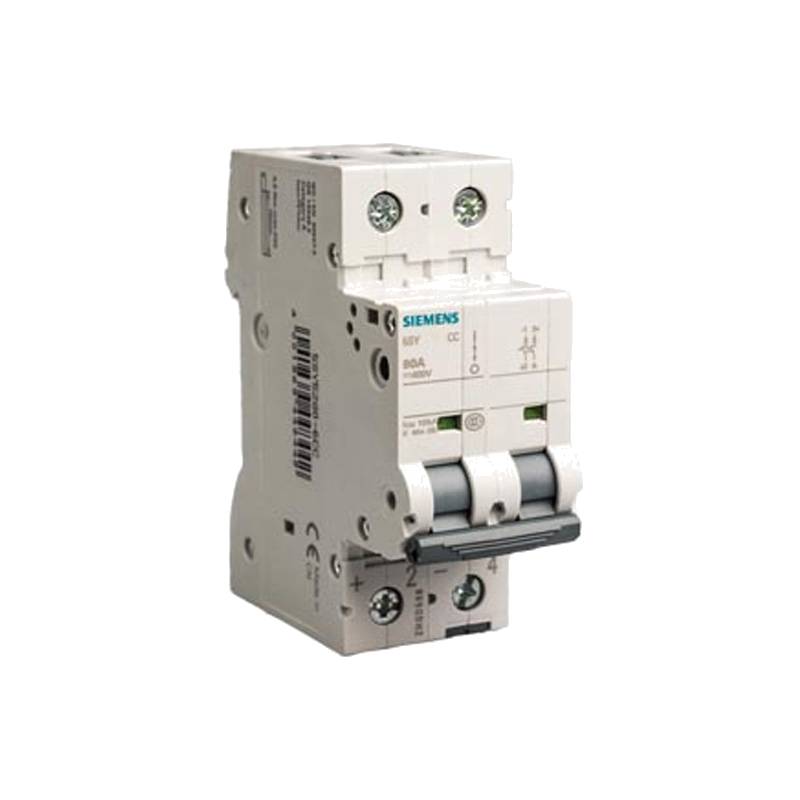












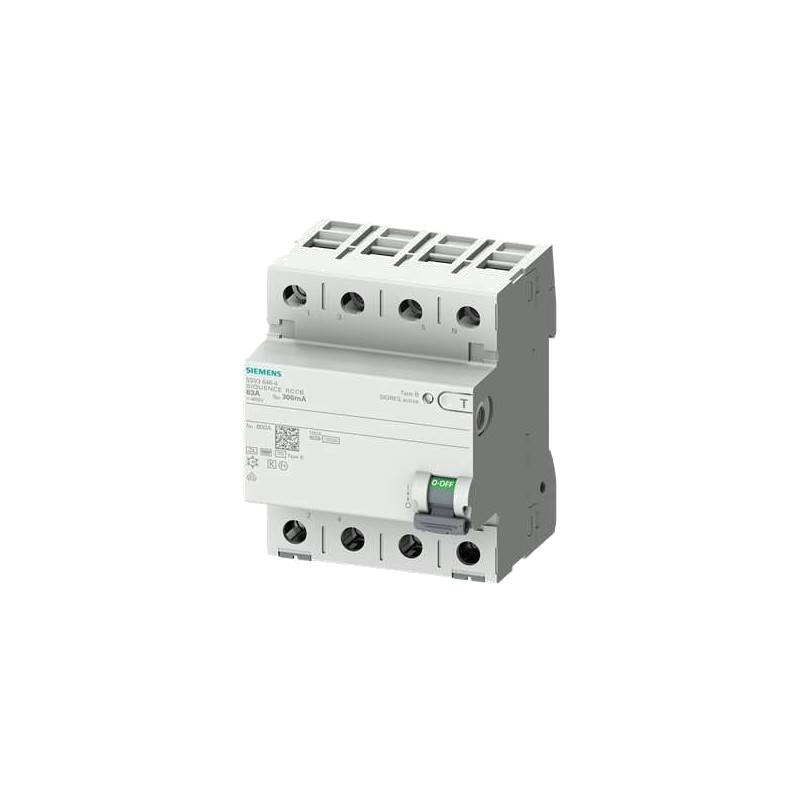
Siemens 5SV3746-6 Miniature Circuit Breaker 4P 63A 500mA


The Siemens 5SV3746-6 Miniature Circuit Breaker (MCB) is a robust, four-pole, 63A, 500mA residual current device (RCD) designed for superior electrical protection in demanding industrial and commercial environments. Its advanced tripping characteristics and high breaking capacity ensure reliable safeguarding against overcurrents and earth faults, minimizing downtime and enhancing operational safety. This MCB features a compact design for efficient panel space utilization and is built with Siemens' renowned quality for long-term performance and peace of mind.
Product Specifications
| Feature | Specification |
| :----------------------- | :------------------------------------------- |
| Product Type | Miniature Circuit Breaker (MCB) with RCD |
| Pole Configuration | 4-Pole |
| Rated Current (In) | 63 A |
| Residual Current (IΔn) | 500 mA |
| Breaking Capacity (Icn) | 6 kA (IEC 60898-1) |
| Tripping Curve | Type C |
| Voltage Rating (Ue) | 400 V AC |
| Frequency | 50/60 Hz |
| Operating Temperature | -25 °C to +45 °C |
| Protection Class | IP20 (Terminals), IP40 (Enclosure) |
| Mounting | DIN Rail (EN 60715) |
| Terminal Type | Screw Terminals |
| Compliance | IEC 60898-1, IEC 61008-1, IEC 61009-1 |
Core Features & Market Positioning
The Siemens 5SV3746-6 stands out due to its integrated residual current protection, offering a two-in-one solution that simplifies installations and reduces component count. Its Type C tripping characteristic provides excellent protection against inductive loads, a common requirement in industrial settings, without nuisance tripping. The substantial 6 kA breaking capacity ensures safety during severe fault conditions, positioning it as a reliable choice for safeguarding critical circuits. Siemens' legacy of quality and innovation underpins the 5SV3746-6's market appeal, offering users the assurance of a durable and dependable protection device.
Key Application Scenarios
This 4-pole, 63A MCB with a 500mA sensitivity is exceptionally suited for main distribution boards and sub-distribution systems in industrial facilities, manufacturing plants, and large commercial buildings. It is ideal for protecting circuits supplying machinery, motors, and heavy-duty equipment where both overcurrent and earth fault protection are paramount. The 500mA residual current setting makes it suitable for fire protection applications and for protecting circuits with higher leakage currents, such as those found in swimming pool installations or areas with increased risk of electrical shock. Its versatility extends to protecting feeders in power distribution networks.
Practical System Integration Guidance
Integrating the Siemens 5SV3746-6 is streamlined due to its standard DIN rail mounting and robust screw terminals, facilitating quick and secure connections. For optimal performance and safety, ensure all incoming and outgoing conductors are correctly sized for the 63A rating and properly terminated. The four-pole design requires connecting all three phases and the neutral conductor. It is crucial to adhere to local electrical codes and standards during installation. Double-check all connections for tightness before energizing the circuit to prevent overheating and ensure reliable fault detection by the 500mA RCD.
Operation and Risk Mitigation
The 5SV3746-6 operates by continuously monitoring the current flowing through the phase conductors. If an imbalance occurs, indicative of a fault current to earth exceeding 500mA, the device rapidly disconnects all poles, interrupting the circuit and preventing electric shock or fire hazards. In case of nuisance tripping, verify the integrity of the protected circuit for excessive leakage currents or overloads exceeding the 63A rating. Ensure proper wiring and avoid overloading downstream equipment. Regular inspection and testing of the RCD function, typically via the integrated test button, are vital for ongoing risk mitigation.
Scalability & Long-Term Value
Siemens' commitment to electrical infrastructure solutions means the 5SV3746-6 is designed for compatibility within a broader ecosystem of Siemens circuit protection devices and switchgear. This inherent compatibility facilitates future system expansions or upgrades. While MCBs themselves are not typically "upgraded" in the traditional sense, their robust construction ensures a long service life. For integration with modern industrial automation and the Industrial Internet of Things (IIoT), consider pairing this MCB with compatible smart monitoring devices or energy management systems that can provide remote status updates and fault logging, enhancing operational visibility and predictive maintenance capabilities.
Frequently Asked Questions
What is the primary function of the Siemens 5SV3746-6 MCB?
This device combines overcurrent and residual current protection. It safeguards electrical circuits from damage caused by excessive current. It also detects earth faults, providing crucial protection against electric shock.
The MCB will trip if the current exceeds its 63A rating due to overload or short circuit. The integrated 500mA RCD will trip if an imbalance of current to earth is detected. This dual-action protection is vital for safety in many applications.
Its primary role is to ensure the safety of personnel and equipment by preventing electrical hazards. It's a fundamental component in modern electrical installations requiring high reliability.
How does the 500mA residual current rating impact its application?
A 500mA residual current sensitivity is higher than standard personal protection levels (e.g., 30mA). This setting is typically used for fire protection or in situations where nuisance tripping might occur with lower sensitivities. It's suitable for main incomers or protecting larger areas.
This rating is ideal for reducing the risk of fire caused by persistent earth leakage currents. It offers a balance between sensitivity and preventing unwanted disconnections in industrial settings. It meets specific safety regulations for certain types of installations.
Applications include protecting distribution boards, sub-distribution systems, and circuits with potentially higher leakage currents that don't require immediate personal protection. It is a critical component for specific fire safety standards.
Can the Siemens 5SV3746-6 be used in residential or commercial buildings?
Yes, the 5SV3746-6 is suitable for commercial buildings and industrial facilities. Its robust design and 6 kA breaking capacity make it well-suited for these environments. For residential use, lower residual current ratings (e.g., 30mA) are often preferred for personal safety.
In commercial applications, particularly in main distribution boards or for protecting specific high-power circuits, the 500mA rating can be appropriate. Always consult local electrical codes and specific project requirements. It ensures compliance with relevant safety standards.
Its 4-pole configuration is also advantageous for systems with three-phase power distribution common in commercial and industrial settings. This ensures complete isolation of all active conductors during a fault.
What does "4-Pole" signify for this circuit breaker?
"4-Pole" indicates that the circuit breaker has four separate switching poles. These poles are mechanically linked, meaning they all open or close simultaneously. For a 4-pole breaker, this typically includes three phase conductors and one neutral conductor.
This design is essential for completely disconnecting all live conductors in a three-phase system during an overload or fault condition. It ensures that no residual voltage remains on the circuit after tripping. This enhances safety during maintenance or fault investigation.
The neutral pole is switched, providing full isolation. This is a critical safety feature, especially in systems where the neutral conductor is grounded or carries current under normal operation. It provides comprehensive circuit protection.
What is the breaking capacity of the 5SV3746-6, and why is it important?
The breaking capacity, rated at 6 kA (6000 Amperes), signifies the maximum fault current the circuit breaker can safely interrupt without being damaged. This rating is crucial for ensuring the device can handle short-circuit conditions. It protects the breaker itself and the electrical installation from catastrophic failure.
A higher breaking capacity provides a greater margin of safety in areas with a high potential for short circuits, such as near power sources or in main distribution panels. The 6 kA rating is suitable for many standard industrial and commercial applications. It ensures reliable protection against severe faults.
Selecting an MCB with an adequate breaking capacity is vital. It must be higher than the prospective short-circuit current at the point of installation. This prevents the MCB from exploding or failing to trip during a severe fault.
How is the Type C tripping curve beneficial for industrial use?
A Type C tripping curve is designed to handle inrush currents typical of inductive loads, such as motors, transformers, and fluorescent lighting ballasts. It allows for a higher current surge upon startup without causing the breaker to trip prematurely. This prevents nuisance tripping in industrial environments.
The Type C characteristic means the breaker will trip at 5 to 10 times its rated current. This provides a good balance between protection against short circuits and accommodating the temporary high currents drawn by many industrial devices. It ensures operational continuity.
This makes the Siemens 5SV3746-6 particularly suitable for circuits powering industrial machinery, pumps, and other equipment that have significant inductive components. It ensures reliable operation while still offering essential overcurrent protection.
What kind of wiring and installation considerations are necessary for this MCB?
Proper wiring involves connecting the incoming power supply to the line terminals and the outgoing load to the load terminals. For a 4-pole breaker, all three phases and the neutral must be correctly connected to their respective terminals. Use appropriate conductor sizes for the 63A rating.
Ensure all connections are tight to prevent overheating and ensure reliable electrical contact. The MCB is designed for mounting on a standard 35mm DIN rail. Adherence to local electrical codes and standards is mandatory for safe and compliant installation.
It is recommended to use ferrules on stranded conductors for a more secure connection. Ensure adequate clearance around the breaker for ventilation and accessibility for operation and testing. Always de-energize the circuit before performing any wiring.
What is the significance of the IP ratings (IP20/IP40) for this product?
The IP20 rating for the terminals indicates that they are protected against solid objects larger than 12.5mm, such as fingers, but are not protected against water ingress. This means the terminals should be protected by the enclosure of the electrical panel. It defines the safety of touching the live parts.
The IP40 rating for the enclosure signifies that the main body of the circuit breaker is protected against solid objects larger than 1mm and has no protection against water. This level of protection is suitable for internal use within electrical cabinets and enclosures. It ensures the internal components are shielded.
These ratings define the level of protection the device offers against foreign objects and moisture, dictating its suitability for different environments. Always ensure the device is installed within an enclosure that meets or exceeds the required protection level for the specific application.
How do I perform a test on the residual current function of the 5SV3746-6?
Locate the test button on the front of the Siemens 5SV3746-6 MCB. Press this button firmly. If the residual current protection is functioning correctly, the breaker's operating mechanism will trip, opening the circuit.
This test simulates an earth fault condition, verifying that the RCD component is sensitive to current imbalances and capable of tripping the breaker. It's a quick and easy way to confirm operational readiness. Regular testing is crucial for maintaining safety.
It is recommended to perform this test periodically, typically monthly, as part of routine electrical maintenance. Ensure the circuit is re-energized and the breaker is reset after the test. If the breaker fails to trip, it requires immediate inspection or replacement.
What troubleshooting steps should be taken if the Siemens 5SV3746-6 trips frequently?
First, determine if the tripping is due to overload or an earth fault. If the breaker trips immediately upon resetting, it likely indicates a severe short circuit or a persistent earth fault. Inspect the connected equipment and wiring for visible damage or faults.
If the tripping occurs under load, check if the total current draw exceeds the 63A rating of the breaker. For earth faults (indicated by the RCD tripping), investigate connected devices for insulation degradation or moisture ingress, especially given the 500mA sensitivity.
If frequent nuisance tripping occurs with inductive loads, ensure the Type C characteristic is appropriate. If the issue persists after thorough inspection, consult a qualified electrician to diagnose potential underlying electrical system problems or consider if a different RCD sensitivity is required for the application.