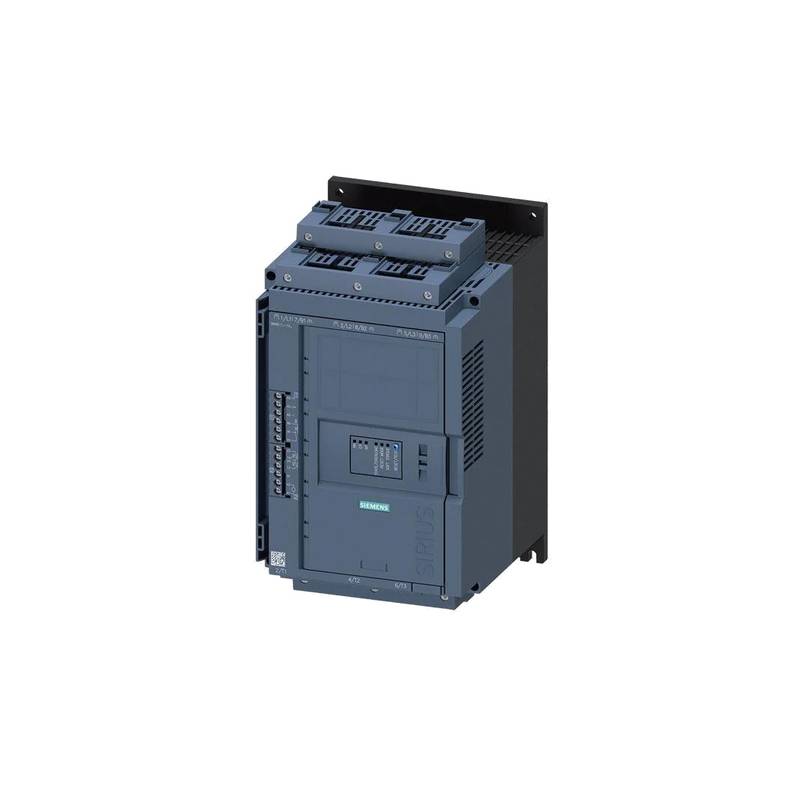













SCHNEIDER ATS22C59Q 590A Motor Soft Starter


The SCHNEIDER ATS22C59Q is a robust 590A motor soft starter designed for demanding industrial applications, offering smooth acceleration, reduced mechanical stress, and enhanced system reliability. Its key advantages include precise control over motor starting torque and current, minimizing inrush current and power system disturbances. This advanced starter features an integrated bypass, ensuring full voltage operation once the motor reaches speed, thereby reducing heat dissipation and energy consumption.
Product Specifications
| Parameter | Value |
| :-------------------- | :---------------------------------- |
| Rated operational current (AC-3) | 590 A |
| Motor power (AC-3) | 315 kW at 400 V |
| Supply voltage | 380-440 V AC, 50/60 Hz |
| Control voltage | 24 V AC |
| Start mode | Ramp start |
| Bypass | Integrated |
| Protection functions | Motor thermal protection, phase loss, overcurrent |
| Dimensions (H x W x D) | 700 x 350 x 300 mm |
| Enclosure rating | IP20 |
Core Features & Market Positioning
The SCHNEIDER ATS22C59Q distinguishes itself through its advanced control algorithms that provide exceptional starting smoothness, significantly outperforming traditional direct-on-line (DOL) starters. This advanced technology minimizes mechanical shock on machinery, extending equipment lifespan and reducing maintenance requirements. Its integrated bypass function is a critical differentiator, simplifying installation by eliminating the need for external bypass contactors and reducing overall footprint and wiring complexity. The robust thermal protection and comprehensive fault diagnostics capabilities position the ATS22C59Q as a reliable and intelligent solution for critical motor control applications where uptime and equipment protection are paramount.
Key Application Scenarios
This soft starter is ideally suited for heavy-duty industrial applications requiring controlled motor acceleration. Common use cases include the starting of centrifugal pumps, fans, compressors, and conveyors in sectors such as water treatment, HVAC, mining, and material handling. The ATS22C59Q excels in scenarios where minimizing the electrical and mechanical stress during startup is crucial. For example, in pump applications, it prevents water hammer, protecting piping systems. In fan applications, it reduces the initial load on motors and belts, prolonging their operational life and ensuring gradual airflow ramp-up.
Practical System Integration Guidance
Integrating the SCHNEIDER ATS22C59Q into an existing or new control system is streamlined due to its user-friendly design. The unit requires a stable power supply within its specified voltage range (380-440V AC). Motor connections are made to the output terminals, and the control circuitry connects to the dedicated 24V AC control voltage terminals. For optimal protection, it is essential to correctly configure the motor thermal overload settings according to the motor's nameplate data, typically accessible via the starter's interface. Proper grounding and adherence to local electrical codes are imperative during installation to ensure safety and reliable operation.
Operation and Risk Mitigation
Operating the ATS22C59Q involves setting the desired acceleration ramp time and current limit, which can be adjusted to match the specific motor and load requirements. The integrated bypass automatically engages once the motor reaches nominal speed, ensuring energy efficiency and reduced heat. Risk mitigation is inherent in the starter's design, featuring protection against phase loss, overcurrent, and motor overload. In the event of a fault, the starter will trip, and an error code will be displayed, allowing for quick identification and resolution. For instance, an overcurrent fault (often indicated by code 'E01') suggests that the motor is drawing too much current during start-up, possibly due to an incorrectly set current limit or an overloaded motor.
Scalability & Long-Term Value
The SCHNEIDER ATS22C59Q offers significant long-term value through its compatibility with Schneider Electric's broader automation ecosystem. It can be integrated into SCADA systems or PLCs for remote monitoring and control, enabling advanced diagnostics and predictive maintenance. While the ATS22 series itself is a mature product line, its robust performance and reliability ensure a long service life. For users requiring advanced network communication or more sophisticated control features, migration to newer Schneider Electric drives or intelligent motor control solutions can be facilitated, leveraging the established power and control infrastructure.
Frequently Asked Questions
Q1: What is the primary benefit of using the SCHNEIDER ATS22C59Q soft starter?
The primary benefit is the smooth and controlled acceleration of electric motors. This minimizes mechanical stress on driven equipment like pumps and conveyors. It also reduces electrical stress on the power supply by limiting inrush current.
This controlled startup prolongs the lifespan of motor components and associated machinery. It also prevents sudden voltage drops on the power network, which can affect other sensitive equipment.
The integrated bypass function further enhances efficiency by reducing heat generation once the motor is at operating speed. This leads to energy savings and a more reliable system overall.
Q2: How do I properly set the thermal overload protection on the ATS22C59Q?
You must consult the motor's nameplate for its full load amperage (FLA) rating. Then, configure the soft starter's thermal overload setting to match or slightly exceed this FLA value. This ensures accurate motor protection against overheating.
Refer to the ATS22C59Q user manual for the specific menu navigation. You will typically find an option to input motor nominal current or thermal class. Correct configuration is vital for safety and motor longevity.
Incorrect settings can lead to nuisance tripping or, worse, motor damage if the protection is set too high. Always verify your settings after initial configuration.
Q3: What are the common fault codes for the SCHNEIDER ATS22C59Q and what do they mean?
A common fault is E01, indicating an overcurrent condition. This can happen if the starting current limit is set too high or if the motor is overloaded. Another common code is E03, signifying a phase loss, which is a critical protection feature.
Code E04 often points to a motor thermal overload, meaning the motor has exceeded its safe operating temperature. Adjusting the thermal setting or investigating motor cooling might be necessary. Always consult the manual for a complete list.
Understanding these codes allows for rapid troubleshooting and minimizes downtime. Promptly addressing faults ensures the continued safe and efficient operation of the motor and starter.
Q4: Can the SCHNEIDER ATS22C59Q be used with 50Hz and 60Hz power supplies?
Yes, the SCHNEIDER ATS22C59Q is designed to operate with both 50Hz and 60Hz power supplies. Its internal electronics automatically adapt to the incoming frequency within its specified voltage range of 380-440V AC.
This dual-frequency capability makes the ATS22C59Q a versatile choice for global applications. It simplifies inventory management for companies operating in regions with different standard frequencies.
Ensure that the motor being controlled is also rated for the intended operating frequency. The soft starter itself will function correctly on either frequency.
Q5: What is the function of the integrated bypass in the ATS22C59Q?
The integrated bypass is a crucial feature that allows the motor to run at full line voltage once it has reached its operating speed. This bypass contactor is built directly into the soft starter unit. It reduces energy loss and heat generation within the soft starter itself.
By switching to bypass mode, the soft starter bypasses its power electronics, allowing power to flow directly from the line to the motor. This is more energy-efficient and extends the lifespan of the starter's components.
This feature simplifies installation by eliminating the need for an external bypass contactor. It reduces wiring complexity and saves valuable panel space.
Q6: How does the SCHNEIDER ATS22C59Q protect the motor from damage?
The ATS22C59Q offers comprehensive motor protection, including thermal overload protection. This feature monitors motor temperature and trips the starter if it exceeds safe limits. It also protects against phase loss, which can severely damage a three-phase motor.
The starter actively monitors the motor's current draw. If it detects an overcurrent condition during startup or operation, it will trip to prevent damage to the motor windings. It also provides protection against short circuits.
These integrated protection functions are vital for ensuring the longevity and reliability of the motor. They help prevent costly repairs and unplanned downtime due to electrical faults.
Q7: What types of motors can be controlled by the ATS22C59Q?
The SCHNEIDER ATS22C59Q is primarily designed to control standard three-phase AC induction motors. These are the most common type of motor used in industrial applications for pumps, fans, conveyors, and compressors.
It is important that the motor's power rating and voltage are compatible with the soft starter's specifications. The starter is rated for motors up to 315 kW at 400V, making it suitable for medium to large industrial motor applications.
Ensure that the motor is designed for soft start operation, though most standard induction motors are compatible. The soft starter provides controlled ramp-up, which is beneficial for all induction motors.
Q8: Is the SCHNEIDER ATS22C59Q suitable for dusty or harsh industrial environments?
The SCHNEIDER ATS22C59Q has an IP20 enclosure rating. This means it is protected against solid objects greater than 12.5mm but offers no protection against water. Therefore, it is best suited for clean, dry indoor environments.
For applications in dusty or wet industrial settings, it is recommended to install the soft starter in a suitable enclosure or control panel. This will provide the necessary environmental protection and ensure its longevity.
Always consider the specific environmental conditions of your installation. If the environment is harsh, an additional protective enclosure is a must for reliable operation.
Q9: Can I integrate the ATS22C59Q into a PLC control system?
Yes, the ATS22C59Q can be integrated into a PLC (Programmable Logic Controller) control system. While it doesn't have native communication ports like Ethernet/IP or Profibus, it can be controlled and monitored using its digital inputs and outputs.
You can wire digital outputs from the PLC to the soft starter's control terminals to initiate start/stop commands. Similarly, the soft starter's status outputs can be wired back to PLC inputs for monitoring.
This allows for remote control and integration into automated sequences, providing a level of automation even without direct network communication. For advanced networking, consider a soft starter with integrated communication capabilities.
Q10: What is the typical lifespan of the SCHNEIDER ATS22C59Q soft starter?
The typical lifespan of the SCHNEIDER ATS22C59Q is highly dependent on the application and operating conditions. However, these units are engineered for robust performance and can last for many years, often exceeding 10-15 years.
Factors influencing lifespan include the frequency of starts, the severity of the starting duty, ambient temperature, and maintenance. The integrated bypass function contributes to longevity by reducing heat stress on the power components.
Regular inspections and adherence to operational guidelines will maximize the service life of the soft starter. Proper ventilation and avoiding over-application are key to achieving its full lifespan potential.