











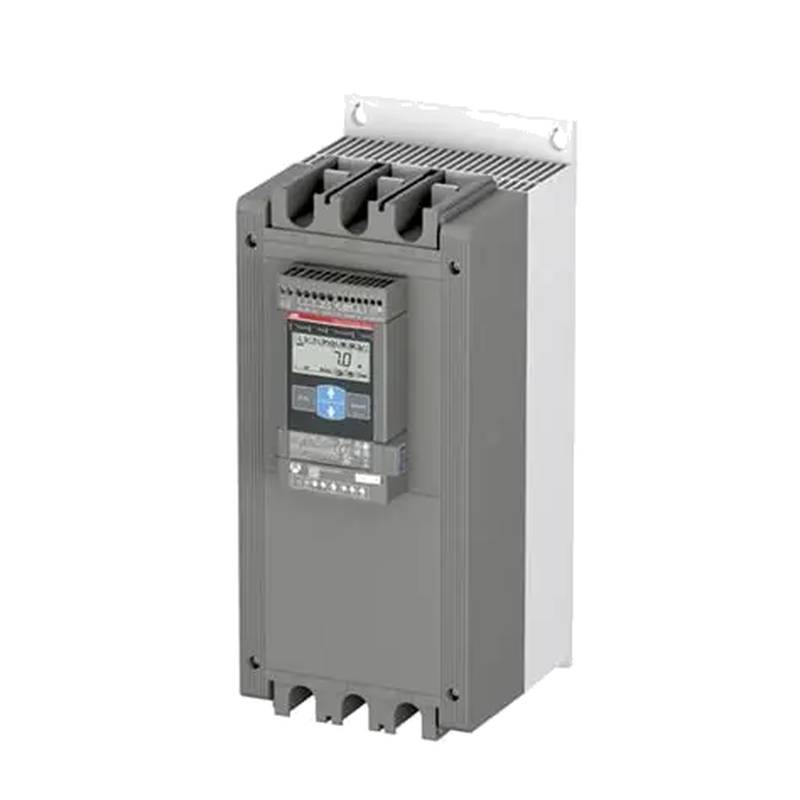
ABB PSE210-600-70-1 210A 3P Efficient Soft Starter


The ABB PSE210-600-70-1 210A 3P Efficient Soft Starter is a robust and advanced motor control solution designed for demanding industrial applications, offering significant energy savings and enhanced operational reliability. This sophisticated device provides a smooth, controlled start for three-phase induction motors, drastically reducing mechanical stress on equipment and electrical inrush current on the power supply. With a rated operational current of 210A and designed for 600V systems, the PSE210-600-70-1 exemplifies ABB's commitment to efficiency and performance in motor control technology. Its core advantages lie in its energy-saving capabilities, extended motor lifespan, and simplified installation, making it an ideal choice for various industrial sectors.
Product Specifications
| Parameter | Value |
| :------------------------ | :----------------- |
| Rated Operational Current | 210 A |
| Number of Poles | 3 |
| Voltage | 600 V |
| Series | PSE210 |
| Control Method | Soft Start |
| Enclosure Type | Open Frame |
| Mounting | DIN Rail / Screw |
| Communication Protocols | Modbus RTU (optional) |
| Overload Protection | Yes |
| Bypass Contactor | Internal |
Core Features & Market Positioning
The ABB PSE210-600-70-1 stands out in the competitive landscape of motor starters due to its integrated bypass, which minimizes energy loss during full-speed operation and reduces heat generation within the starter. This feature directly contributes to improved energy efficiency and a longer product lifespan compared to traditional starters. The unit’s advanced control algorithms ensure precise torque control, preventing mechanical shock during startup and shutdown, which is a critical differentiator in applications sensitive to vibration or stress. Furthermore, the PSE210 series is positioned as a highly reliable and cost-effective solution for medium to heavy-duty motor applications, providing essential protection and control features without unnecessary complexity.
Key Application Scenarios
This efficient soft starter is exceptionally well-suited for a wide array of industrial applications where smooth motor acceleration and deceleration are paramount. It excels in controlling pumps, fans, compressors, conveyors, and mixers across sectors such as water and wastewater treatment, HVAC, material handling, and food and beverage processing. The ability to manage high-inertia loads and reduce starting torque makes it ideal for applications where high starting currents can trip circuit breakers or overload transformers. For instance, in pump applications, the PSE210-600-70-1 mitigates water hammer effects, thereby protecting piping systems and reducing maintenance. In fan systems, it offers gradual speed ramp-up, optimizing airflow and reducing noise pollution.
Practical System Integration Guidance
Integrating the ABB PSE210-600-70-1 into an industrial control system is streamlined due to its compact design and versatile mounting options, supporting both DIN rail and direct screw mounting. The unit features clearly labeled power terminals for easy wiring of the main motor circuit. For control and signaling, standard wiring practices for motor starters apply, with connections for start/stop commands, fault signaling, and optional external controls. The internal bypass contactor simplifies wiring by eliminating the need for an external bypass starter. While basic operation requires minimal setup, advanced configurations, such as parameter adjustments for specific motor characteristics or integration with higher-level automation systems via optional communication modules, can be achieved using ABB's dedicated software tools.
Operation and Risk Mitigation
Operating the ABB PSE210-600-70-1 involves setting crucial parameters such as motor full-load current, start time, and stop ramp time to match the specific motor and load requirements. Proper configuration is key to maximizing energy savings and ensuring motor protection. The soft starter incorporates comprehensive protection functions, including overload, short circuit, and phase loss protection, to safeguard the motor and the starter itself. Common troubleshooting involves checking motor parameters, supply voltage, and control wiring. Critical error codes, indicated via status LEDs or communication interfaces, provide diagnostic information for identifying and resolving issues promptly, minimizing downtime.
Scalability & Long-Term Value
The PSE210-600-70-1 offers a high degree of long-term value through its robust construction and inherent energy-saving features that reduce operational costs. While the PSE210 is a dedicated soft starter, ABB's broader motor control portfolio allows for seamless integration with variable frequency drives (VFDs) and other intelligent automation devices for more complex speed control applications. This compatibility ensures that as system requirements evolve, the PSE210 can coexist within a larger ABB ecosystem, or be part of a planned upgrade path. The optional communication capabilities also enable integration with Industrial Internet of Things (IIoT) platforms, facilitating remote monitoring, diagnostics, and predictive maintenance for enhanced operational efficiency.
Frequently Asked Questions
Q1: What is the primary benefit of using the ABB PSE210-600-70-1 soft starter?
The primary benefit is significantly reduced mechanical stress on motor and connected equipment during startup. This smooth acceleration extends the lifespan of machinery by minimizing wear and tear. It also lowers electrical inrush current, preventing voltage sags and protecting the power distribution system.
Another key advantage is substantial energy savings, especially during the start-up phase. The soft starter's design optimizes power consumption, unlike direct-on-line (DOL) starters that draw maximum current instantaneously. This efficiency translates directly to lower electricity bills for industrial operations.
Finally, it offers enhanced operational control and reliability. By providing adjustable ramp-up and ramp-down times, users can fine-tune motor behavior to suit specific application needs, leading to more stable processes and fewer operational disruptions.
Q2: How does the internal bypass feature of the ABB PSE210-600-70-1 improve efficiency?
The internal bypass contactor engages once the motor reaches full speed. This bypass effectively takes the soft starter electronics out of the main power path during continuous operation. Consequently, energy losses typically associated with passing current through power semiconductors are eliminated.
This reduction in energy loss directly translates to improved overall system efficiency. Less wasted energy means lower electricity consumption and reduced heat generation within the starter itself. This can also lead to smaller enclosure sizes or less need for external cooling.
Furthermore, by bypassing the soft starter components during normal running, their operational life is extended. They are not subjected to continuous current and heat, preserving their performance and reliability for the critical start and stop phases.
Q3: What are the typical electrical parameters to consider when installing the ABB PSE210-600-70-1?
Crucially, ensure the incoming power supply voltage matches the 600V rating of the soft starter. Incorrect voltage can cause damage or malfunction. The rated operational current of 210A must also be suitable for the motor it will control, with a safety margin considered.
Verify the motor's full load current (FLC) setting on the soft starter. This parameter is vital for accurate motor protection and optimal performance. Incorrect FLC settings can lead to nuisance tripping or inadequate protection against overloads.
Consider the ambient temperature and environmental conditions where the starter will be installed. Ensure it is within the specified operating temperature range to prevent overheating and maintain reliable operation. Adequate ventilation is also essential.
Q4: Can the ABB PSE210-600-70-1 be used with single-phase motors?
No, the ABB PSE210-600-70-1 is specifically designed and rated for three-phase induction motors. Its internal circuitry and control logic are engineered to manage the three alternating current phases required for the efficient operation of these motor types.
Utilizing this soft starter with a single-phase motor would not be functional and could potentially lead to damage to both the motor and the starter. Single-phase motors have different starting mechanisms and power requirements that necessitate specialized control equipment.
For single-phase motor control, alternative starters or motor protection devices designed for single-phase applications should be selected. ABB offers a range of products suitable for various motor types and sizes.
Q5: What are common fault indications on the ABB PSE210-600-70-1 and how to troubleshoot them?
Common fault indications are often displayed via status LEDs on the front panel or through diagnostic codes if communication is enabled. These can signal overloads, phase loss, short circuits, or internal faults.
To troubleshoot, first consult the product manual for the specific fault code displayed. Then, systematically check the motor parameters set on the starter, ensuring they accurately reflect the connected motor. Inspect motor windings for insulation breakdown.
Next, verify the incoming power supply for correct voltage and phase sequence. Examine all power and control wiring for loose connections, damage, or incorrect routing. If the fault persists after these checks, an internal starter issue may be present, requiring professional assessment.
Q6: How does the ABB PSE210-600-70-1 protect the motor from overload conditions?
The soft starter monitors the current drawn by the motor in real-time. It uses internal algorithms and user-configured parameters, like the motor full-load current (FLC) and thermal memory, to detect when the motor is operating beyond its safe current limits.
When an overload condition is detected, the PSE210-600-70-1 will initiate a controlled shutdown sequence or trip the motor off the line. This action prevents the motor from overheating and sustaining damage to its windings, which is a primary cause of motor failure.
This protection is crucial for extending motor life and ensuring operational continuity. The starter's ability to accurately detect and respond to overloads is a key element of its overall motor management capabilities.
Q7: What is the maximum power rating or motor size this soft starter can handle?
The ABB PSE210-600-70-1 is rated for a continuous operational current of 210 Amperes at 600 Volts. This current rating directly translates to the maximum power or motor size it can reliably start and control within its specified operating conditions.
To determine the exact maximum motor size, one must consider the motor’s specific design and starting characteristics, as well as the power supply capabilities. Generally, for standard industrial motors, this rating suggests it's suitable for motors in the range of hundreds of horsepower, depending on voltage and service factor.
Always refer to the ABB product manual and perform a proper motor sizing calculation for your specific application to ensure the soft starter is adequately sized. This prevents under-sizing, which can lead to premature failure, or over-sizing, which can be unnecessarily costly.
Q8: Can the ABB PSE210-600-70-1 be programmed for different motor acceleration profiles?
Yes, the ABB PSE210-600-70-1 offers adjustable acceleration and deceleration ramp times. This allows users to tailor the motor's start-up and stop sequences to match the specific mechanical load and process requirements.
Users can configure parameters like start time (how long it takes to reach full speed) and stop ramp time (how long it takes to decelerate to a standstill). These settings are crucial for applications involving pumps, fans, or conveyors to prevent shock, water hammer, or material spillage.
Precise control over these profiles ensures smoother operation, reduced mechanical stress, and optimized energy usage during transitional periods, contributing to overall system efficiency and longevity.
Q9: Does the ABB PSE210-600-70-1 support communication protocols for integration into SCADA or PLC systems?
Yes, the PSE210 series, including the PSE210-600-70-1, typically supports optional communication modules. These modules enable integration with higher-level automation systems like SCADA or PLC networks.
Commonly supported protocols include Modbus RTU, allowing for real-time monitoring of motor status, current, voltage, and fault information. It can also receive start/stop commands remotely and allow for parameter adjustments via the network.
This capability is essential for modern industrial automation, enabling centralized control, data acquisition, remote diagnostics, and integration into IIoT solutions for predictive maintenance and enhanced operational intelligence.
Q10: What are the physical dimensions and mounting requirements for the ABB PSE210-600-70-1?
The ABB PSE210-600-70-1 is designed as an open-frame unit for panel mounting, offering flexibility in installation. Its compact size is intended to facilitate integration into control cabinets where space may be limited.
It supports both DIN rail mounting and direct screw mounting onto a panel or backplate. This dual mounting capability enhances installation versatility, catering to different cabinet designs and user preferences for secure fixture.
Adequate ventilation around the unit is critical for its efficient operation and longevity. Ensure sufficient clearance is maintained according to the installation manual to prevent overheating and maintain optimal performance.