











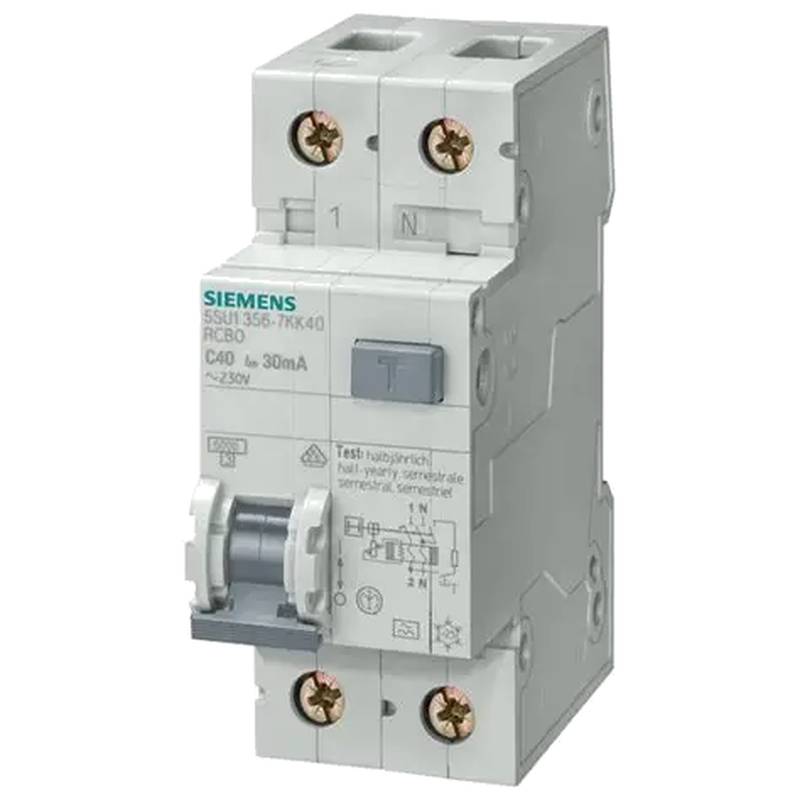
Siemens 5SU1656-1KK13 Residual Current Protective Device (RCD) 13A 300mA 1P+N C


The Siemens 5SU1656-1KK13 is a vital component for safeguarding electrical installations against earth leakage faults. This 13A, 300mA, 1-pole + neutral Residual Current Protective Device (RCD) with a Type C tripping characteristic offers robust protection for circuits susceptible to moderate inrush currents. Its compact design and adherence to stringent international standards ensure reliable performance and seamless integration into modern electrical systems. Key advantages include enhanced safety for personnel and equipment, prevention of fire hazards caused by insulation failures, and compliance with critical electrical safety regulations.
Product Specifications
| Feature | Specification |
| :--------------------------- | :--------------------------------------------- |
| Product Type | Residual Current Protective Device (RCD) |
| Manufacturer | Siemens |
| Model Number | 5SU1656-1KK13 |
| Rated Current (In) | 13A |
| Rated Residual Current (IΔn) | 300mA |
| Number of Poles | 1 Pole + Neutral (1P+N) |
| Tripping Characteristic | Type C |
| Rated Voltage (Un) | 230V AC |
| Frequency | 50/60 Hz |
| Breaking Capacity (Icn) | 10kA |
| Degree of Protection | IP20 |
| Mounting Type | DIN Rail |
| Standard | IEC/EN 61009-1 |
Core Features & Market Positioning
The Siemens 5SU1656-1KK13 distinguishes itself through its Type C tripping characteristic, making it particularly well-suited for circuits feeding equipment with inductive loads that exhibit higher inrush currents, such as motors, transformers, and fluorescent lighting. This feature minimizes nuisance tripping, ensuring operational continuity while maintaining essential safety. Its 13A rating positions it as an ideal solution for protecting dedicated circuits in residential, commercial, and light industrial settings where loads are moderate but require sensitive earth fault detection. The device embodies Siemens' commitment to high-quality, reliable electrical protection solutions, leveraging decades of experience in circuit protection technology.
Key Application Scenarios
This RCD is indispensable for protecting circuits supplying appliances and equipment that may experience significant initial current surges upon startup. Common applications include protection for distribution boards in residential buildings, particularly for circuits feeding lighting, socket outlets, and small appliances with inductive components. In commercial environments, it is frequently deployed in office buildings, retail spaces, and small workshops to safeguard circuits powering office equipment, ventilation systems, and general-purpose machinery. For light industrial use, the 5SU1656-1KK13 provides essential protection for machine tool circuits, control panels, and pump systems where moderate inrush currents are a characteristic.
Practical System Integration Guidance
Integrating the Siemens 5SU1656-1KK13 into an electrical system is straightforward, requiring adherence to standard wiring practices for RCDs. The device is designed for top-hat DIN rail mounting, ensuring easy installation within standard electrical enclosures. The line (input) terminals are typically connected to the upstream power source, while the load (output) terminals connect to the protected circuit. It is crucial to connect the neutral conductor to the designated neutral terminal to ensure correct operation of the RCD. Proper grounding of the protected equipment is also a fundamental requirement for effective earth fault protection. Ensure all connections are secure and conform to local electrical codes and standards.
Operation and Risk Mitigation
The Siemens 5SU1656-1KK13 operates by continuously monitoring the balance of current flowing through the live and neutral conductors of a circuit. If an imbalance exceeding the rated residual current of 300mA occurs, indicating current leakage to earth (fault current), the RCD rapidly trips, disconnecting the power supply. This rapid disconnection is critical for preventing electric shock to individuals who may come into contact with a faulty appliance or conductor, and it mitigates the risk of fire ignition due to overheating caused by earth faults. Regular testing of the RCD using its integrated test button or a dedicated RCD tester is recommended to ensure its continued operational integrity and safety performance.
Scalability & Long-Term Value
The Siemens 5SU1656-1KK13, as part of the broader Siemens SENTRON protection device portfolio, offers excellent compatibility with other Siemens circuit protection components and modular switchgear. This inherent compatibility facilitates straightforward system expansion and upgrades, allowing for the integration of additional RCDs or miniature circuit breakers (MCBs) as power distribution requirements evolve. While this specific model is designed for direct installation, its integration capabilities within larger Siemens electrical infrastructure systems provide a foundation for future smart grid or IIoT connectivity through compatible upstream or downstream intelligent devices, ensuring long-term value and adaptability.
Frequently Asked Questions
Q1: What is the primary function of the Siemens 5SU1656-1KK13?
This RCD's main role is earth leakage protection. It safeguards against electrical shocks and fire hazards.
It detects imbalances in current flow. These imbalances signal a fault to earth.
The device then rapidly disconnects the power supply.
Q2: Why is the Type C tripping characteristic important for this RCD?
Type C is essential for inductive loads. It handles moderate inrush currents without nuisance tripping.
This ensures stable operation of motors and transformers. It prevents unnecessary disconnections.
It balances safety with operational continuity for specific equipment.
Q3: What types of circuits is the 5SU1656-1KK13 best suited for?
It is ideal for circuits with moderate inrush currents. This includes motors, transformers, and lighting.
Applications range from residential to light industrial settings. It protects socket outlets and appliance circuits.
Its 13A rating and 300mA sensitivity are key parameters.
Q4: How is the 5SU1656-1KK13 installed in an electrical panel?
Installation is on a standard top-hat DIN rail. This is common in most electrical enclosures.
Connect incoming power to line terminals and outgoing to load terminals. Ensure correct neutral connection.
Follow all local electrical codes and wiring regulations.
Q5: What is the significance of the 300mA residual current rating?
300mA is a higher sensitivity than standard 30mA RCDs. It is suitable for fire protection.
It is commonly used for main incoming supplies or circuits where fire risk is a concern. It provides protection against severe earth faults.
This rating is specified by certain electrical standards for specific applications.
Q6: Can this RCD be used for personal protection against electric shock?
While it provides protection, 30mA RCDs are generally preferred for direct personal protection. The 300mA rating is more focused on fire prevention.
For sensitive personal protection, a downstream 30mA RCD is recommended. This offers enhanced safety for individuals.
The 5SU1656-1KK13 is often used upstream for broader circuit protection.
Q7: What does "1P+N" signify for this RCD?
"1P+N" means it protects one live (phase) conductor and the neutral conductor. It switches both simultaneously.
This ensures complete isolation of the protected circuit. It's crucial for safety and maintenance.
It occupies two modules on a standard DIN rail.
Q8: How often should the Siemens 5SU1656-1KK13 be tested?
Regular testing is crucial for RCD reliability. It should be tested periodically, at least annually.
Use the integrated test button for a quick functional check. For formal verification, use a calibrated RCD tester.
Testing ensures the tripping mechanism is functioning correctly.
Q9: Is this RCD compatible with other Siemens electrical components?
Yes, it is part of the Siemens SENTRON product range. It offers excellent compatibility.
It integrates seamlessly with other Siemens MCBs and RCDs. This facilitates system design and expansion.
This interoperability ensures system coherence and reliability.
Q10: What are the implications of nuisance tripping with this RCD?
Nuisance tripping occurs when the RCD trips without a genuine earth fault. This can be due to high inrush currents.
The Type C characteristic helps mitigate this for inductive loads. If tripping persists, investigate the protected circuit for faults.
Excessive leakage or faulty equipment can cause persistent tripping.