











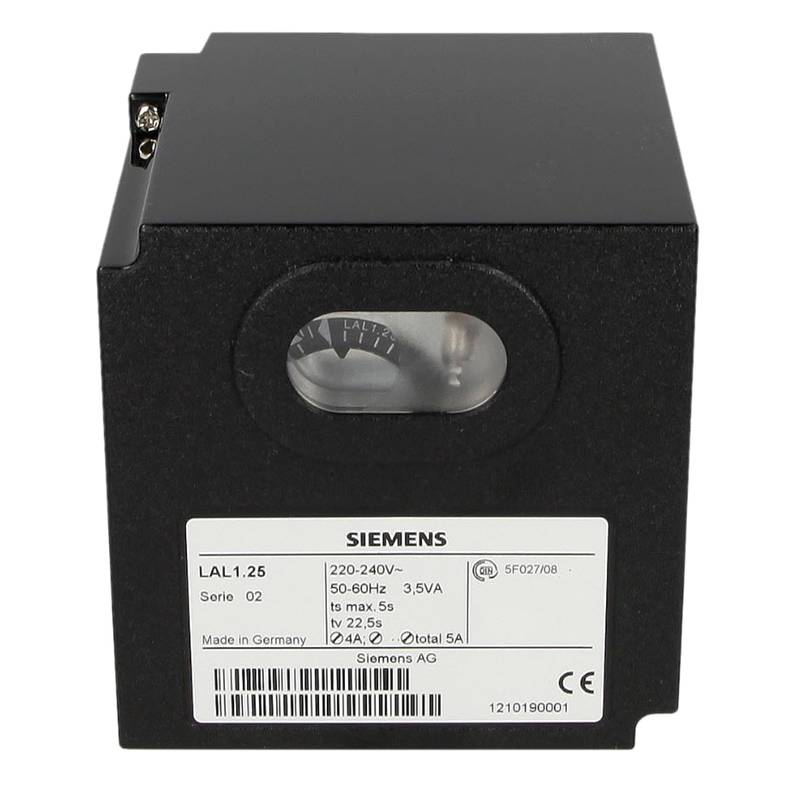
SIEMENS LAL1.25 Oil Burner Control Box Single Stage


The SIEMENS LAL1.25 single-stage oil burner control box is a critical component for reliable and efficient operation of domestic and small commercial oil heating systems. This robust control unit offers enhanced safety features, precise flame monitoring, and straightforward integration. Its core advantages include dependable ignition sequencing, integrated safety shut-off, and compatibility with various burner types. Key technical parameters include a voltage rating of 220-240V AC, a frequency of 50/60 Hz, and an ambient operating temperature range of -20°C to +60°C. The LAL1.25 is designed for single-stage oil burners, ensuring consistent performance.
| Feature | Specification |
| :------------------ | :---------------------------- |
| Product Type | Oil Burner Control Box |
| Stage | Single Stage |
| Manufacturer | SIEMENS |
| Model | LAL1.25 |
| Voltage | 220-240V AC |
| Frequency | 50/60 Hz |
| Ambient Temp. Range | -20°C to +60°C |
| IP Protection | IP40 |
| Safety Class | Class I |
Core Features & Market Positioning
The SIEMENS LAL1.25 distinguishes itself through its inherent reliability and Siemens' reputation for industrial automation excellence. It provides a single-stage flame monitoring solution, typically utilizing a flame rod for detection, ensuring that the burner operates only when a stable flame is established. This control box integrates essential safety functions, including pre-purge and post-purge cycles, along with post-ignition safety time, all crucial for preventing hazardous conditions. Its market positioning is that of a dependable, no-nonsense control for standard oil burner applications where robust performance and safety are paramount, avoiding the complexities and costs associated with multi-stage or modulating controls.
Key Application Scenarios
This control box is ideally suited for single-stage oil burners found in residential furnaces, boilers, and small commercial heating units. Common user search needs that align with the LAL1.25 include "oil burner won't ignite," "oil furnace safety control," or "Siemens burner controller replacement." It’s frequently integrated into systems manufactured by various OEMs, serving as a replacement part or original equipment in applications requiring a straightforward, reliable ignition and flame control sequence. Its application spans detached homes, small office buildings, and light industrial spaces where consistent, single-stage heating is sufficient.
Practical System Integration Guidance
Integrating the SIEMENS LAL1.25 typically involves connecting the main power supply, the oil pump, the ignition transformer, the thermostat, and the flame sensor (flame rod) to the designated terminals on the control box. Wiring diagrams are essential and usually provided in the product's installation manual. The control box initiates a pre-purge sequence to clear the combustion chamber of any residual gases before ignition. Following ignition, it monitors the flame via the flame rod; if a flame is not detected within the specified safety time, it will shut down the burner and prevent reignition until reset. A post-purge cycle follows burner shutdown to cool the system.
Operation and Risk Mitigation
Operation of the LAL1.25 is automated and managed by its internal logic, activated by a thermostat signal. Safety is a primary design consideration, with built-in interlocks to prevent burner operation without a flame and to ensure proper purging. Risk mitigation is achieved through adherence to installation guidelines and regular maintenance. Common troubleshooting might involve checking for power supply issues, verifying thermostat signals, ensuring the flame rod is clean and properly positioned, and confirming the ignition transformer is functioning. Fault codes are typically indicated by the status light on the control box, often requiring reference to the specific burner or control documentation for interpretation.
Scalability & Long-Term Value
While the LAL1.25 is a single-stage control, its long-term value lies in its robust and proven design for specific applications. It is not inherently designed for scalability in terms of multi-stage or modulating burner control. However, its compatibility with standard thermostat wiring and its straightforward operational logic mean it integrates seamlessly into established heating systems. For advanced digital integration or IIoT capabilities, a separate building automation system or a more sophisticated burner management system would be required, with the LAL1.25 potentially serving as the base-level control within that architecture, though direct digital integration is limited by its fundamental design.
---
Frequently Asked Questions
What is the primary function of the SIEMENS LAL1.25?
The LAL1.25 controls the ignition and flame monitoring for single-stage oil burners. It ensures the burner ignites safely and operates only when a stable flame is present. This sequential control prevents hazardous conditions by managing pre-purge, ignition, and post-purge cycles.
It acts as the brain for basic oil heating systems, ensuring components like the oil pump and ignition transformer work in the correct order. This reliability is crucial for consistent home or building heating. Its core purpose is safety and operational efficiency for simple oil-fired appliances.
The control box monitors the flame through a flame rod, shutting down the system if the flame is lost. This safety interlock is vital for preventing unburnt fuel from accumulating in the combustion chamber. It is designed for single-stage operation, meaning it provides one level of heat output.
How do I reset a SIEMENS LAL1.25 oil burner control box?
To reset the LAL1.25, you typically need to interrupt the power supply to the control box. Turn off the main power switch or circuit breaker that supplies electricity to the furnace or boiler. Wait for about 30 seconds to allow any internal capacitors to discharge.
After the waiting period, restore power to the control box. The control box should then attempt to restart the heating cycle. If the burner still does not operate, the issue may be a persistent fault that requires professional diagnosis.
A manual reset button is not a standard feature on the LAL1.25 for typical fault conditions. The reset is usually achieved by cycling the main power. If a fault persists, it indicates an underlying problem that must be addressed before normal operation can resume.
What are common issues with the SIEMENS LAL1.25?
A frequent problem is the failure to ignite the oil burner, which could stem from an issue with the ignition transformer, oil nozzle, or fuel supply. Another common symptom is the burner shutting down shortly after ignition, often indicating a faulty flame rod or a problem with flame sensing.
The control box itself can fail due to age, power surges, or internal component failure, leading to a complete lack of operation or intermittent cycling. Overheating of the control box, often due to poor ventilation or proximity to hot components, can also cause malfunctions.
Interrupted pre-purge or post-purge cycles can also occur, affecting efficiency and safety. Ensuring proper wiring connections and a stable power supply is crucial, as loose connections or voltage fluctuations can mimic control box faults.
Can the SIEMENS LAL1.25 be used with a two-stage oil burner?
No, the SIEMENS LAL1.25 is specifically designed and rated for single-stage oil burners only. It cannot manage the sequential operation or flame monitoring requirements of a two-stage or modulating oil burner system.
Using the LAL1.25 with a two-stage burner would result in improper operation, potential safety hazards, and a failure to achieve the intended heating output. Two-stage burners require more complex control logic and often different types of flame sensors or monitoring devices.
For two-stage or modulating oil burners, you would need to select a control box specifically designed for those applications, such as those in the SIEMENS LGK or LMV series, which offer advanced features for multi-stage control.
What is the safety time for the SIEMENS LAL1.25?
The safety time for the SIEMENS LAL1.25, also known as the post-ignition safety time, is typically around 3 to 4 seconds. This is the maximum allowable time for the control box to detect a stable flame after the ignition sequence has begun.
If a stable flame is not reliably detected by the flame rod within this safety time, the control box will shut down the oil burner and initiate a safety lockout procedure. This prevents the accumulation of unburned fuel in the combustion chamber.
This safety parameter is critical for preventing potential explosions or hazardous conditions. It ensures that the burner is only allowed to operate when the flame is established, providing a crucial safety interlock in the heating system's operation.
How do I wire a SIEMENS LAL1.25?
Wiring the LAL1.25 involves connecting several components to specific terminals on the control box. These connections include the main power supply (220-240V AC), the thermostat or building automation system, the oil pump, the ignition transformer, and the flame rod.
Referencing the wiring diagram provided with the product or on the burner assembly is essential. Terminals are clearly marked for each input and output. Ensure all connections are secure and made according to electrical codes to prevent shorts or operational failures.
Proper wiring is critical for the correct sequencing of operations, including pre-purge, ignition, flame monitoring, and post-purge. Incorrect wiring can lead to immediate malfunctions, safety lockouts, or damage to the control box or connected components.
What is the voltage and frequency rating for the LAL1.25?
The SIEMENS LAL1.25 operates on a standard voltage of 220-240 Volts AC. This is a common voltage range for electrical systems in residential and commercial buildings in many regions worldwide.
The control box is designed to function with a frequency of either 50 Hz or 60 Hz. This dual-frequency compatibility makes it suitable for a wide range of electrical grids, enhancing its versatility and application scope.
Always ensure the power supply to the installation location matches these specifications to guarantee optimal performance and prevent damage to the control unit. Incorrect voltage or frequency can lead to malfunction or premature failure.
What is the IP rating of the SIEMENS LAL1.25?
The SIEMENS LAL1.25 has an IP40 rating. This signifies that the enclosure provides protection against solid objects larger than 1 millimeter, such as thin wires or small tools.
However, an IP40 rating means the enclosure offers no protection against water or moisture ingress. It is designed for installation in clean, dry environments where exposure to water is not a concern.
Installations in areas prone to dust, humidity, or liquid splashes would require a control box with a higher IP rating to ensure durability and safety. Always consider the operating environment when selecting and installing control components.
What type of flame detection does the LAL1.25 use?
The SIEMENS LAL1.25 typically employs a flame rod for flame detection in its single-stage operation. The flame rod is a conductive probe inserted into the flame path.
As the oil burner operates, the flame energizes the flame rod. The control box senses the electrical current flowing through the flame and the ground (the burner assembly) to confirm the presence of a stable flame.
This method is common for single-stage oil burners and is part of the safety system to ensure the burner is not running without a flame. If the current drops below a set threshold, indicating flame loss, the control box will initiate a shutdown.
Where is the SIEMENS LAL1.25 typically installed?
The LAL1.25 is usually mounted directly onto the oil burner assembly itself or within the control panel of the oil-fired appliance, such as a boiler or furnace. It is typically housed within the burner's control compartment.
The location is chosen to be close to the ignition transformer, oil pump, and flame sensor for efficient wiring and quick response times. It needs to be installed in an area protected from direct weather exposure and excessive moisture.
Installation must be in a well-ventilated space to prevent overheating, as the control box generates some heat during operation. Adherence to manufacturer guidelines for mounting and clearances is crucial for both safety and longevity.