











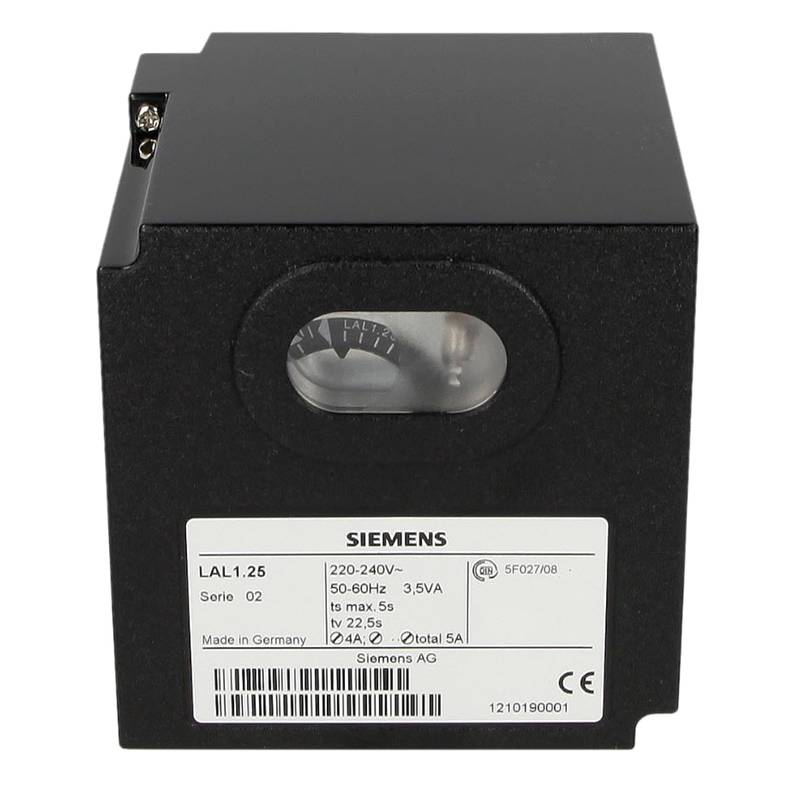
SIEMENS LAL2.25-110V 110V Oil Burner Safety Control


The SIEMENS LAL2.25-110V 110V Oil Burner Safety Control is a critical component for ensuring the safe and reliable operation of oil-fired heating systems. This advanced safety control provides robust flame monitoring and system interlock capabilities, crucial for preventing hazardous conditions such as uncontrolled fuel ignition or incomplete combustion. Its core advantages lie in its high reliability, compact design, and straightforward integration into various burner management systems. Key technical parameters include an operating voltage of 110V AC, making it suitable for a wide range of industrial and commercial applications. The LAL2.25 series is engineered to meet stringent safety standards, offering peace of mind and operational efficiency for facility managers and maintenance professionals.
Product Specifications
| Feature | Specification |
| :--------------------- | :------------------------------------------ |
| Product Type | Oil Burner Safety Control |
| Manufacturer | Siemens |
| Model | LAL2.25 |
| Operating Voltage | 110V AC |
| Flame Detection | Photocell (QRB1) or Ionization Probe |
| Purge Time | Adjustable (typically 30-120 seconds) |
| Pre-ignition Delay | Adjustable (typically 5-20 seconds) |
| Post-purge Time | Adjustable (typically 15-60 seconds) |
| Safety Circuit Type | 7-second safety time |
| Ambient Temperature | -20°C to +60°C |
| Enclosure Protection | IP40 (depending on mounting) |
| Dimensions (approx.) | Varies by specific sub-model and enclosure |
| Certifications | CE, UL, CSA (depending on regional variant) |
Core Features & Market Positioning
The SIEMENS LAL2.25-110V stands out in the competitive burner control market due to its sophisticated flame sensing technology and adaptable operational sequencing. It expertly utilizes either a photocell (QRB1) for detecting oil flames or an ionization probe for gas flames, providing versatility for different fuel types and combustion environments. This dual-capability, combined with its precise timing adjustments for purge, pre-ignition, and post-purge cycles, allows for optimized burner startup and shutdown sequences, minimizing fuel waste and maximizing combustion efficiency. Its market positioning is firmly established as a reliable, high-performance safety control unit for demanding industrial applications where operational integrity is paramount. Siemens' reputation for engineering excellence and robust product design further solidifies the LAL2.25-110V's standing as a trusted solution among HVAC technicians and plant engineers.
Key Application Scenarios
This safety control finds indispensable application in a multitude of industrial heating scenarios. It is a standard component in commercial boiler systems for office buildings, hospitals, and manufacturing facilities, ensuring safe ignition and continuous operation of oil burners. Industrial process heating, such as in food production, chemical processing, and metal treatment plants, also heavily relies on the LAL2.25-110V for secure burner management. Furthermore, it is crucial for standalone industrial furnaces and large-scale hot water generation systems where consistent and safe heat output is a non-negotiable requirement. Its 110V AC operating voltage makes it compatible with a wide array of electrical infrastructures commonly found in these settings, simplifying integration and deployment.
Practical System Integration Guidance
Integrating the SIEMENS LAL2.25-110V into an existing burner system requires careful attention to wiring and configuration. The unit typically interfaces with the ignition transformer, oil pump, fan motor, and various safety limit switches (e.g., high-limit, low-water cut-off). Proper grounding is essential for reliable operation and to prevent electrical interference. The photocell or ionization probe must be correctly positioned within the combustion chamber to accurately detect the flame. Wiring diagrams provided in the Siemens technical documentation are indispensable for correct installation. Configuration of the purge times, pre-ignition delay, and post-purge durations is achieved through adjustment potentiometers on the control unit itself, allowing for precise tuning to match specific burner and boiler characteristics.
Operation and Risk Mitigation
The primary function of the SIEMENS LAL2.25-110V is to prevent hazardous situations arising from burner malfunction. Upon receiving a call for heat, the control initiates a pre-purge cycle to clear any residual fuel or combustion products from the chamber. It then enables the ignition and fuel supply. During operation, the flame detector continuously monitors for flame presence. If flame is lost or fails to establish within the designated safety time (typically 7 seconds), the control will immediately shut off fuel and air, initiating a post-purge cycle. This fail-safe mechanism is critical for mitigating risks such as delayed ignition, which can lead to dangerous fuel-air mixture explosions. Understanding common fault codes, often indicated by LED patterns on the unit, is vital for rapid troubleshooting and minimizing downtime.
Scalability & Long-Term Value
While the SIEMENS LAL2.25-110V is a self-contained safety control, its value extends through its compatibility with broader Siemens burner management systems and its role in robust, long-lasting heating infrastructure. It can be integrated into more complex control architectures that incorporate PLCs for advanced monitoring and data logging. Its durable construction and Siemens' commitment to quality ensure a long operational lifespan, reducing the total cost of ownership. For facilities looking to embrace digital transformation, the LAL2.25-110V can be part of a system that feeds operational data to IIoT platforms, enabling predictive maintenance and remote performance analysis, thus contributing to the overall energy efficiency and reliability of the heating plant.
FAQs
1. What is the primary purpose of the SIEMENS LAL2.25-110V oil burner safety control?
This control ensures safe ignition and continuous operation of oil burners. It monitors flame presence and sequences critical functions like purging.
It acts as a failsafe to prevent hazardous conditions such as fuel explosions. Its precise timing controls are vital for burner efficiency.
By detecting flame failure instantly, it shuts down fuel and air to mitigate risks. This prevents dangerous accumulation of unburnt fuel.
2. What types of flame detection does the LAL2.25-110V support?
It can utilize a photocell (like the Siemens QRB1) to detect oil flames. This is common for typical domestic and commercial oil burners.
Alternatively, it supports ionization probes for sensing the electrical conductivity of gas flames. This broadens its applicability.
The choice of flame detector depends on the fuel type and the specific combustion chamber design. Proper installation is key for accurate detection.
3. How is the operating voltage of 110V AC significant for this product?
The 110V AC operating voltage makes it compatible with standard electrical systems in many regions. This simplifies installation and reduces the need for voltage converters.
It ensures broad applicability in commercial and industrial settings where 110V is common. This avoids complex electrical retrofitting.
This voltage specification is crucial for system designers and maintenance personnel to verify power supply compatibility. It ensures correct electrical hookup.
4. Can the purge times on the LAL2.25-110V be adjusted?
Yes, the purge times for both pre-purge and post-purge cycles are adjustable. This allows for optimization based on burner size and chamber volume.
Adjustments are typically made via potentiometers directly on the control unit. Consult the manual for specific ranges.
Properly setting purge times is essential for safe startup and shutdown, ensuring complete clearing of the combustion chamber. This maximizes efficiency.
5. What is the "7-second safety time" in relation to this control?
The 7-second safety time refers to the maximum duration allowed for flame establishment after ignition is initiated. If flame is not detected within this window, the burner is shut down.
This is a critical fail-safe mechanism designed to prevent fuel accumulation in the event of ignition failure. It is a key safety feature.
Exceeding this safety time indicates a potential problem with ignition, fuel delivery, or flame sensing, requiring investigation. It is a critical operational parameter.
6. How does the LAL2.25-110V prevent oil burner explosions?
It prevents explosions by ensuring a safe sequence of operations. This includes purging the combustion chamber before ignition to remove any residual fuel.
If flame is not established within the safety time, it immediately shuts off fuel and air. This prevents dangerous build-ups of unburnt fuel.
Continuous flame monitoring during operation allows for immediate shutdown if the flame is lost. This prevents re-ignition of accumulated fuel.
7. What are common troubleshooting issues with oil burner safety controls like the LAL2.25-110V?
Frequent issues include flame detection failures due to dirty photocells or probe contamination. Incorrectly set timing parameters can also cause operational problems.
Electrical connection issues, such as loose wiring or power supply problems, can prevent proper functioning. Faulty limit switches can also lead to shutdowns.
Understanding the control's LED indicators for fault codes is crucial for diagnosing problems like ignition failure, flame loss, or short cycling. Refer to the manual for specific codes.
8. Is the SIEMENS LAL2.25-110V compatible with gas burners?
The LAL2.25 series can be adapted for gas burners, but typically requires an ionization probe for flame detection instead of a photocell. The specific sub-model and configuration are critical.
While the core safety functions remain the same, gas combustion characteristics differ from oil. Ensuring the correct flame sensor and settings is paramount.
Always consult the Siemens product documentation to confirm compatibility and the specific requirements for using the LAL2.25 with gas burners. It may not be a direct replacement.
9. What is the typical lifespan of a SIEMENS LAL2.25-110V oil burner safety control?
With proper installation and maintenance, these controls are designed for long-term reliable operation. Siemens products are known for their durability and robust construction.
The lifespan can be influenced by operating environment, such as exposure to extreme temperatures or vibrations. Regular inspections can help prolong service life.
Typical lifespans can range from 10 to 20 years, though actual service life can vary significantly based on application and maintenance practices. They are a long-term investment.
10. Can this safety control be integrated into a modern IIoT system?
Direct integration into IIoT platforms is usually achieved through a supervisory control system or PLC. The LAL2.25-110V itself does not have native IIoT connectivity.
However, the operational status and fault data from the LAL2.25-110V can be collected by a PLC. This data can then be transmitted to an IIoT platform for remote monitoring and analysis.
This integration allows for predictive maintenance, performance optimization, and remote diagnostics, enhancing the overall smart building capabilities. It adds a layer of digital intelligence.