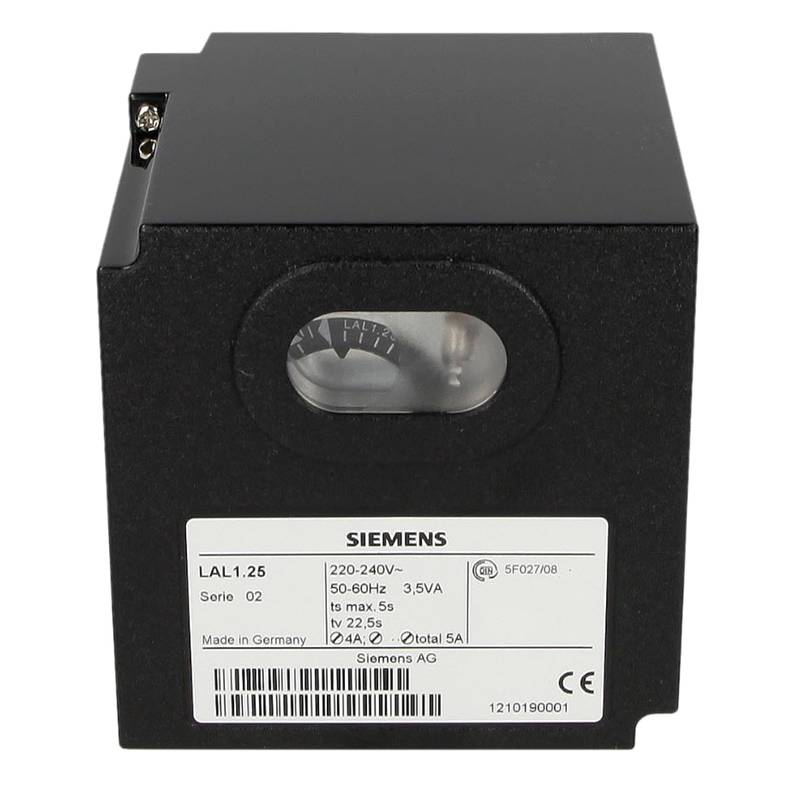
SIEMENS LFL1.322-110V 110V Forced Draught Burner Controller


The Siemens LFL1.322-110V is a robust 110V forced draught burner controller designed for optimal combustion management in industrial applications. Its core advantages lie in its reliable ignition sequence, comprehensive safety monitoring, and straightforward integration into existing systems. Key features include a multi-stage flame control, an integrated air damper control, and a unified operating concept for simplified setup and maintenance. Technically, it operates with a supply voltage of 110V and is engineered for demanding environments, ensuring consistent performance across various operational demands.
Product Specifications
| Feature | Specification |
| :------------------ | :-------------------------------- |
| Model Number | LFL1.322-110V |
| Supply Voltage | 110V AC |
| Application | Forced draught burners |
| Flame Monitoring | Integrated |
| Control Type | Multi-stage, sequence control |
| Air Damper Control | Integrated |
| Operating Principle | Ignition and combustion control |
| Safety Functions | Pre-purge, post-purge, flame supervision |
| Ambient Temperature | -20°C to +60°C |
| Protection Class | IP40 |
Core Features & Market Positioning
The Siemens LFL1.322-110V distinguishes itself through its advanced safety interlocks and programmable logic, crucial for preventing burner malfunctions and ensuring operational integrity in industrial settings. This controller is positioned as a reliable, high-performance solution for applications demanding precise fuel-air ratio control and secure ignition sequences. Its robust construction and adherence to stringent safety standards make it a preferred choice for engineers prioritizing dependable operation and extended equipment lifespan. The integrated flame monitoring system offers immediate detection of flame loss, triggering rapid shutdown procedures to prevent hazardous conditions.
Key Application Scenarios
This burner controller finds its primary utility in managing forced draught burners across a spectrum of industrial heating processes. Common applications include its deployment in industrial boilers, process heaters, thermal oxidizers, and drying ovens where efficient and safe combustion is paramount. Industries such as manufacturing, food processing, and chemical production frequently rely on the LFL1.322-110V for their continuous operational needs, where burner uptime and safety are non-negotiable. Its versatility allows for seamless integration into systems requiring single or multi-stage burner operation, adapting to fluctuating heat demands.
Practical System Integration Guidance
Integrating the Siemens LFL1.322-110V into an existing combustion system typically involves connecting power, burner ignition, fuel valves, and flame detection sensors according to the provided wiring diagrams. The controller utilizes a standardized terminal block for straightforward connections. Commissioning requires a systematic approach, beginning with verifying electrical connections and then proceeding through the pre-ignition checks and safety function tests. The controller's internal logic manages the ignition sequence, pre-purge, main flame establishment, and post-purge cycles, minimizing manual intervention during startup and shutdown. Proper grounding and adherence to local electrical codes are essential for safe and reliable operation.
Operation and Risk Mitigation
Safe operation of the LFL1.322-110V necessitates adherence to the manufacturer's guidelines and a thorough understanding of its safety interlocks. The controller is designed with multiple redundant safety mechanisms, including flame supervision, pressure monitoring, and end-switch verification, to mitigate risks associated with burner failure. In the event of a fault, such as flame failure during operation or an unsuccessful ignition attempt, the controller will execute a programmed safety shutdown. Critical error codes are typically indicated via diagnostic LEDs on the unit, providing technicians with specific information for troubleshooting. Common troubleshooting steps involve checking fuel supply, ignition system functionality, and sensor integrity.
Scalability & Long-Term Value
The Siemens LFL1.322-110V offers significant long-term value through its robust design and compatibility with Siemens' broader industrial automation portfolio. While it is a dedicated burner controller, its integration within a larger control system can be facilitated through signaling outputs that interface with PLCs or SCADA systems. This allows for remote monitoring, data logging, and integration into IIoT platforms for predictive maintenance and energy optimization strategies. The inherent reliability and durability of Siemens components ensure a long operational life, reducing the total cost of ownership over time.
FAQs
What is the primary function of the Siemens LFL1.322-110V?
This controller manages the ignition and combustion process for forced draught burners, ensuring safe and efficient operation. It sequences burner startup, monitors flame, and executes shutdowns if faults occur.
It is engineered to control fuel and air supply, maintaining optimal combustion parameters for various industrial heating applications. The unit also performs crucial safety checks before, during, and after the firing cycle.
Its core role involves orchestrating a safe and reliable ignition sequence, followed by stable flame establishment and continued combustion control. This automation is critical for preventing hazardous conditions and maximizing energy efficiency.
What are the key technical specifications for this burner controller?
The LFL1.322-110V operates on a 110V AC supply voltage. It is designed for forced draught burner applications and features integrated flame monitoring and air damper control.
It includes multi-stage control capabilities and is built to withstand ambient temperatures from -20°C to +60°C, with an IP40 protection class. Safety functions like pre-purge and post-purge are standard.
This controller provides essential parameters for system design, including its operating voltage and environmental tolerances. Its compact design aids in integration into various burner management systems.
How is the Siemens LFL1.322-110V typically installed?
Installation involves wiring the unit to the power supply, burner ignition system, fuel valves, and flame sensor according to manufacturer specifications. Proper grounding is critical for safety and performance.
Technicians must follow the detailed wiring diagrams provided by Siemens to ensure correct connections for all safety interlocks and operational controls. The controller is usually panel-mounted.
Commissioning starts with verifying all electrical connections and then proceeding through a series of functional tests to ensure the ignition sequence and safety shutdowns operate as intended.
What types of industrial applications is the LFL1.322-110V suitable for?
This controller is ideal for industrial boilers, process heaters, and thermal oxidizers that utilize forced draught burners. It is also commonly found in drying ovens and other combustion-based heating systems.
Its robust design and safety features make it suitable for demanding environments in manufacturing, chemical processing, and food production industries. It manages burners requiring single or multi-stage operation.
The controller's ability to ensure consistent and safe combustion makes it a reliable choice for applications where high uptime and operational integrity are essential.
How does the LFL1.322-110V ensure burner safety?
It incorporates multiple safety interlocks, including continuous flame monitoring and pre- and post-purge cycles. These functions detect flame loss or ignition failure and initiate immediate safe shutdown.
The controller verifies the status of end switches and air dampers, ensuring proper sequencing and preventing unsafe operating conditions. It will prevent burner operation if any critical safety parameter is not met.
Its internal logic is programmed to manage fault detection and response, minimizing the risk of dangerous fuel accumulation or uncontrolled combustion events. Diagnostic LEDs assist in identifying fault causes.
Can this burner controller be integrated into a larger automation system?
Yes, the LFL1.322-110V can interface with PLCs or SCADA systems via its signaling outputs for remote monitoring and control. This allows for centralized management of combustion processes.
Integration enables data logging for performance analysis and optimization, as well as connection to IIoT platforms for predictive maintenance and advanced diagnostics.
By communicating operational status and fault information, it can be part of a comprehensive industrial control network, enhancing overall plant efficiency and safety.
What are common troubleshooting issues for this type of controller?
Common issues include flame failure detection, ignition system problems, or issues with fuel valve operation. Incorrect wiring or sensor faults can also cause operational problems.
Troubleshooting often involves checking the integrity of the flame sensor, verifying the functionality of the ignition transformer and electrodes, and ensuring adequate fuel pressure and flow.
The controller's diagnostic LEDs provide initial clues to the fault; consulting the user manual for specific error code interpretations is crucial for effective problem resolution.
What is the voltage requirement for the Siemens LFL1.322-110V?
The product designation "110V" clearly indicates its requirement for a 110-volt alternating current (AC) power supply. This is a critical parameter for proper installation and operation.
Ensuring the local power supply matches this 110V AC specification is fundamental to avoid damaging the controller or preventing it from functioning correctly. Always verify before connecting.
Users must confirm that the power source feeding the LFL1.322-110V is indeed 110V AC and stable, to guarantee reliable performance and longevity of the equipment.
What does "forced draught" mean in relation to this burner controller?
"Forced draught" signifies that the burner uses a fan to actively push combustion air into the burner. This ensures a consistent and controlled air supply, independent of natural air movement.
The LFL1.322-110V is specifically designed to manage the combustion process in systems that employ such a fan, controlling both fuel input and the fan's output to maintain optimal air-fuel ratios.
This active air control is essential for achieving efficient combustion, reducing emissions, and ensuring stable operation across varying ambient conditions, which this controller facilitates.
What is the significance of the IP40 rating for this product?
An IP40 rating indicates that the controller is protected against solid objects larger than 1mm (like wires or tools) and offers no protection against liquids. It's suitable for dry, indoor environments.
This means the unit should be installed in locations where it won't be exposed to water jets, dust ingress beyond limited particulate, or corrosive substances that could compromise its internal components.
The IP40 protection level is common for control devices mounted within enclosures or panels in industrial settings, safeguarding them from accidental contact and larger debris.