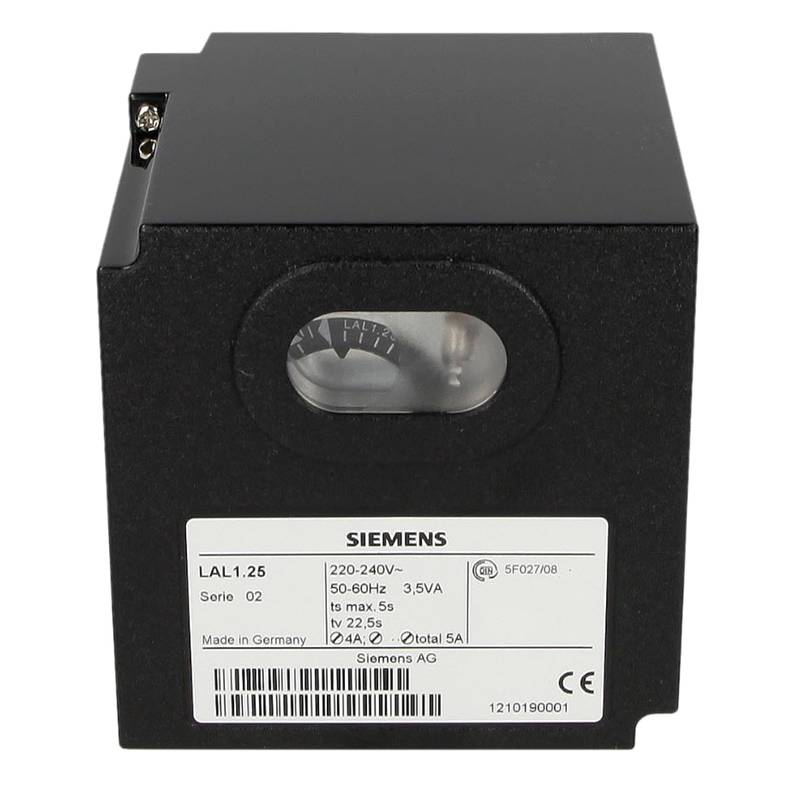
SIEMENS LFL1.635-110V 110V Program Controller LFL1.635


The Siemens LFL1.635-110V 110V Program Controller is a sophisticated burner control unit designed for the precise management and supervision of forced draft burners. Its core advantages lie in its universal applicability for multistage or modulating burners and its robust construction, featuring an impact-proof and heat-resistant casing. Key technical parameters include an operating voltage of 110V and an IP40 rating, ensuring reliable performance in industrial environments. This controller is engineered for medium to high capacity applications requiring intermittent operation, where at least one controlled shutdown occurs every 24 hours.
SIEMENS LFL1.635-110V: Core Features and Market Positioning
The SIEMENS LFL1.635-110V Program Controller stands out in the industrial combustion control market due to its comprehensive safety features and adaptable functionality. It is designed for the control and supervision of forced draft burners, offering a high degree of reliability for gas, oil, or dual-fuel applications. The unit's plug-in base and connectors are specifically engineered to ensure compatibility only with other LFL1 type burner controls, preventing incorrect installations and enhancing system integrity. Market positioning emphasizes its suitability for medium to high capacity burners, whether they are multistage or modulating, operating intermittently. This controller's adherence to safety standards, such as EN 298, and CE marking underscores its commitment to operational safety and regulatory compliance, making it a trusted choice for OEMs integrating burner controls into their products.
Product Specifications
| Specification | Value |
| :-------------------- | :-------------------------------------------- |
| Product Type | Gas Burner Control / Burner Sequence Controller |
| Model | LFL1.635-110V |
| Operating Voltage | 110V AC |
| Application | Control and supervision of forced draft burners |
| Burner Capacity | Medium to High |
| Operation Type | Intermittent (min. 1 controlled shutdown/24h) |
| Burner Types | Multistage, Modulating, Gas, Oil, Dual-fuel |
| Flame Supervision | UV detectors (QRA...) or ionization probe |
| Enclosure Material | Impact-proof, heat-resistant black plastic |
| IP Rating | IP40 |
| Operating Temperature | -20°C to +60°C |
| Safety Standards | Tested according to EN 298, CE marked |
| Connection Terminals | 24 |
| Purge Time | 60 seconds |
| TSA (Safety Time) | 2.5 seconds |
| t9 (Safety Time) | 5 seconds |
Key Application Scenarios
The SIEMENS LFL1.635-110V is a critical component in a wide array of industrial heating systems. Its primary application is in the control and supervision of forced draft burners used in boilers, furnaces, and industrial air heaters. This includes systems requiring precise management of gas, oil, or dual-fuel burners, particularly those with medium to high capacities that operate on an intermittent cycle. The controller is exceptionally well-suited for multistage or modulating burners, where fine-tuning of heat output is essential for efficiency and process control. Furthermore, its compatibility with checked air damper control ensures optimal combustion air supply, vital for safe and efficient operation in applications such as stationary air heaters (WLE).
Practical System Integration Guidance
Integrating the SIEMENS LFL1.635-110V requires careful attention to wiring and component selection. The controller utilizes a plug-in base with 24 connection terminals, simplifying installation and maintenance. For optimal flame detection, it supports either UV detectors (like the QRA series) or an ionization probe. When installing, it is crucial to ensure the baseplate is correctly wired, as the LFL1.635-110V is designed to prevent incorrect plug-in connections. For systems that do not have air pressure monitoring, terminal 4 must be linked to terminal 12, and terminal 6 to terminal 14, to ensure proper operation. Always refer to the specific burner manufacturer's diagrams for safety valve connections and ensure all wiring is secure and protected against electrical shock hazards.
Operation and Risk Mitigation
The LFL1.635-110V operates on a fixed sequence, with a lockout reset button that includes a viewing window to indicate the unit's status. In the event of a startup failure, where required input signals are absent, the controller interrupts the sequence and initiates a lockout as per safety regulations. The lockout indicator symbols on the control correspond to those detailed in the technical documentation. To mitigate risks, it is imperative to avoid opening, interfering with, or modifying the unit. Before any electrical work, disconnect the unit from the mains supply. Ensure adequate protection for connection terminals and maintain orderly wiring. If a lockout occurs, consult the sequence dial for fault identification. Common causes for lockout include issues with flame detection (weak or absent flame signal), faulty sensors, electrical problems like loose wiring, airflow inconsistencies, or fuel supply interruptions.
Scalability & Long-Term Value
While the LFL1 burner series has been noted as discontinued by some sources, the established functionality and robust design of the LFL1.635-110V continue to offer long-term value in existing installations. Its compatibility with specific LFL1 components ensures that systems built around this controller can maintain operational integrity. For future upgrades or replacements, it is advisable to consult with the manufacturer or a qualified distributor for compatible alternatives that maintain the required safety and performance standards. The controller's integration into industrial systems underscores the importance of reliable combustion control for continuous process efficiency and safety.
Frequently Asked Questions (FAQs)
What is the primary function of the SIEMENS LFL1.635-110V?
The SIEMENS LFL1.635-110V is a burner control unit. It manages and supervises forced draft burners during their operation. This ensures safe ignition, continuous flame monitoring, and controlled shutdown sequences.
This controller is crucial for maintaining operational safety in industrial heating systems. It is designed for gas, oil, or dual-fuel burners. It caters to medium to high capacity applications.
Its primary role is to execute a predefined sequence for burner startup and operation. It also initiates a lockout in case of any detected fault or unsafe condition.
What types of burners is the SIEMENS LFL1.635-110V compatible with?
This Siemens controller is designed for forced draft burners. It is suitable for both expanding flame and interrupted pilot ignition systems. It handles gas, oil, and dual-fuel burner configurations.
The unit is universally applicable for multistage or modulating burners. This allows for precise control over heat output and operational efficiency. It is also compatible with stationary air heaters (WLE).
Its robust design makes it ideal for medium to high capacity applications. It is specifically intended for systems requiring intermittent operation.
What are the key safety features of the SIEMENS LFL1.635-110V?
The LFL1.635-110V incorporates essential safety features for burner control. It performs immediate detector and extraneous light tests upon startup. This prevents operation with open fuel valves.
Flame supervision is a critical safety aspect, achieved through UV detectors or ionization probes. The unit automatically checks the flame supervision circuit during each startup. This ensures reliable flame detection.
It complies with EN 298 safety standards and is CE marked. The controller initiates a lockout if any unsafe condition is detected, ensuring system protection.
How do I perform a lockout reset on the SIEMENS LFL1.635-110V?
A lockout reset on the SIEMENS LFL1.635-110V is typically initiated manually. The unit features a dedicated lockout reset button for this purpose. It also has a viewing window to observe the unit's status.
It is important not to press the lockout reset button for more than 10 seconds. Excessive pressing can lead to unintended consequences or system errors. Always follow specific operational guidelines.
If the lockout persists after a reset, it indicates an underlying fault that needs professional diagnosis. This might involve checking flame sensors, wiring, or fuel/air supply issues.
What is the significance of the 60-second purge time on the LFL1.635-110V?
The 60-second purge time is a pre-ignition safety feature. It ensures that the combustion chamber is cleared of any residual gases before ignition. This prevents potential explosive conditions.
This extended purge duration is critical for certain high-capacity or specific burner configurations. It provides an ample window for ensuring a safe environment for ignition. It is a standard setting for this model.
The purge sequence is an integral part of the controller's fixed program. It is automatically initiated at the start of a burner cycle. This enhances overall system safety.
Can the SIEMENS LFL1.635-110V be used for continuous burner operation?
No, the SIEMENS LFL1.635-110V is specifically designed for intermittent operation. This means at least one controlled shutdown must occur every 24 hours. Continuous operation requires different control units.
For burners operating continuously, Siemens offers alternative models, such as the LGK16 series. Using the LFL1.635-110V in a continuous operation scenario would violate its design parameters and safety protocols.
Adhering to the intermittent operation requirement is crucial for the safe and reliable functioning of the LFL1.635-110V. It ensures that safety checks are performed regularly.
What are the implications if the required input signals are not present during startup?
If the necessary input signals are absent during the startup sequence, the controller will intervene. The LFL1.635-110V will interrupt the sequence at specific points. It will then initiate a lockout.
This mechanism is a core safety feature. It prevents the burner from operating under unsafe conditions. It ensures that all critical parameters are met before ignition.
The specific points of interruption are indicated by symbols on the control. These symbols correspond to those shown in the unit's documentation. This aids in diagnosing startup failures.
How is flame supervision handled by the LFL1.635-110V?
Flame supervision is a critical function of the LFL1.635-110V. It ensures that a flame is present when the burner is supposed to be firing. This prevents the release of unburnt fuel.
The controller supports two primary methods for flame detection. These are UV detectors (such as the QRA series) or an ionization probe. The choice depends on the burner type and installation environment.
The controller continuously monitors the flame signal. If the signal is lost or becomes weak during operation, it will trigger a lockout to ensure safety.
What does the IP40 rating signify for the SIEMENS LFL1.635-110V?
The IP40 rating indicates the level of protection provided by the enclosure. "IP" stands for Ingress Protection. The first digit, "4", means it is protected against solid objects larger than 1mm.
The second digit, "0", signifies that there is no specific protection against water ingress. Therefore, the unit is not designed for environments with significant moisture or direct water contact.
This rating suggests the controller is suitable for indoor industrial applications where protection against dust and accidental contact is required. It should be installed in a relatively clean and dry environment.
Is the SIEMENS LFL1.635-110V still available for purchase, or has it been discontinued?
Some sources indicate that the LFL1 burner series, including the LFL1.635, has been discontinued. This means new production may have ceased. However, the product might still be available through distributors or as refurbished stock.
Replacement parts and technical documentation may also become scarcer over time. If a replacement is needed, it is advisable to consult with Siemens or a reputable industrial parts supplier for compatible alternatives.
Even if discontinued, the LFL1.635-110V remains a robust controller for existing systems. Understanding its specifications and limitations is key for ongoing maintenance.