











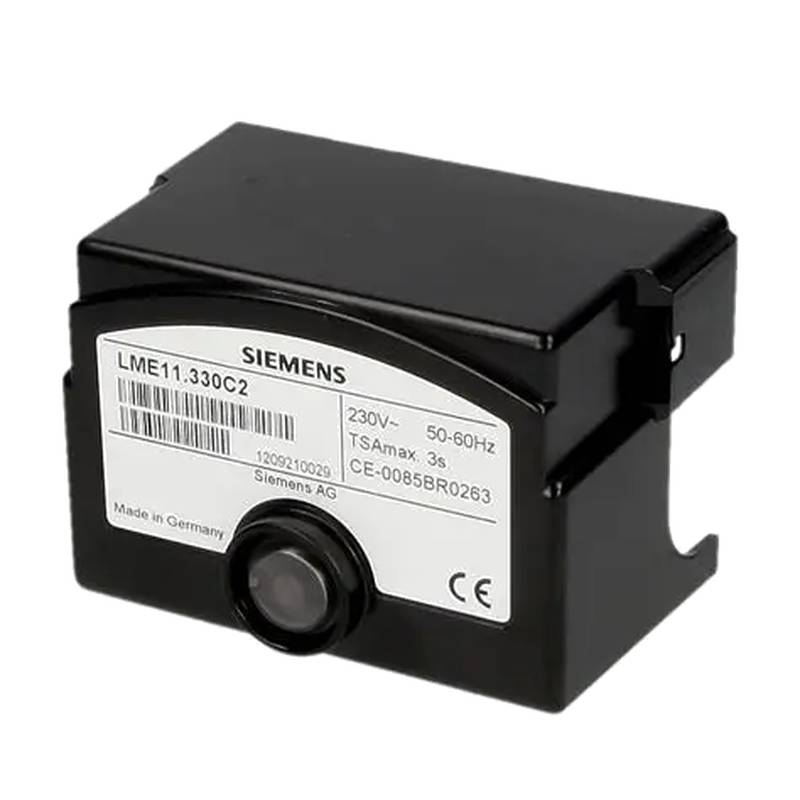
SIEMENS LME11.330C2 Burner Control Unit LME11 Compact


The SIEMENS LME11.330C2 Burner Control Unit LME11 Compact is a sophisticated, reliable solution for managing combustion processes in industrial applications. This unit excels in providing precise control, enhanced safety, and operational efficiency, making it a cornerstone for modern burner management systems. Its key advantages include a compact design for space-constrained installations, robust performance under demanding conditions, and seamless integration capabilities. Core features encompass advanced flame monitoring, safety interlock management, and a user-friendly interface for simplified operation and diagnostics. The LME11.330C2 boasts a voltage supply of 230V AC, operates within a temperature range of -20°C to +60°C, and features a maximum power consumption of 5 VA, ensuring efficient and dependable performance.
Product Specifications
| Parameter | Value |
| :-------------------- | :-------------------------- |
| Product Type | Burner Control Unit |
| Model | LME11.330C2 |
| Voltage Supply | 230V AC |
| Operating Temperature | -20°C to +60°C |
| Power Consumption | Max. 5 VA |
| Application | Compact burner control unit |
| Dimensions | Compact |
| Safety | Integrated safety functions |
Core Features & Market Positioning
The SIEMENS LME11.330C2 distinguishes itself through its integrated safety functions, crucial for preventing hazardous operating conditions in combustion systems. Its compact form factor is a significant market differentiator, allowing for installation in tight spaces where larger control units would be impractical. The unit's design emphasizes reliability and longevity, supported by Siemens' reputation for high-quality industrial automation components. This positions the LME11.330C2 as a preferred choice for original equipment manufacturers (OEMs) and end-users seeking dependable and space-efficient burner control solutions. Its advanced flame detection capabilities ensure optimal combustion and immediate response to abnormal flame conditions, contributing to overall system safety and efficiency.
Key Application Scenarios
This burner control unit is ideally suited for a wide array of industrial heating applications. It is commonly employed in controlling single-stage or two-stage gas burners, oil burners, and dual-fuel burners. Typical scenarios include process heaters, industrial boilers, and thermal oxidizers where precise and safe management of the combustion process is paramount. The LME11.330C2's robust design makes it suitable for environments requiring continuous operation and high reliability, such as in chemical plants, food processing facilities, and manufacturing operations. Its ability to manage safety interlocks and monitor flame status ensures compliance with stringent safety regulations across these diverse industrial sectors.
Practical System Integration Guidance
Integrating the SIEMENS LME11.330C2 Burner Control Unit is designed for straightforward implementation. The unit typically connects to a pre-purge fan, ignition transformer, main fuel valve, and a flame detector (e.g., a flame rod or UV scanner). Wiring follows established industrial standards, with clear terminal designations on the unit facilitating correct connections. The control unit's internal logic manages the sequence of operations, including ignition, main flame establishment, and post-purge. For commissioning, initial setup often involves verifying electrical connections and then proceeding through functional tests to ensure all safety interlocks and flame monitoring circuits operate as expected. Troubleshooting typically involves checking power supply, sensor inputs, and actuator outputs against the unit's diagnostic indicators.
Operation and Risk Mitigation
Safe operation of the SIEMENS LME11.330C2 Burner Control Unit is inherent in its design, featuring multiple safety checks to prevent hazardous situations. It monitors the presence and stability of the flame, automatically shutting down fuel supply if the flame is lost or if ignition fails within the designated timeframe. Critical error codes, if displayed or indicated, usually point to specific fault conditions such as flame failure, interlock issues, or internal component malfunctions. Users should always refer to the official Siemens documentation for a comprehensive list of error codes and their corresponding remediation steps. Proper installation, regular maintenance, and adherence to operating procedures are vital for risk mitigation and ensuring the long-term, safe performance of the combustion system.
Scalability & Long-Term Value
The SIEMENS LME11.330C2 offers dependable long-term value through its robust construction and Siemens' commitment to product support. While a compact unit, its integration capabilities allow it to be a key component within larger, more complex automation systems. It can interface with PLCs and SCADA systems for centralized monitoring and control, enabling data logging and advanced analytics. For users looking to enhance their industrial processes, the LME11.330C2 serves as a reliable foundation that can be part of a broader digital transformation strategy, supporting IIoT initiatives through its communication interfaces when integrated into a networked control architecture. Its compatibility with other Siemens automation products ensures seamless upgrades and expansion of combustion control capabilities over time.
Frequently Asked Questions
What is the primary function of the SIEMENS LME11.330C2?
It safely controls the ignition and operation of industrial burners. It sequences fuel supply and monitors flame presence.
This unit ensures the burner starts correctly and runs without hazardous conditions. It's a critical safety device for combustion systems.
It prevents fuel accumulation during failed ignition or flame loss. This mitigates explosion risks in industrial heating.
What are the main advantages of using the LME11.330C2?
Its compact design saves valuable space in control cabinets. It offers reliable and proven Siemens combustion control technology.
The unit integrates essential safety interlocks and flame monitoring. This simplifies system design and reduces component count.
It provides robust performance in demanding industrial environments. This ensures operational continuity and longevity.
Can the LME11.330C2 be used with different types of burners?
Yes, it is suitable for single and two-stage gas burners. It also works with oil burners and dual-fuel systems.
The control unit is versatile for various industrial heating applications. This includes boilers, process heaters, and thermal oxidizers.
Its flexible configuration allows adaptation to specific burner requirements. This ensures precise combustion control across different fuels.
What is the typical voltage supply for this control unit?
The SIEMENS LME11.330C2 operates on a 230V AC power supply. This is a standard voltage for many industrial electrical systems.
Ensure the power source matches this requirement for correct operation. Proper wiring to the 230V AC source is crucial.
Always verify the local power grid voltage before installation. Incorrect voltage can damage the unit.
What is the operational temperature range of the LME11.330C2?
This unit can operate reliably between -20°C and +60°C. This wide range accommodates many industrial settings.
It is designed to withstand both cold and hot operational environments. This ensures consistent performance in diverse climates.
Avoid exposing the unit to temperatures outside this specified range. Extreme temperatures can impact its functionality and lifespan.
How does the LME11.330C2 ensure burner safety?
It monitors flame conditions continuously using integrated sensors. If flame is lost, it immediately cuts off fuel supply.
Safety interlocks are managed to prevent unsafe start-ups or operations. This includes checks on air supply and valve positions.
The unit follows a strict pre-programmed sequence for ignition and operation. Any deviation triggers a safety shutdown.
What does "compact" mean in the context of the LME11.330C2?
"Compact" refers to its small physical size and footprint. This allows easy installation in confined spaces.
It enables higher control density within electrical panels. This is beneficial for OEMs with space constraints.
The reduced size simplifies handling and mounting during assembly. It is designed for efficient use of available space.
How is the LME11.330C2 commissioned?
Commissioning involves wiring all components correctly per the manual. This includes the burner, flame detector, and valves.
Functional tests are performed to verify all safety interlocks and sequences. This ensures the unit operates as intended.
Initial setup might involve setting parameters specific to the burner type. This optimizes combustion performance and safety.
What kind of flame detection does the LME11.330C2 support?
It supports common flame detection methods like flame rods. It can also be used with UV scanners for specific applications.
The choice of flame detector depends on the burner type and combustion environment. Ensure compatibility with the chosen detection method.
Proper installation and connection of the flame sensor are critical for reliable detection. This is key to the unit's safety function.
Where can I find the full technical specifications and manual?
The most detailed technical specifications and the complete operating manual are available from Siemens. Refer to the official Siemens product documentation portal.
You can also find product data sheets and manuals through authorized Siemens distributors. These resources provide in-depth information.
Always consult the latest version of the manual for accurate installation and operation guidance. This ensures compliance and safety.