











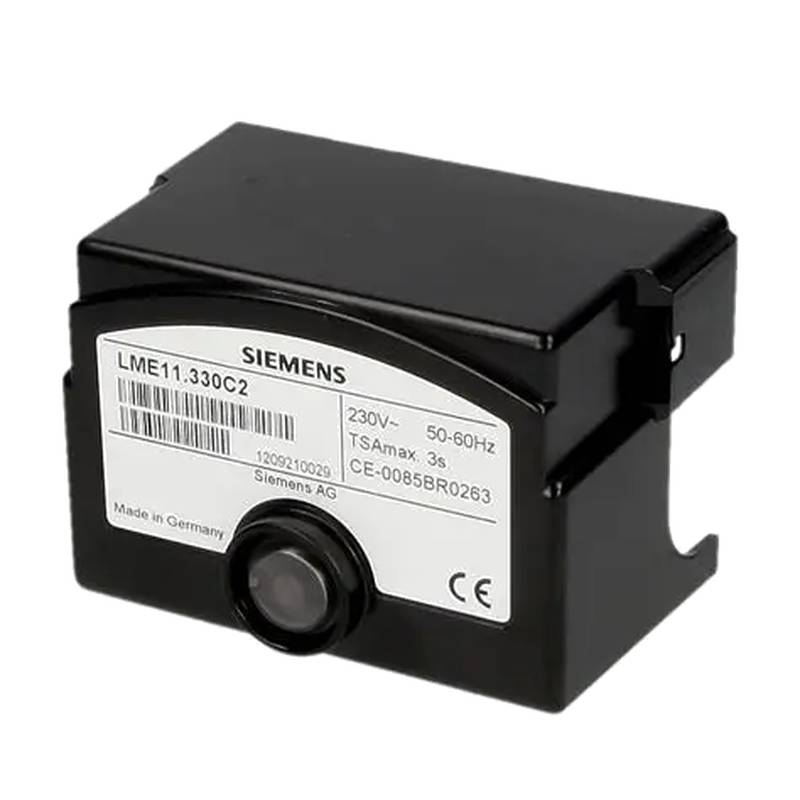
SIEMENS LME21.130C2 Burner Control Box LME21 Modulating


The SIEMENS LME21.130C2 Burner Control Box LME21 Modulating is a high-performance, reliable solution for controlling industrial burners, offering precise modulation and robust safety features. This control box is engineered to optimize combustion processes, ensuring peak efficiency and operational safety in demanding industrial environments. Its core advantages lie in its precise control capabilities, advanced safety interlocking, and straightforward integration into various burner management systems. Key technical parameters include its suitability for modulating gas and oil burners, a voltage supply of 100-240 VAC, and comprehensive diagnostic functions.
Product Specifications
| Feature | Specification |
| :---------------------- | :-------------------------------------------- |
| Product Type | Burner Control Box, Modulating |
| Manufacturer | Siemens |
| Model | LME21.130C2 |
| Voltage Supply | 100-240 VAC |
| Application | Modulating control of gas and oil burners |
| Functions | Combustion control, safety interlocking |
| Diagnostic Capabilities | Integrated diagnostics for troubleshooting |
| Protection Class | IP 40 |
| Operating Temperature | -20 to +60 °C |
Core Features & Market Positioning
The SIEMENS LME21.130C2 distinguishes itself through its sophisticated modulating control algorithm, enabling fine-tuned fuel-air ratio adjustments for optimal combustion efficiency and reduced emissions. This advanced control is critical for industrial processes requiring precise temperature regulation, positioning the LME21 series as a premium choice for discerning engineers and plant operators. Its market positioning is reinforced by Siemens' reputation for industrial automation reliability and innovation, offering a robust solution that minimizes downtime and operational costs. The integrated diagnostic features simplify troubleshooting and maintenance, further enhancing its value proposition in competitive industrial markets.
Key Application Scenarios
This burner control box finds extensive application in various industrial heating and process applications where modulating burner control is paramount. It is ideally suited for use in industrial boilers, process heaters, thermal oxidizers, and specialized combustion equipment across sectors such as chemical manufacturing, food and beverage processing, and power generation. The LME21.130C2 is particularly valuable in scenarios demanding consistent output temperatures and efficient fuel utilization, such as those requiring precise control for material curing, drying, or steam generation. Its adaptability allows for seamless integration into existing plant infrastructure, making it a go-to component for modernizing combustion systems.
Practical System Integration Guidance
Integrating the SIEMENS LME21.130C2 into an industrial system involves careful attention to electrical connections and system configuration. The unit requires proper wiring of power supply, actuator, flame sensor, and auxiliary interlocks according to the wiring diagram provided in the technical documentation. For modulating control, the LME21.130C2 interfaces with a modulating actuator that adjusts fuel and air dampers in response to a demand signal, typically from a PLC or temperature controller. Proper grounding and electrical noise suppression are essential for reliable operation. A pre-purge and post-purge sequence is standard, ensuring safe startup and shutdown cycles.
Operation and Risk Mitigation
Safe and efficient operation of the SIEMENS LME21.130C2 Burner Control Box is ensured through its built-in safety interlocks and diagnostic capabilities. Before commissioning, engineers must verify that all safety devices, such as pressure switches and limit controls, are correctly wired and functioning within their set parameters. The control box monitors the flame signal continuously during operation and initiates a shutdown sequence if a flame failure is detected or if any critical safety parameters are violated. Error codes are displayed on the unit or can be accessed via a connected interface, providing specific guidance for troubleshooting and preventing recurrence of issues. Regular maintenance and adherence to operational guidelines are crucial for mitigating risks associated with industrial combustion.
Scalability & Long-Term Value
The SIEMENS LME21.130C2 offers excellent scalability and long-term value, particularly when integrated into broader Siemens automation platforms. Its compatibility with various Siemens actuators and flame sensors ensures a cohesive system design. While the LME21.130C2 itself is a dedicated burner controller, its integration capabilities allow it to be part of a larger Distributed Control System (DCS) or SCADA system, enabling remote monitoring, data logging, and advanced process optimization. This connectivity facilitates the adoption of IIoT strategies, allowing for predictive maintenance and performance analytics, thereby extending the operational lifespan and economic benefits of the combustion system.
FAQs
What are the primary advantages of the SIEMENS LME21.130C2?
It offers precise modulating combustion control for optimal efficiency.
Its robust safety features ensure reliable and secure burner operation.
The integrated diagnostics simplify troubleshooting and reduce downtime.
What types of burners can the LME21.130C2 control?
This control box is designed for modulating gas burners.
It is also suitable for modulating oil burners, providing versatile application.
It can be used with single or two-stage burners in modulating service.
How does the LME21.130C2 ensure burner safety?
It incorporates essential safety interlocks for critical system parameters.
Continuous flame monitoring detects flame loss and initiates shutdown.
Pre- and post-purge cycles ensure safe startup and shutdown procedures.
What is the typical voltage requirement for the LME21.130C2?
The unit operates on a wide voltage supply range of 100 to 240 VAC.
This broad voltage compatibility simplifies installation across different power grids.
Ensure the supply voltage is stable and within the specified tolerance for optimal performance.
How do I troubleshoot issues with the LME21.130C2?
Utilize the integrated diagnostic codes for fault identification.
Consult the technical manual for detailed explanations of error codes and their solutions.
Verify all electrical connections and ensure proper signal integrity from sensors.
Can the LME21.130C2 be used for single-stage burners?
Yes, it can manage single-stage burners effectively in modulating applications.
It allows for the burner to operate at a specific, optimized output level.
The control box ensures safe sequencing and flame monitoring for single-stage operation.
What are the environmental operating limits for this control box?
The LME21.130C2 operates within an ambient temperature range of -20 to +60 °C.
Its IP40 protection class shields it from solid objects larger than 1mm.
Avoid exposure to excessive humidity, dust, or corrosive atmospheres beyond its rating.
How does the modulating control function work?
It adjusts fuel and air input proportionally to meet heat demand.
This precise ratio control optimizes combustion and minimizes emissions.
An external modulating actuator executes the damper and fuel valve adjustments.
What is the role of the flame sensor with the LME21.130C2?
The flame sensor provides a crucial signal to confirm burner ignition and flame presence.
It continuously monitors the flame during operation to detect any loss.
Different flame sensor types (e.g., UV scanner, flame rod) may be compatible.
How can the LME21.130C2 be integrated into a larger control system?
It can interface with PLCs or SCADA systems via its input/output terminals.
This allows for remote monitoring, control, and data acquisition.
It forms a key component in a comprehensive industrial automation and control architecture.