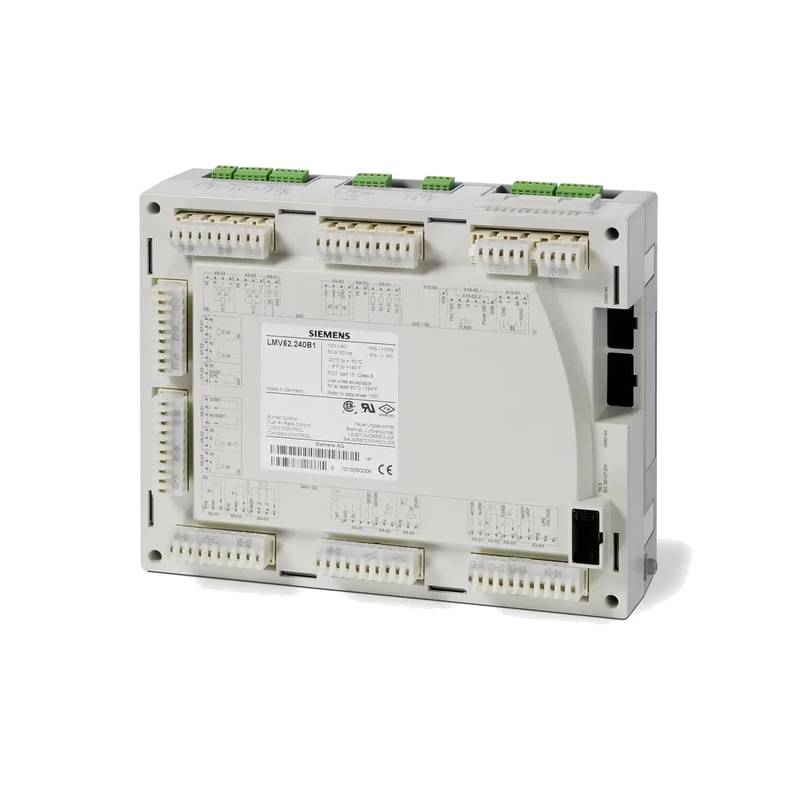
SIEMENS LMV51.300B2 LMV5 Electronic Air/Fuel Control 230V


The SIEMENS LMV51.300B2 is an advanced electronic air/fuel control unit designed for high-capacity boiler systems and industrial furnace applications. This microprocessor-based burner management system ensures precise fuel-air ratio control, leading to significant energy savings and reduced emissions. Its robust design supports both single and dual-fuel operations, offering versatility for various industrial heating processes. Key technical parameters include a 230V AC power supply with a frequency range of 50/60 Hz, an operating temperature range of -20°C to +60°C, and a protection class of IP40. The unit features continuous (PID) and 2-stage modulation capabilities, CAN-bus expandability for O2 sensors and actuators, and Modbus communication compatibility. Safety functions are paramount, including flame supervision, leakage tests, and limit monitoring, contributing to safe and reliable operation.
Product Specifications
| Specification | Value |
| :-------------------- | :------------------------------------------------------- |
| Product Name | SIEMENS LMV51.300B2 LMV5 Electronic Air/Fuel Control |
| Power Supply | 230 V AC, 50/60 Hz |
| Modulation | Continuous (PID control), 2-stage |
| Expandability | CAN-Bus connections (O2 sensor, actuators, etc.) |
| HMI Compatibility | Compatible with AZL2 series displays |
| Communication | CAN-Bus, Modbus |
| Safety Functions | Flame supervision, leakage test, limit monitoring |
| Temperature Range | -20 °C to +60 °C |
| Protection Class | IP40 (in housing) |
| Actuator Control | Up to 4 actuators (LMV50/LMV51), up to 6 (LMV52) |
| Mode of Operation | Type 2B in accordance with DIN EN 60730-1 |
| Under Voltage Detection | 196V-250VAC |
| Designed Lifetime | 250,000 startup cycles (approx. 10 years) |
Core Features & Market Positioning
The SIEMENS LMV51.300B2 distinguishes itself in the market through its advanced electronic air-fuel ratio control, a significant upgrade from traditional mechanical systems. This "linkageless" technology offers superior precision, leading to higher combustion efficiency and reduced environmental impact. The unit is designed for longevity, boasting a designed lifetime of 250,000 startup cycles, equating to approximately 10 years of service under normal operating conditions. Its modular design and CAN-bus expandability allow for flexible integration with various sensors and actuators, including O2 trim control and Variable Speed Drive (VSD) modules, positioning it as a future-proof solution for sophisticated combustion control. The LMV5 series, in general, is recognized for its user-friendly interface, simplifying commissioning and maintenance processes, which translates to lower operational costs for end-users.
Key Application Scenarios
The SIEMENS LMV51.300B2 is ideally suited for demanding applications requiring precise and efficient combustion control. Its primary applications include high-capacity boiler systems, industrial furnace and process heating systems, and systems that require combined burner control for optimal performance and emissions management. It is particularly effective in low-emission systems that utilize O2 trim control to fine-tune the air-fuel mixture, ensuring compliance with stringent environmental regulations. Furthermore, its capability to manage dual-fuel operations makes it a versatile choice for facilities that switch between oil and gas fuels, providing seamless transitions and continuous operational efficiency. The unit's integrated PID temperature/pressure controller also makes it suitable for thermal fluid heaters and industrial heating processes where precise temperature regulation is critical.
Practical System Integration Guidance
Integrating the SIEMENS LMV51.300B2 into an existing or new system requires careful attention to wiring and configuration. The unit utilizes CAN-bus for connecting peripherals like O2 sensors and actuators, enabling a robust and efficient communication network. Electrical connections for flame detectors, such as ionization probes or UV/IR detectors, are crucial for safe operation and require proper signal transmission integrity. The system's modularity allows for integration with external systems, including PLCs, via Modbus communication, offering flexibility in system architecture. For optimal performance, it is recommended to ensure correct parameter settings according to the specific application standards and fuel types, which can be managed through the AZL5 series display and operating unit. Attention to wiring, especially for the CAN bus and power supply, is critical for reliable communication and operation.
Operation and Risk Mitigation
Safe and efficient operation of the SIEMENS LMV51.300B2 relies on understanding its safety features and potential troubleshooting scenarios. The unit incorporates comprehensive safety functions, including flame supervision, gas valve proving, and leakage tests, to prevent hazardous conditions. Error codes and fault histories are logged, aiding in diagnostics and troubleshooting. Common issues might involve CAN-bus communication errors, which can be mitigated by checking wiring integrity, power supply to the bus, and the shielding of the CAN bus cable. In cases of flame failure or other critical errors, the LMV5 system is designed to initiate a safe shutdown sequence. Regular maintenance and adherence to operational guidelines, as detailed in the product manuals, are essential for mitigating risks and ensuring the long-term reliability of the system.
Scalability & Long-Term Value
The SIEMENS LMV51.300B2 offers significant scalability and long-term value, primarily due to its CAN-bus expandability and compatibility with a wide range of Siemens combustion control components. The LMV5 series is designed to be integrated into broader industrial automation systems, supporting Modbus communication for seamless data exchange with building automation systems and PLCs. This allows for remote monitoring, control, and integration with Industrial Internet of Things (IIoT) platforms, providing insights into operational efficiency and predictive maintenance capabilities. The availability of optional modules, such as O2 trim control and VSD control, allows users to enhance system performance and efficiency over time, adapting to evolving operational needs and regulatory requirements. The system's robust construction and designed lifetime of 250,000 startup cycles further underscore its long-term value proposition.
Frequently Asked Questions
1. What is the primary function of the SIEMENS LMV51.300B2?
The SIEMENS LMV51.300B2 is an advanced electronic burner management system. It precisely controls the air-fuel ratio for optimal combustion efficiency in gas and oil burners. This unit ensures safe operation through integrated safety functions.
2. What are the key technical specifications of the SIEMENS LMV51.300B2?
This control unit operates on a 230V AC power supply (50/60 Hz) and functions within a temperature range of -20°C to +60°C. It supports continuous (PID) and 2-stage modulation and is compatible with CAN-bus and Modbus communication protocols.
3. In which industrial applications is the SIEMENS LMV51.300B2 typically used?
The LMV51.300B2 is ideal for high-capacity boiler systems and industrial furnace applications. It is also highly effective in low-emission systems requiring O2 trim control and for dual-fuel burner applications.
4. How does the LMV51.300B2 ensure safe burner operation?
It incorporates critical safety features such as flame supervision, gas valve proving, and leakage tests. These functions continuously monitor the combustion process and will initiate a safe shutdown if any anomaly is detected.
5. What are the advantages of electronic air-fuel ratio control offered by the LMV51.300B2?
Electronic control provides superior precision and repeatability compared to mechanical systems. This leads to enhanced combustion efficiency, reduced fuel consumption, lower emissions, and simpler burner design.
6. Can the SIEMENS LMV51.300B2 be integrated with other control systems?
Yes, the LMV51.300B2 supports Modbus communication, allowing for seamless integration with PLCs and building automation systems for advanced control and monitoring.
7. What is the expected lifespan of the SIEMENS LMV51.300B2?
The unit has a designed lifetime of approximately 250,000 startup cycles, which typically translates to about 10 years of service under normal operating conditions.
8. Does the LMV51.300B2 support variable speed drive (VSD) control?
Yes, VSD control is an available option, often integrated with modules like the LMV52, enabling more precise control of combustion air blowers for improved efficiency and safety.
9. What troubleshooting steps can be taken for common issues with the LMV51.300B2?
Common issues like CAN-bus communication failures can often be resolved by checking wiring integrity, power supply, and shielding. Reviewing logged error codes on the HMI is also crucial for diagnosing specific problems.
10. What makes the LMV51.300B2 a long-term valuable investment?
Its scalability through CAN-bus, compatibility with IIoT platforms, and optional upgrade modules like O2 trim and VSD control ensure the system can adapt to future needs, maximizing its operational life and return on investment.