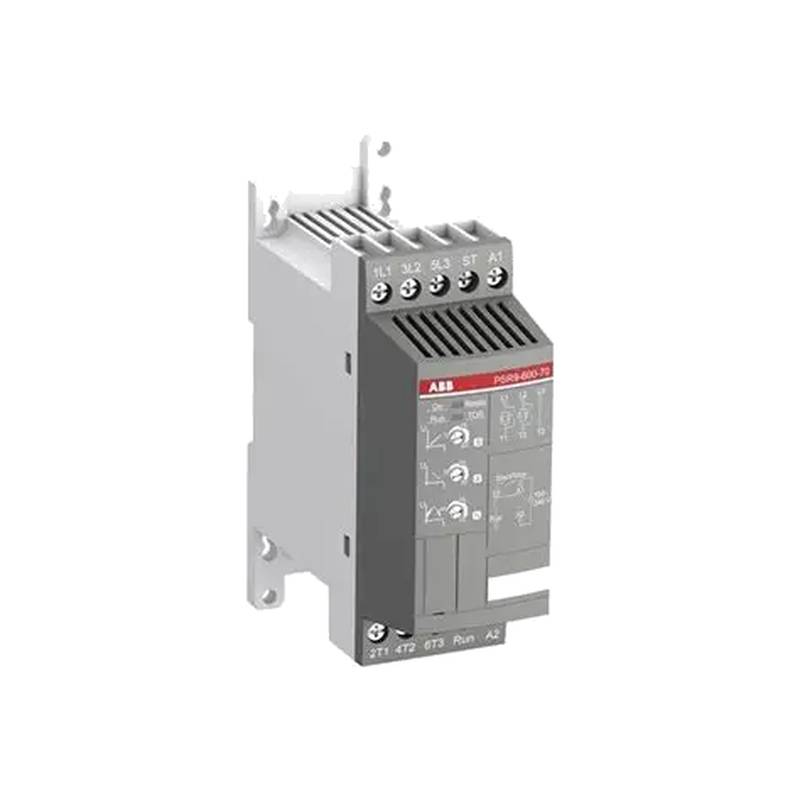
SIEMENS 6ES7417-4XT05-0AB0 S7-400 CPU 417-4 High-Performance PLC


The Siemens 6ES7417-4XT05-0AB0 is a high-performance S7-400 CPU 417-4 central processing unit designed for demanding automation tasks. This module provides advanced processing capabilities for complex control applications.
Product Type Definition
This device is classified as a high-end Programmable Logic Controller (PLC) CPU within the Siemens SIMATIC S7-400 product family. It is engineered for critical industrial automation systems requiring substantial processing power and memory.
Key Specifications
Processor Type: 32-bit RISC
Clock Speed: 100 MHz
Memory: 12 MB RAM, 8 MB Load Memory
I/O Capacity: Up to 131,072 digital, 4,096 analog
Backplane Bus Transfer Rate: 10 MB/s
Operating Temperature: 0 to 55 degrees Celsius
Dimensions (W x H x D): 140 x 290 x 219 mm
Certifications: UL, CSA, FM, IEC, CE
Technical Highlights & System Integration
Powerful Processing: The CPU 417-4 boasts a 100 MHz clock speed and a 32-bit RISC architecture, enabling it to execute complex logic and handle extensive data processing efficiently. This high processing power is critical for real-time control of intricate manufacturing processes and large-scale plant operations.
Extensive Memory: With 12 MB of RAM and 8 MB of load memory, this CPU supports large, sophisticated automation projects, including extensive data logging and complex algorithms. The substantial memory capacity ensures smooth operation even with very large application programs and data sets.
Scalable System Architecture: The S7-400 platform, utilizing the CPU 417-4, allows for significant system expansion by integrating numerous I/O modules and communication processors. This scalability permits adaptation to evolving plant requirements and the integration of diverse automation subsystems. What is the maximum number of I/O points supported by the S7-400 system with this CPU? The S7-400 system, when equipped with the CPU 417-4, can support up to 131,072 digital I/O points and 4,096 analog I/O points, providing extensive connectivity for complex industrial environments.
High-Speed Communication: The integrated MPI (Multi-Point Interface) and the option for PROFIBUS DP master/slave configurations facilitate high-speed data exchange between controllers and distributed I/O. This ensures rapid communication for time-critical control loops and system synchronization.
Redundancy Capabilities: The CPU 417-4 supports redundancy configurations, allowing for high availability and continuous operation in critical applications where downtime is unacceptable. This feature ensures that if one CPU fails, a redundant unit can seamlessly take over control.
Key Application Scenarios
High-Speed Batch Processing: Enables precise control and rapid sequencing for complex batch operations, reducing cycle times by up to 15%.
Large-Scale Material Handling: Manages intricate routing and coordination of numerous conveyors and sorting systems, improving throughput by 10%.
Complex Motion Control: Executes sophisticated multi-axis motion profiles for robotics and automated assembly lines with high accuracy and repeatability.
Process Automation in Petrochemicals: Provides robust control for critical refining processes requiring high reliability and extensive data acquisition, ensuring operational stability.
Selection Guidance & Operation
System Requirements Analysis: Evaluate the total I/O count, processing speed requirements for control logic, and communication protocols needed for plant integration. Accurate assessment ensures the CPU meets the demands without over-provisioning.
Memory Allocation Planning: Determine the program size, data block requirements, and any logging or archiving needs to select the appropriate memory configuration. Efficient memory management optimizes performance and prevents runtime errors.
Integration with Existing Infrastructure: Verify compatibility with existing Siemens hardware, such as I/O modules and communication cards, and ensure seamless integration with higher-level SCADA or MES systems. Compatibility minimizes engineering effort and commissioning time.
Operating Environment Considerations: Confirm that the operating temperature range, power supply requirements, and physical space within the control cabinet are suitable for the intended installation location. Adherence to environmental specifications guarantees reliable operation.
FAQ
What are the primary advantages of using the Siemens 6ES7417-4XT05-0AB0 CPU 417-4 in high-performance automation?
The CPU 417-4 offers superior processing power for complex logic and rapid data handling. Its extensive memory supports sophisticated applications and large data volumes.
This high-performance unit enables efficient execution of demanding control tasks, crucial for industries with complex operational requirements. It provides the computational backbone for advanced automation strategies.
The CPU’s architecture is optimized for speed and reliability, ensuring timely responses in critical automation scenarios and supporting high throughput.
How does the memory capacity of the CPU 417-4 impact its application suitability?
The 12 MB RAM and 8 MB load memory allow for the implementation of very large and complex automation programs. This extensive capacity is ideal for projects with extensive user code and substantial data management needs.
Applications requiring significant data logging, historical trending, or complex algorithmic calculations benefit greatly from this generous memory endowment. It ensures that performance does not degrade with program size.
Engineers can develop more feature-rich and advanced control strategies without being constrained by memory limitations, leading to more optimized and capable automation solutions.
What industrial standards and certifications does the Siemens 6ES7417-4XT05-0AB0 CPU 417-4 comply with?
The CPU 417-4 holds certifications including UL, CSA, FM, and CE, meeting rigorous international safety and performance benchmarks. These approvals are essential for deployment in regulated industries and global markets.
Compliance with IEC standards further assures its suitability for demanding industrial environments and interoperability within standardized automation systems. It signifies adherence to established best practices.
These certifications underscore the product’s reliability and suitability for critical applications, providing assurance for integrators and end-users regarding its quality and safety.
Can the CPU 417-4 be used in redundant configurations for high availability systems?
Yes, the CPU 417-4 is designed to support redundant configurations for enhanced system availability. This feature is critical for preventing operational downtime in essential industrial processes.
Implementing redundancy ensures that control operations continue uninterrupted even in the event of a single CPU module failure. This provides a robust safety net for continuous production.
Redundant setups are vital for industries where unscheduled shutdowns can lead to significant financial losses or safety risks, making this CPU a valuable component for such deployments.
What is the typical communication speed and protocol support for this CPU?
The CPU 417-4 supports high-speed communication through its MPI interface, operating at 12 MB/s. It also facilitates PROFIBUS DP master/slave communication for efficient networking.
These communication capabilities enable fast data exchange with distributed I/O modules and other automation devices, which is essential for real-time control. It ensures efficient system integration.
The robust communication options allow for flexible and high-performance integration into complex industrial networks, supporting diverse automation architectures.