











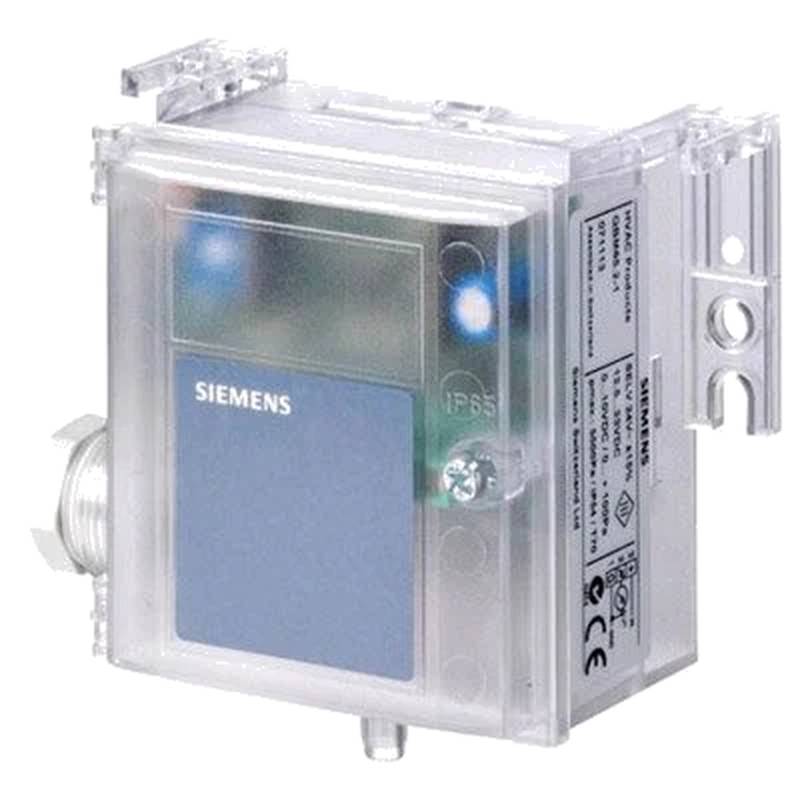
SIEMENS QBM3020-1 Differential Pressure Sensor 100 Pa Duct


The SIEMENS QBM3020-1 Differential Pressure Sensor 100 Pa Duct is engineered for precise and reliable measurement of air and non-combustible gas pressures within HVAC and building automation systems. This sensor excels with its robust construction, offering a selectable measuring range, integrated mounting flange, and a user-friendly interface for rapid installation and commissioning. Key technical parameters include a selectable differential pressure range of 0-100 Pa or 0-500 Pa, an output signal of 0-10 V or 4-20 mA, and an operating temperature range of -20 to +50°C. Its IP54 protection rating ensures durability in demanding industrial environments, making it a superior choice for critical airflow monitoring applications.
Core Features & Market Positioning
The SIEMENS QBM3020-1 stands out in the market due to its inherent flexibility and Siemens' reputation for industrial-grade quality. The sensor's ability to offer two distinct pressure ranges (0-100 Pa and 0-500 Pa) via simple configuration reduces the need for stocking multiple devices, thereby optimizing inventory and reducing costs for facility managers and system integrators. This adaptability, coupled with its precision and the trust associated with the Siemens brand, positions the QBM3020-1 as a premium, yet cost-effective, solution for demanding differential pressure monitoring tasks. Its integrated mounting flange simplifies duct installation, a significant advantage over sensors requiring separate mounting hardware.
Key Application Scenarios
This differential pressure sensor is ideally suited for a wide array of HVAC and building automation applications where precise airflow control is paramount. Common use cases include monitoring static pressure in ventilation ducts to ensure optimal airflow delivery, controlling fan speed based on pressure differentials, and verifying the performance of air filters by measuring pressure drop. It is also vital for maintaining room pressure differentials in critical environments such as laboratories, cleanrooms, and operating theaters, ensuring controlled air exchange and preventing cross-contamination. Facility managers frequently utilize the SIEMENS QBM3020-1 for zone control, variable air volume (VAV) box control, and general building performance diagnostics.
Practical System Integration Guidance
Integrating the SIEMENS QBM3020-1 into existing systems is straightforward, facilitated by its versatile output options and straightforward wiring. The sensor typically connects to a Building Management System (BMS) or a Programmable Logic Controller (PLC) using its 0-10 V or 4-20 mA analog output. For duct mounting, the integrated flange allows for direct attachment to standard ductwork, often requiring only a few screws. Power supply requirements are typically 24 VAC or VDC, depending on the specific model configuration, and must be correctly applied to the designated terminals. Careful consideration of the selected pressure range during initial setup ensures accurate readings for the intended application.
Operation and Risk Mitigation
Proper operation of the SIEMENS QBM3020-1 relies on adhering to its specified environmental and electrical conditions. Risks of malfunction can be mitigated by avoiding installation in areas with excessive dust, moisture, or corrosive gases, despite its IP54 rating, and by ensuring the power supply is stable and within the specified voltage range. Over-pressurization beyond the selected range can damage the sensor; therefore, system design should incorporate safeguards or verify that system pressures remain within the sensor's limits. Regular visual inspection of the sensor and its connections can help identify potential issues early, preventing system downtime.
Scalability & Long-Term Value
The SIEMENS QBM3020-1 offers excellent long-term value through its compatibility with Siemens' broader range of automation products and its ability to integrate into evolving digital infrastructures. Its standard analog output signals make it easily adaptable to numerous BMS platforms, ensuring it can remain a functional component even as control systems are upgraded. For facilities moving towards Industrial Internet of Things (IIoT) solutions, sensors like the QBM3020-1 provide foundational data that can be leveraged by more advanced analytics platforms, contributing to energy efficiency optimization and predictive maintenance strategies. This inherent flexibility ensures the sensor remains relevant and valuable over the lifespan of building infrastructure.
*
Frequently Asked Questions
Q1: What is the primary function of the SIEMENS QBM3020-1?
The SIEMENS QBM3020-1 is a differential pressure sensor designed for HVAC and building automation. It accurately measures air and non-combustible gas pressures. This enables critical airflow control and monitoring within ventilation systems.
Its core purpose is to provide reliable differential pressure data for system regulation. It ensures precise environmental control in various building applications.
This sensor is crucial for maintaining desired static pressure levels. It supports applications requiring precise airflow management and system diagnostics.
Q2: What are the selectable pressure ranges for the QBM3020-1?
This sensor offers users two selectable differential pressure ranges. The available ranges are 0-100 Pascal and 0-500 Pascal.
Configuration of the desired range is typically done via dip switches or simple jumper settings. This allows for tailored application-specific calibration.
Selecting the appropriate range ensures optimal accuracy and sensitivity for the intended monitoring task. It prevents over-ranging and potential damage.
Q3: What output signals does the SIEMENS QBM3020-1 provide?
The QBM3020-1 sensor provides standard analog output signals for integration. It offers either a 0-10 Volt or a 4-20 milliampere output.
These signals are compatible with most Building Management Systems (BMS) and Programmable Logic Controllers (PLCs). This ensures easy connection to control hardware.
The choice between voltage and current output allows flexibility in system design and wiring practices. Both are industry-standard for pressure transmitter signals.
Q4: How is the QBM3020-1 installed in a duct?
Installation is simplified by an integrated mounting flange. This flange allows direct attachment to ventilation ducts.
The sensor's port is typically inserted into the duct, and the flange is secured with screws. Proper sealing is important for accurate readings.
Ensure the sensor is mounted in a location representative of the desired pressure measurement point. Avoid turbulent airflow areas if possible.
Q5: What is the IP rating of the QBM3020-1 and what does it signify?
The SIEMENS QBM3020-1 has an IP54 protection rating. This means it is protected against dust ingress and splashing water.
The "5" in IP54 indicates a high level of dust protection, though not complete. The "4" signifies protection against water spray from any direction.
This rating makes the sensor suitable for many industrial and commercial environments. However, it is not intended for submersion.
Q6: Can the QBM3020-1 be used for measuring positive and negative pressures?
Yes, this sensor is designed for differential pressure measurement. It can effectively measure both positive and negative pressure differences.
It monitors the pressure between two points, which can include atmospheric pressure or another duct section. This allows for various airflow control strategies.
The sensor's ability to read in both directions is fundamental to its application in HVAC for static pressure and airflow monitoring. It provides a relative pressure value.
Q7: What are the typical operating temperature and humidity limits for this sensor?
The sensor operates reliably within a temperature range of -20 to +50 degrees Celsius. This covers most standard building and industrial operating conditions.
Relative humidity specifications should be checked in the full datasheet. However, it's designed for typical indoor HVAC environments.
Avoid exposing the sensor to extreme temperatures or high condensation to ensure longevity and performance accuracy. Proper ventilation around the sensor is advisable.
Q8: How does the QBM3020-1 contribute to energy efficiency in buildings?
By accurately measuring airflow and pressure, the sensor enables precise control of ventilation systems. This optimization prevents over-ventilation and reduces unnecessary fan energy consumption.
It supports variable air volume (VAV) systems, where airflow is adjusted based on demand. This fine-tuning minimizes energy waste.
The data provided can also be used for monitoring filter performance. Clogged filters cause increased fan power usage, which this sensor can help identify.
Q9: Is the QBM3020-1 compatible with older Siemens control systems?
Generally, Siemens products maintain a degree of backward compatibility. The QBM3020-1's standard analog outputs ensure broad compatibility.
Its integration with older Siemens systems often depends on the specific interface of the legacy controller. However, it's designed for modern automation integration.
Consulting Siemens' compatibility charts or technical support is recommended for specific legacy system integration queries. Datasheets provide technical connection details.
Q10: Where can I find the official product datasheet for the SIEMENS QBM3020-1?
The official product datasheet is available on the Siemens Building Technologies website. Searching for "SIEMENS QBM3020-1 datasheet" will direct you.
You can also often find datasheets through authorized Siemens distributors or industrial automation component suppliers. These sites usually offer downloadable PDF documents.
The datasheet contains the most comprehensive technical specifications, wiring diagrams, and application notes for the product. Always refer to it for definitive information.