











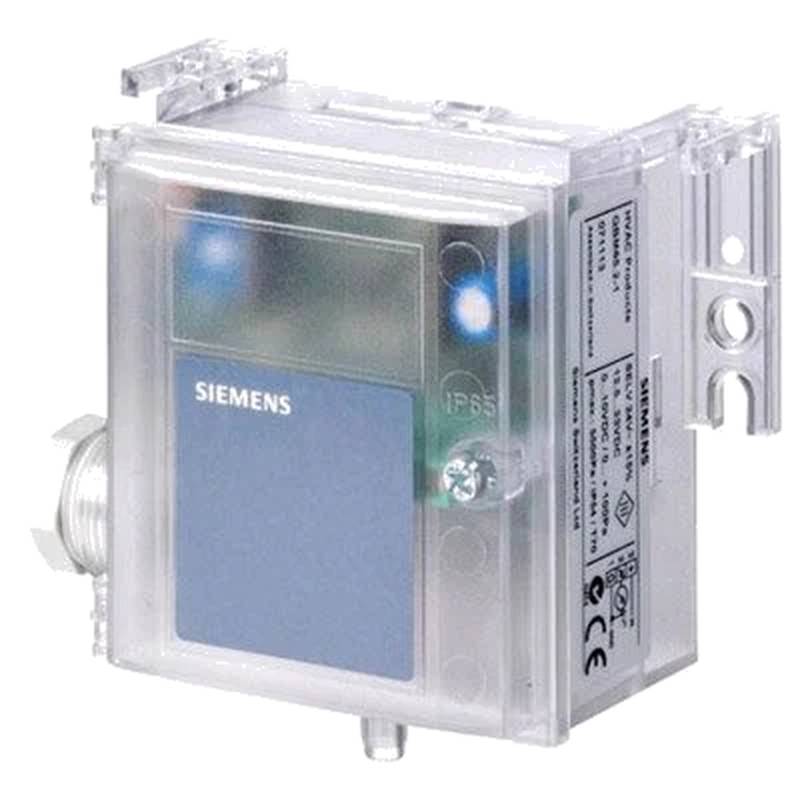
SIEMENS QBM3020-1U Differential Pressure Sensor Universal 100 Pa


The SIEMENS QBM3020-1U Differential Pressure Sensor is engineered for precise and reliable measurement of differential pressure in HVAC and building automation systems. Offering a universal range of 100 Pa, this device excels in applications requiring accurate airflow monitoring and control. Its robust design ensures long-term stability and dependable performance, making it a cornerstone for energy efficiency and system optimization. Key technical parameters include a measurement range of 0 to 100 Pa, an output signal of 0-10 VDC, and power requirements of 24 VAC/VDC. The QBM3020-1U is designed for straightforward installation and seamless integration into existing control infrastructures.
Product Specifications
| Parameter | Specification |
| :-------------------- | :--------------------------------------------- |
| Product Type | Differential Pressure Sensor |
| Model | QBM3020-1U |
| Measurement Range | 0...100 Pa |
| Output Signal | 0...10 VDC |
| Power Supply | 24 VAC / VDC |
| Accuracy | ±1.5 Pa (within 0-50 Pa), ±3 Pa (within 50-100 Pa) |
| Operating Temperature | -20...+50 °C |
| Ingress Protection | IP54 |
| Mounting | Wall or duct mounting |
| Connection Type | Screw terminals |
Core Features & Market Positioning
The SIEMENS QBM3020-1U differentiates itself through its universal applicability and Siemens' commitment to quality and innovation. This sensor is positioned as a high-value solution for building automation, offering precise differential pressure readings crucial for fan coil units, VAV boxes, and air handling units. Its ability to provide a linear 0-10 VDC output simplifies integration with a wide array of Building Management Systems (BMS) and controllers. The robust construction and IP54 rating ensure operational reliability even in demanding industrial environments, setting it apart from less durable alternatives and underscoring its value in long-term operational cost savings.
Key Application Scenarios
This versatile differential pressure sensor is indispensable across numerous HVAC and building automation scenarios. It is expertly deployed for monitoring fan status, ensuring optimal filter performance by detecting pressure drop, and controlling airflow in ventilation systems. The SIEMENS QBM3020-1U is also critical for maintaining pressure differentials in cleanrooms and laboratories, where precise air quality control is paramount. Its universal 100 Pa range makes it ideal for general-purpose pressure monitoring in applications such as controlling variable air volume (VAV) systems and ensuring the correct operation of air handling units.
Practical System Integration Guidance
Integrating the SIEMENS QBM3020-1U differential pressure sensor into your system is a streamlined process. For installation, secure the sensor to a flat surface using the provided mounting points or directly onto a duct, ensuring a leak-free connection for the pressure ports. Wiring involves connecting the power supply (24 VAC/VDC) to terminals 1 and 2, and the output signal (0-10 VDC) to terminals 3 and 4, with terminal 4 serving as the common ground. For commissioning, after powering the system, the sensor will output a signal proportional to the measured differential pressure. It's advisable to calibrate the sensor against a known reference if extreme precision is required, though its inherent accuracy often negates this need for standard applications.
Operation and Risk Mitigation
Operating the SIEMENS QBM3020-1U differential pressure sensor requires adherence to its specified environmental conditions. Avoid exposing the sensor to pressures exceeding its rated range, as this can lead to inaccurate readings or permanent damage. Regular inspection of tubing connections to prevent leaks is crucial for maintaining measurement integrity. In case of erratic readings, first verify power supply and wiring connections. A common troubleshooting step is to ensure that the pressure ports are not obstructed. While the QBM3020-1U is designed for reliability, fault codes are not typically generated; instead, observe the output signal behavior to diagnose potential issues, such as a zero-offset drift that may require recalibration.
Scalability & Long-Term Value
The SIEMENS QBM3020-1U offers significant long-term value through its compatibility with Siemens' broader Desigo™ building automation platform and other industry-standard BMS. This ensures seamless integration into existing or future digitalized building management strategies, including the Internet of Things (IIoT) ecosystem. Its robust design guarantees a long operational lifespan, minimizing replacement costs and downtime. While the sensor itself is not upgradeable, its straightforward communication protocol and standard output signal mean it can easily interface with advanced control logic or data analytics platforms as building management systems evolve, providing a scalable foundation for smart building initiatives.
Frequently Asked Questions
What is the measurement range of the SIEMENS QBM3020-1U?
The SIEMENS QBM3020-1U sensor measures differential pressure within a precise range. It is specifically designed for applications requiring sensitivity up to 100 Pascals. This range is ideal for low-pressure HVAC systems.
This universal range allows for accurate monitoring in various building automation tasks. It's suitable for controlling airflow and fan operation effectively.
The sensor's 0-100 Pa capability ensures high resolution for subtle pressure changes. This precision is key for optimizing energy consumption.
How is the SIEMENS QBM3020-1U powered?
This differential pressure sensor operates on a universal power supply. It accepts either 24 volts AC or 24 volts DC. This flexibility simplifies integration.
Ensure the power source is stable and within the specified voltage range. Incorrect voltage can damage the unit.
Terminal connections for power are clearly marked on the device for straightforward wiring. Always follow proper electrical safety procedures.
What type of output signal does the SIEMENS QBM3020-1U provide?
The SIEMENS QBM3020-1U outputs a linear 0-10 VDC signal. This analog output is standard in many control systems. It corresponds directly to the measured pressure.
This voltage output makes it easy to interface with PLCs, BMS, and other controllers. The signal is easily scaled in software.
Higher pressure differentials will result in a higher voltage output within the 0-10 VDC range. This predictable output simplifies system configuration.
Can the SIEMENS QBM3020-1U be used for filter monitoring?
Yes, the QBM3020-1U is highly effective for monitoring air filters. It measures the pressure drop across the filter element. A rising pressure drop indicates a clogged filter.
This allows for timely filter replacement, ensuring optimal HVAC system performance. It also prevents increased energy consumption from overworking fans.
The 100 Pa range is well-suited for typical filter differential pressures encountered in HVAC. This proactive maintenance prevents system issues.
What are the typical applications for this sensor?
This sensor is common in HVAC and building automation. It's used for airflow control in VAV boxes and ducts. Fan status monitoring is another key application.
It's also valuable for maintaining pressure differentials in sensitive areas. Examples include cleanrooms and laboratories requiring precise air control.
General pressure monitoring and differential pressure indication in industrial processes are also well within its capabilities. Its versatility is a major advantage.
What is the accuracy of the SIEMENS QBM3020-1U?
The accuracy varies slightly within its measurement range. From 0-50 Pa, it offers an accuracy of ±1.5 Pa. This is very precise for low-pressure applications.
For the upper portion of the range, 50-100 Pa, the accuracy is ±3 Pa. This specification ensures reliable readings across its entire operational span.
These accuracy figures are critical for applications where precise airflow control impacts comfort and energy efficiency. It meets demanding industrial standards.
What is the ingress protection rating of the SIEMENS QBM3020-1U?
The SIEMENS QBM3020-1U features an IP54 ingress protection rating. This means it is protected against dust ingress. It is also safeguarded against splashing water from any direction.
This rating makes the sensor suitable for environments with moderate dust or moisture. It ensures reliable operation in many industrial and commercial settings.
Proper installation within enclosures or protected areas can further enhance its longevity. However, IP54 offers a good baseline for typical installations.
How is the SIEMENS QBM3020-1U mounted?
The sensor is designed for flexible mounting options. It can be conveniently mounted on a wall surface. Alternatively, it can be directly installed onto a duct.
Specific mounting brackets or screws may be required depending on the chosen installation method. Ensure a secure and stable fit for accurate measurements.
Proper sealing around connection points is crucial to prevent air leaks that could affect differential pressure readings. This is especially important for duct installations.
What are the operating temperature limits for this sensor?
The SIEMENS QBM3020-1U operates reliably within a broad temperature range. It can function effectively in temperatures from -20°C to +50°C. This wide span covers most building environments.
Avoid operating the sensor outside these specified limits. Extreme temperatures can affect performance and potentially damage the device.
Ensure adequate ventilation if installed in enclosed spaces that might experience significant temperature fluctuations. This helps maintain optimal operating conditions.
Does the SIEMENS QBM3020-1U require calibration?
In most standard HVAC applications, factory calibration is sufficient. The sensor is designed for high accuracy out-of-the-box. Its performance is reliable for typical use.
For highly critical applications demanding extreme precision, recalibration might be considered. This would involve comparing readings against a calibrated reference device.
Siemens recommends following specific procedures for any recalibration, ensuring it's performed by qualified personnel to maintain accuracy. This ensures continued optimal performance.