











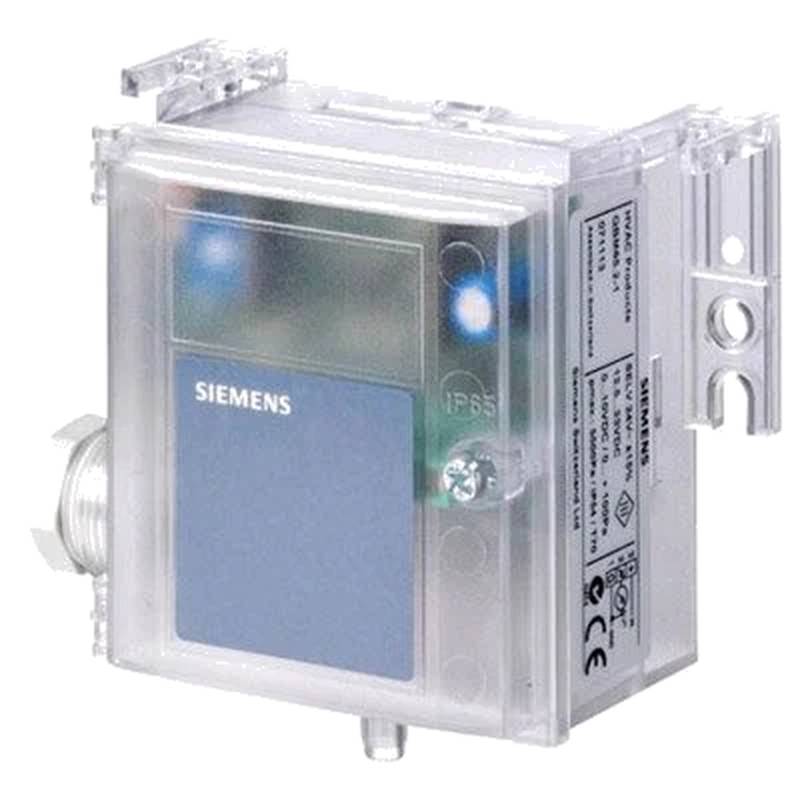
SIEMENS QBM3020-3D Differential Pressure Sensor 300 Pa Display


The SIEMENS QBM3020-3D Differential Pressure Sensor 300 Pa Display is a sophisticated instrument engineered for precise differential pressure measurement in demanding industrial environments. Its core advantages lie in its robust design, high accuracy, and integrated display, offering immediate visual feedback for critical HVAC and industrial process control applications. Key technical parameters include a selectable measuring range, typically from 0 to 300 Pa, an analog output signal (e.g., 0-10V or 4-20mA), and a clear digital display for local readings. This sensor is designed for reliability and ease of integration, making it a valuable component for optimizing building automation and industrial processes.
Product Specifications
| Feature | Specification |
| :--------------------- | :----------------------------------------------- |
| Product Model | SIEMENS QBM3020-3D |
| Differential Pressure | 0 to 300 Pa (Selectable or fixed range) |
| Output Signal | Analog (e.g., 0-10 V or 4-20 mA) |
| Display | Integrated Digital Display |
| Power Supply | Typically 24 VAC/VDC |
| Accuracy | High precision, typically ±1% of full scale |
| Operating Temperature | -10 to +50 °C (or as specified) |
| Ingress Protection | IP54 or higher, depending on model variant |
| Media Compatibility | Non-corrosive gases |
Core Features & Market Positioning
The SIEMENS QBM3020-3D stands out due to its integrated digital display, a significant differentiator that provides on-site, real-time pressure readings without requiring external monitoring devices. This immediate visual access enhances operational efficiency and aids in rapid diagnostics. Its high accuracy ensures precise control over HVAC systems, crucial for maintaining optimal indoor air quality and energy efficiency in commercial buildings. The sensor's robust construction, often with IP protection ratings, positions it as a reliable choice for industrial applications where durability and consistent performance are paramount. Its compatibility with standard building management systems (BMS) and industrial control platforms further solidifies its market position as a versatile and dependable differential pressure solution.
Key Application Scenarios
This differential pressure sensor is ideally suited for monitoring air and gas pressures in a variety of critical applications. In Building Automation Systems (BAS), it excels in controlling and monitoring filter status in air handling units (AHUs), ensuring optimal performance and preventing system damage. It is also widely used for room pressure control in cleanrooms, laboratories, and healthcare facilities, maintaining precise pressure differentials to prevent contamination. Furthermore, the SIEMENS QBM3020-3D finds application in industrial settings for airflow monitoring in ventilation systems, duct pressure control, and verifying the performance of fans and blowers, thereby contributing to process stability and safety.
Practical System Integration Guidance
Integrating the SIEMENS QBM3020-3D into existing systems is straightforward, thanks to its standard analog output signals and common power requirements. For wiring, connect the power supply (typically 24 VAC or VDC) to the designated terminals, ensuring correct polarity. The analog output signal (0-10V or 4-20mA) should be connected to the corresponding input of your BMS or PLC. When installing, ensure the sensor is mounted in a location representative of the pressure being measured, with proper sealing to prevent air leaks, which could compromise accuracy. The integral display facilitates local commissioning and verification of readings against your control system setpoints.
Operation and Risk Mitigation
Operating the SIEMENS QBM3020-3D primarily involves setting the correct measuring range and output scaling within your control system, based on the application's pressure differential requirements. Risk mitigation strategies focus on preventing over-pressurization beyond the sensor's rated limits, which could lead to damage. Regular checks of the pressure sensing ports for any obstructions, such as dust or debris, are crucial for maintaining accuracy and preventing sensor failure. In environments with potential for condensation, ensure proper installation and consider using appropriate accessories if specified by Siemens for such conditions. Periodic calibration, though often not required frequently due to its inherent stability, is recommended for critical applications to guarantee long-term performance.
Scalability & Long-Term Value
The SIEMENS QBM3020-3D offers significant long-term value through its compatibility with a wide range of Siemens automation platforms and open standard protocols, facilitating integration into evolving industrial control architectures. Its reliable performance minimizes downtime and the need for frequent replacements, contributing to lower total cost of ownership. For scalability, multiple QBM3020-3D sensors can be networked within a larger BMS or SCADA system, enabling comprehensive monitoring and control across extensive facilities. Its future-proofing is further enhanced by Siemens' commitment to supporting advanced digital solutions, allowing for seamless integration with IIoT initiatives for predictive maintenance and advanced data analytics.
Frequently Asked Questions
What is the primary function of the SIEMENS QBM3020-3D?
The SIEMENS QBM3020-3D sensor precisely measures differential pressure, crucial for HVAC systems. It monitors air and gas pressure differences to ensure optimal system performance and safety. Its integrated display provides immediate local readings, aiding in quick operational checks and diagnostics.
This device is vital for maintaining stable environments in cleanrooms and laboratories. It is used to control and monitor airflow in ventilation systems within industrial settings. Its high accuracy supports energy efficiency in building management by optimizing fan operation.
Its key role is in applications requiring precise control of air pressure, such as filter monitoring and room pressurization. The sensor's robust design ensures reliable operation in demanding industrial and commercial environments. This makes it a cornerstone for achieving desired environmental conditions and process integrity.
How do I calibrate the SIEMENS QBM3020-3D?
Calibration typically involves comparing the sensor's reading to a known, accurate pressure source. Refer to the specific model's manual for detailed procedures, as Siemens sensors often utilize software-based calibration. This process usually requires access to the control system or dedicated Siemens software tools.
Zeroing the sensor is often the first step, performed when both sides of the diaphragm are exposed to the same pressure. Adjustments are then made to align the output signal with the applied pressure, according to the device's specification range. Regular calibration ensures ongoing measurement accuracy.
For critical applications, recalibration might be scheduled annually or as per internal quality control protocols. Ensure that any calibration performed is documented thoroughly to maintain traceability and system validation. Using certified calibration equipment is essential for reliable results.
What are the common issues with the SIEMENS QBM3020-3D?
A frequent issue is inaccurate readings due to blocked sensing ports from dust or debris. Ensure the ports are clear and the connecting tubes are properly sealed to prevent leaks. This is critical for maintaining the integrity of the pressure measurement.
Another concern can be incorrect wiring or power supply issues, leading to no output or erratic signals. Double-check the power source voltage and polarity, as well as the analog output connections, against the installation manual. Ensure compliance with voltage requirements.
Over-pressurization beyond the sensor's limits can cause permanent damage and inaccurate readings. Protect the sensor from pressure spikes by implementing appropriate system safeguards. Environmental factors like extreme temperatures can also affect performance over time.
What is the selectable measuring range of the SIEMENS QBM3020-3D?
The SIEMENS QBM3020-3D often features selectable pressure ranges to suit diverse applications. A common configuration allows selection between several low-pressure spans, such as 0-50 Pa, 0-100 Pa, or up to 0-300 Pa. Consult the specific product variant's datasheet for exact available ranges.
This selection is typically performed via DIP switches on the device or through software configuration within the building management system. Proper selection ensures the sensor operates within its optimal accuracy band for the particular application. It maximizes the resolution of the measurement.
The ability to select the range enhances the sensor's versatility, allowing it to be used in different scenarios without requiring hardware replacement. This flexibility is key for adapting to changing system requirements or for commissioning in various pressure regimes. It optimizes performance and cost-effectiveness.
Can the SIEMENS QBM3020-3D be used for liquid pressure measurement?
The SIEMENS QBM3020-3D is specifically designed for measuring differential pressure in gaseous media, such as air and non-corrosive gases. Its diaphragm and internal construction are optimized for these applications, not for the higher densities and corrosive potentials of liquids.
Using this sensor with liquids can lead to inaccurate readings, premature failure, or damage to the sensor. For liquid pressure measurements, a different type of pressure transmitter or sensor designed for liquid compatibility and appropriate pressure ranges must be selected. Siemens offers specific products for liquid applications.
Always consult the product's technical documentation to confirm its intended use and media compatibility. Attempting to use the QBM3020-3D with liquids will void its warranty and likely result in system malfunction or sensor failure. It is engineered for air and gas systems only.
What type of output signal does the SIEMENS QBM3020-3D provide?
The SIEMENS QBM3020-3D typically provides a standard analog output signal for integration with control systems. Common outputs include a 0-10V DC voltage signal or a 4-20mA current signal, depending on the specific model variant and configuration.
These standard signals are universally compatible with most building automation systems (BAS), programmable logic controllers (PLCs), and data acquisition systems. The output signal is linearly proportional to the measured differential pressure within the selected range. This ensures accurate data transfer to controllers.
The specific output type (voltage or current) can often be selected or configured during installation. This flexibility allows the sensor to be seamlessly integrated into diverse control architectures, whether they are designed for voltage-based inputs or current-based inputs. Verify the terminal configuration for the correct output.
How is the SIEMENS QBM3020-3D powered?
The SIEMENS QBM3020-3D is typically powered by a low-voltage DC or AC power supply. Common requirements are 24V DC or 24V AC, aligning with standard power supplies used in building automation and industrial control panels. Always verify the exact voltage and polarity requirements in the product manual.
Correct power connection is essential for the sensor's operation and longevity. Reversing polarity on a DC supply or using an incorrect voltage can damage the internal electronics. Ensure that the power source is stable and meets the specified current draw for the sensor.
The power supply connects to dedicated terminals on the sensor. Ensure proper insulation and secure connections to prevent shorts or intermittent power loss, which could disrupt system operation. Adhering to wiring diagrams provided in the installation guide is paramount.
Where is the SIEMENS QBM3020-3D commonly installed?
This sensor is frequently installed within air handling units (AHUs) to monitor the pressure drop across filters. This allows for timely filter replacement, optimizing air quality and system efficiency. Its precise readings are vital for maintaining AHU performance.
It is also used for room pressure monitoring in sensitive environments like cleanrooms, operating theaters, and laboratories. This ensures the required positive or negative pressure differentials are maintained to control airflow and prevent contamination. Proper sealing of the installation point is key.
Installation in ductwork for airflow monitoring or fan performance verification is another common scenario. The sensor is typically mounted to provide a representative pressure reading, often with impulse lines connected to the measurement points. Ensure orientation and mounting follow manufacturer guidelines.
What are the advantages of the integrated display on the QBM3020-3D?
The integrated display offers immediate, on-site visibility of the differential pressure readings. This allows facility managers and technicians to quickly assess system status without needing external measurement tools or accessing the control system interface. It simplifies troubleshooting.
This feature significantly speeds up commissioning and verification processes. During installation or maintenance, technicians can readily confirm that the sensor is functioning correctly and accurately measuring the pressure as expected. It provides direct validation of sensor output.
Having a local display also serves as a valuable backup if the central control system is temporarily unavailable or undergoing maintenance. It ensures that critical pressure data remains accessible at the point of measurement. This enhances operational continuity and safety.
What is the typical accuracy of the SIEMENS QBM3020-3D?
The SIEMENS QBM3020-3D generally offers high accuracy, typically within ±1% of its full-scale measuring range. This precision is critical for applications where even small deviations in pressure can have significant consequences for system performance or environmental control.
This level of accuracy ensures reliable operation in demanding scenarios such as maintaining precise room pressures in cleanrooms or optimizing airflow in critical industrial processes. It contributes directly to energy efficiency and consistent operational outcomes. Always refer to the product datasheet for the exact accuracy specification.
The sensor's accuracy is maintained through robust design and quality manufacturing processes. However, environmental conditions and proper installation play a role in achieving and sustaining this specified performance over time. Regular checks ensure continued accuracy.