











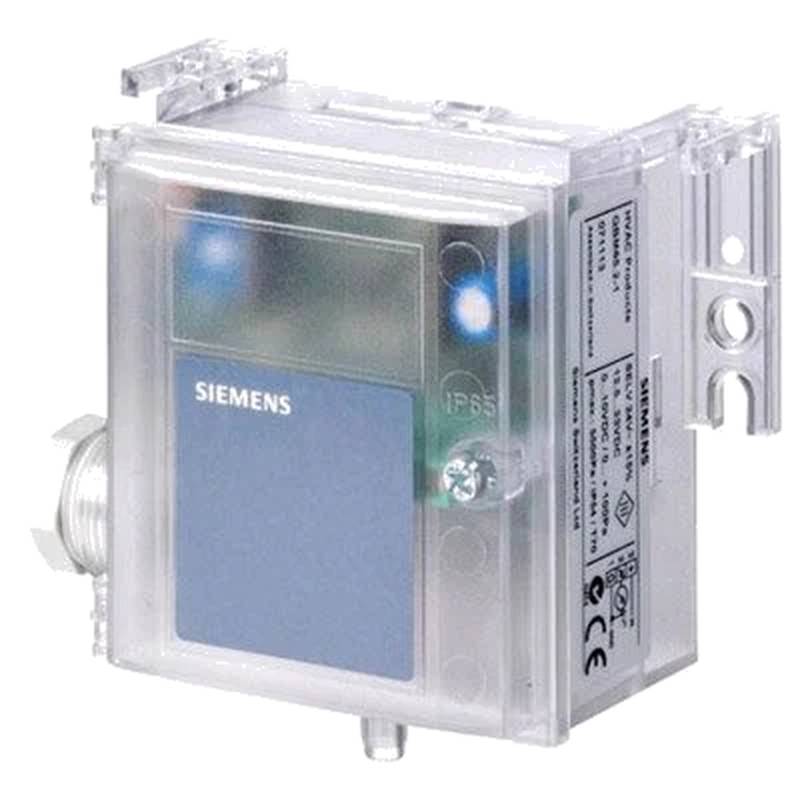
SIEMENS QBM3120-5 Differential Pressure Sensor 500 Pa for HVAC


The SIEMENS QBM3120-5 Differential Pressure Sensor is engineered for precise air pressure monitoring in HVAC systems, offering critical advantages like high accuracy and robust performance for optimal building management. With a measuring range of 0 to 500 Pascals (Pa), this sensor is indispensable for controlling airflow, monitoring filter status, and ensuring efficient ventilation. Its key technical parameters include an output signal of 0-10 VDC, a power supply requirement of 24 VAC/VDC, and an IP54 protection rating, ensuring reliable operation in demanding industrial environments.
Product Specifications
| Parameter | Specification |
| :------------------ | :-------------------------- |
| Product Type | Differential Pressure Sensor |
| Model | QBM3120-5 |
| Measuring Range | 0…500 Pa |
| Output Signal | 0…10 VDC |
| Power Supply | 24 VAC/VDC |
| Accuracy | ±5 Pa (at 100 Pa) |
| Operating Temperature | -10…50 °C |
| Protection Class | IP54 |
| Mounting | Wall or duct mounting |
| Connection | Screw terminals |
Core Features & Market Positioning
The SIEMENS QBM3120-5 distinguishes itself through its high accuracy and reliable Siemens engineering, crucial for maintaining optimal HVAC performance and energy efficiency. Its robust construction, evidenced by the IP54 rating, positions it as a dependable choice for applications where dust and moisture are present. This sensor integrates seamlessly into Building Management Systems (BMS), providing essential data for automated control and diagnostics, differentiating it from less sophisticated measurement devices. Its suitability for critical airflow control applications makes it a preferred component in sophisticated HVAC designs aiming for superior indoor air quality and operational cost savings.
Key Application Scenarios
This differential pressure sensor is vital in monitoring the pressure drop across air filters, signaling when maintenance is required to prevent system inefficiency and equipment damage. It plays a critical role in maintaining stable airflow in ventilation systems, ensuring consistent air exchange rates for occupant comfort and health in commercial buildings, hospitals, and laboratories. The QBM3120-5 is also frequently employed for static pressure control in ductwork, enabling precise regulation of air distribution to various zones within an HVAC system. Its application extends to controlling fan speeds based on system demand, thereby optimizing energy consumption.
Practical System Integration Guidance
Integration of the SIEMENS QBM3120-5 involves straightforward electrical connections to the HVAC control system. The sensor requires a 24 VAC or 24 VDC power supply, with terminals clearly marked for power and ground. The 0-10 VDC output signal connects to a corresponding analog input on the controller. For mounting, the sensor can be secured to a wall or directly onto a duct using appropriate fasteners, ensuring a sealed connection to the air stream. It is essential to use the provided pressure tappings, connecting them to the high and low-pressure ports according to the system's airflow direction. Calibration may be necessary post-installation to ensure peak accuracy within the 0-500 Pa range.
Operation and Risk Mitigation
Proper operation of the SIEMENS QBM3120-5 relies on ensuring its connections are secure and that it is exposed only to the intended pressure differentials within its specified range. Risks of inaccurate readings can arise from leaks in the pressure tubing, improper mounting, or exposure to pressures outside the 0-500 Pa limit. Electrical faults due to incorrect wiring or power surges are also potential issues. To mitigate these, regular inspection of tubing for cracks or disconnections, verification of wiring against the installation manual, and the use of surge protection devices are recommended. Environmental factors such as extreme temperatures or excessive humidity beyond the IP54 rating can also lead to sensor failure.
Scalability & Long-Term Value
The SIEMENS QBM3120-5 offers significant long-term value through its compatibility with broader Siemens automation platforms and its ability to provide data for advanced IIoT integration. Its standard analog output makes it easily adaptable to various Building Management Systems, allowing for future upgrades or expansions without necessitating a complete sensor replacement. This inherent flexibility ensures that the sensor remains a relevant component even as building control technologies evolve. By providing reliable data for energy management and predictive maintenance, it contributes to operational cost reductions and extends the lifespan of HVAC equipment, enhancing overall system value over time.
FAQs
What is the primary function of the SIEMENS QBM3120-5?
This sensor measures the difference between two air pressures.
It is crucial for monitoring airflow and filter status in HVAC systems.
Its data enables precise control of ventilation and air distribution.
How accurate is the SIEMENS QBM3120-5 Differential Pressure Sensor?
The sensor offers an accuracy of ±5 Pa at a 100 Pa differential.
This precision ensures reliable monitoring for critical HVAC applications.
Maintaining accurate readings is vital for energy efficiency and air quality.
What is the operating temperature range for this sensor?
The QBM3120-5 operates reliably between -10 and 50 degrees Celsius.
This range covers most standard indoor and duct environments.
Operating outside this range can affect sensor performance and lifespan.
Can the SIEMENS QBM3120-5 be used outdoors?
The sensor has an IP54 protection rating.
This means it is protected against dust and splashing water.
However, it is primarily designed for indoor HVAC system integration.
What kind of output signal does the QBM3120-5 provide?
It outputs a linear 0-10 VDC signal.
This analog signal is standard for many Building Management Systems.
The signal directly correlates to the measured differential pressure.
What power supply is required for the SIEMENS QBM3120-5?
The sensor operates on 24 VAC or 24 VDC.
Ensure the power supply is stable and within the specified voltage.
Incorrect voltage can damage the sensor.
How is the SIEMENS QBM3120-5 installed?
It can be wall or duct-mounted using provided fittings.
Pressure tubes connect to the high and low ports for measurement.
Ensure all connections are airtight for accurate readings.
What are common issues with differential pressure sensors?
Clogged pressure ports or tubing are a frequent problem.
Electrical connection issues or faulty wiring can also occur.
Environmental factors like dust can impact performance over time.
Is the QBM3120-5 compatible with older HVAC control systems?
Its standard 0-10 VDC output ensures broad compatibility.
It can easily integrate with most modern BMS.
Older analog input systems can also typically accommodate this signal.
What is the maximum pressure the QBM3120-5 can measure?
The sensor's measuring range is 0 to 500 Pascals.
Exceeding this range can lead to sensor damage or inaccurate readings.
Always ensure the system operates within the specified limits.