











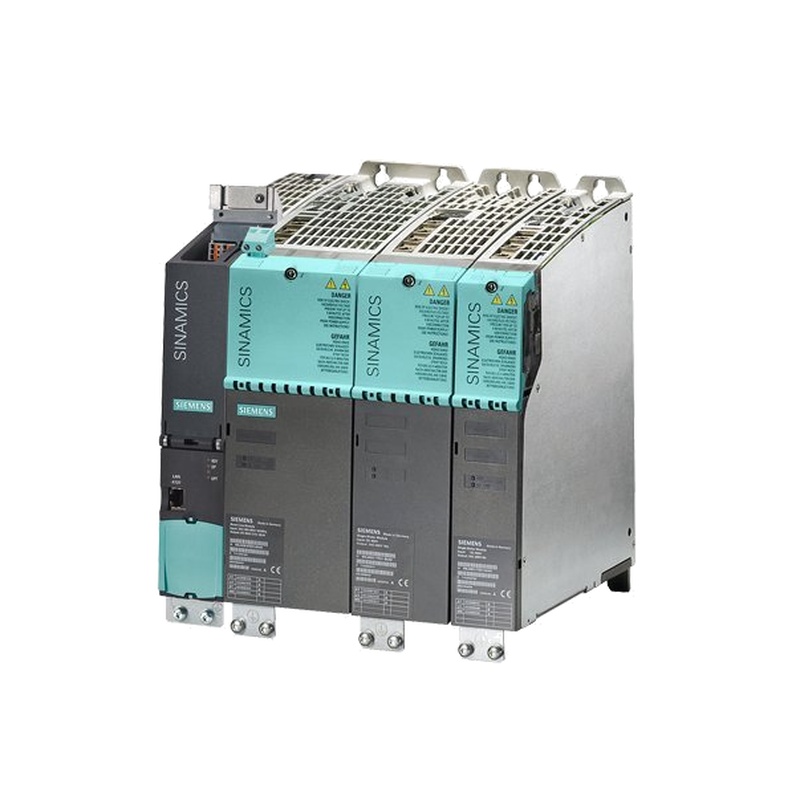
SIEMENS 6SL3321-1TE37-4AA0 SINAMICS S120 Motor Module Chassis 2 355kW System Component 740A Internal Cooling


The SIEMENS 6SL3321-1TE37-4AA0 SINAMICS S120 Motor Module Chassis 2 is a high-performance drive component engineered for demanding industrial applications. This 355kW system component boasts a robust 740A internal cooling capacity, ensuring reliable operation under extreme conditions. Its key advantages lie in its advanced control capabilities, energy efficiency, and seamless integration within the broader SINAMICS S120 platform, making it a cornerstone for modern automation solutions. The module excels in precise motion control, dynamic acceleration and deceleration, and efficient power regeneration, directly contributing to optimized production processes and reduced operational costs.
Product Specifications
| Feature | Specification |
| :----------------------- | :-------------------------------------------------- |
| Product Type | SINAMICS S120 Motor Module Chassis 2 |
| Model Number | 6SL3321-1TE37-4AA0 |
| Rated Power | 355 kW |
| Rated Current (Continuous) | 740 A |
| Cooling | Internal Cooling |
| Voltage Range | Varies based on configuration; typically 400-480V |
| Control Type | Vector Control, Servo Control |
| Communication Interfaces | PROFIBUS DP, PROFINET |
| Protection | Overload, Overvoltage, Undervoltage, Short Circuit, Overtemperature |
| Dimensions (H x W x D) | Specific dimensions vary; refer to datasheet |
| Weight | Specific weight varies; refer to datasheet |
Core Features & Market Positioning
The SIEMENS 6SL3321-1TE37-4AA0 distinguishes itself through its exceptional power density and sophisticated control algorithms, enabling precise and dynamic motor performance essential for high-end automation. Its market positioning is firmly within the premium industrial drive segment, catering to industries that demand superior reliability, efficiency, and integration capabilities. The SINAMICS S120 platform, of which this module is a part, is renowned for its flexibility and scalability, allowing for tailored solutions across a wide spectrum of applications. The internal cooling system is a significant differentiator, simplifying installation by eliminating the need for external cooling infrastructure and ensuring consistent thermal management for peak performance.
Key Application Scenarios
This motor module is ideally suited for a diverse range of demanding industrial applications where high power and precise control are paramount. It finds extensive use in complex machinery requiring rapid acceleration and deceleration, such as in printing presses, converting machines, and automated warehousing systems. Furthermore, its robust design and efficient operation make it a prime choice for heavy industries, including metal forming, plastics extrusion, and material handling, where continuous, reliable power delivery is critical. The module's adaptability also supports applications in renewable energy, such as wind turbine pitch control, and in high-performance servo applications across various manufacturing sectors.
Practical System Integration Guidance
Integrating the SIEMENS 6SL3321-1TE37-4AA0 into a SINAMICS S120 system involves careful consideration of power supply, motor connection, and control communication. The module connects to the DC bus of the S120 drive system, requiring appropriate line filters and protective devices for robust operation. Motor connections should adhere to the specified wiring diagrams for the connected motor type, ensuring correct phase sequencing and grounding. Commissioning typically involves parameterization using Siemens' STARTER or TIA Portal software, where motor data, control modes (e.g., vector control, servo control), and safety functions are configured. Attention to the internal cooling system's airflow requirements within the control cabinet is crucial for maintaining optimal operating temperatures.
Operation and Risk Mitigation
Operating the SIEMENS 6SL3321-1TE37-4AA0 requires adherence to safety protocols and an understanding of its operational parameters. Proper grounding and insulation checks are essential before energizing the drive system to prevent electrical hazards. Overload protection is a critical feature, but users must ensure the motor and load do not exceed the module's rated capacity for extended periods. Common fault codes, such as F1, F2, and F3, often indicate overcurrent, overvoltage, or undervoltage conditions, respectively, which can be mitigated by verifying power supply stability and correct parameter settings. Regular monitoring of temperature indicators and ensuring adequate ventilation for the chassis are vital to prevent thermal shutdown and ensure longevity.
Scalability & Long-Term Value
The SINAMICS S120 platform, with the 6SL3321-1TE37-4AA0 as a component, offers significant scalability and long-term value through its modular design. This chassis can be integrated into larger SINAMICS S120 drive lines, allowing for expansion of power and control capabilities as application requirements grow. Compatibility with a wide range of Siemens automation products and industrial communication protocols like PROFINET enables seamless integration into existing or future Industry 4.0 environments, facilitating data exchange for advanced diagnostics and predictive maintenance. This future-proof design ensures that investments in this drive system remain relevant and adaptable to evolving industrial demands and digital transformation initiatives.
Frequently Asked Questions
What is the rated power of the SIEMENS 6SL3321-1TE37-4AA0?
The SIEMENS 6SL3321-1TE37-4AA0 has a rated power of 355 kW. This high power output is designed for demanding industrial applications.
This power rating ensures the module can drive large motors and handle significant load requirements. It is suitable for heavy-duty machinery and continuous operation.
The 355 kW capacity signifies its capability in applications requiring substantial torque and speed control. This makes it a robust choice for advanced automation.
What type of cooling does the 6SL3321-1TE37-4AA0 use?
This motor module features internal cooling. This integrated system manages heat generated during operation.
Internal cooling simplifies installation by reducing external component needs. It ensures efficient thermal dissipation within the drive chassis itself.
Proper airflow within the control cabinet is still important for the internal cooling system to function optimally. This prevents overheating.
What communication protocols does the SINAMICS S120 motor module support?
The 6SL3321-1TE37-4AA0 supports PROFIBUS DP and PROFINET. These are standard industrial communication interfaces.
These protocols allow for seamless integration into Siemens automation systems and other compatible networks. They facilitate data exchange for control and monitoring.
Using PROFINET enables advanced diagnostic capabilities and integration with Industry 4.0 solutions. This enhances operational visibility.
What are the typical applications for the SIEMENS 6SL3321-1TE37-4AA0?
It is ideal for high-performance motion control applications. This includes printing, converting, and packaging machinery.
The module is also used in heavy industries like metal forming and material handling. It handles demanding torque and dynamic requirements.
Its versatility extends to renewable energy systems and complex robotics. It provides precise and efficient motor control.
How is the SIEMENS 6SL3321-1TE37-4AA0 commissioned?
Commissioning is typically performed using Siemens STARTER or TIA Portal software. This allows for detailed parameter configuration.
Key parameters include motor data, control modes, and safety functions. Correct setup is crucial for optimal performance and protection.
Proper wiring and connection to the SINAMICS S120 drive line are prerequisites for successful commissioning. Ensure all safety guidelines are followed.
What safety features are integrated into this drive module?
The module includes overcurrent, overvoltage, and undervoltage protection. It also has short-circuit and overtemperature monitoring.
These integrated safety features protect the drive and connected motor from damaging electrical conditions. They enhance operational reliability.
Advanced safety functions like Safe Torque Off (STO) are also available, depending on the specific S120 system configuration. This is vital for personnel safety.
Can this motor module be scaled for larger systems?
Yes, the 6SL3321-1TE37-4AA0 is part of the scalable SINAMICS S120 platform. It can be integrated into larger drive lines.
This modularity allows for future expansion of system power and control capabilities. It adapts to growing automation needs.
Compatibility with other SINAMICS S120 components ensures a cohesive and expandable drive solution. This provides long-term value.
What are common fault codes for this product?
Common fault codes include F1 (overcurrent), F2 (overvoltage), and F3 (undervoltage). These indicate power supply or load issues.
Troubleshooting involves verifying the power supply stability and checking motor load. Parameter settings should also be reviewed.
Refer to the SINAMICS S120 system manual for a comprehensive list of fault codes and their detailed diagnostic and resolution steps. This ensures proper maintenance.
What is the rated current of the SIEMENS 6SL3321-1TE37-4AA0?
The rated current for this motor module is 740 A. This indicates its substantial current handling capability.
This high current rating is essential for powering high-demand motors and managing peak loads effectively. It supports the 355 kW power output.
Ensuring that the connected motor and application do not exceed this continuous current rating is vital for preventing component damage and ensuring operational safety. This requires careful load calculation.
What are the benefits of using internal cooling in this drive module?
Internal cooling simplifies system design and installation. It eliminates the need for external heat exchangers or water cooling systems.
This integrated cooling solution contributes to a more compact control cabinet layout. It also reduces overall system complexity and potential points of failure.
Consistent thermal management provided by internal cooling ensures the drive operates reliably under high load conditions, enhancing its lifespan and performance. This is crucial for demanding environments.