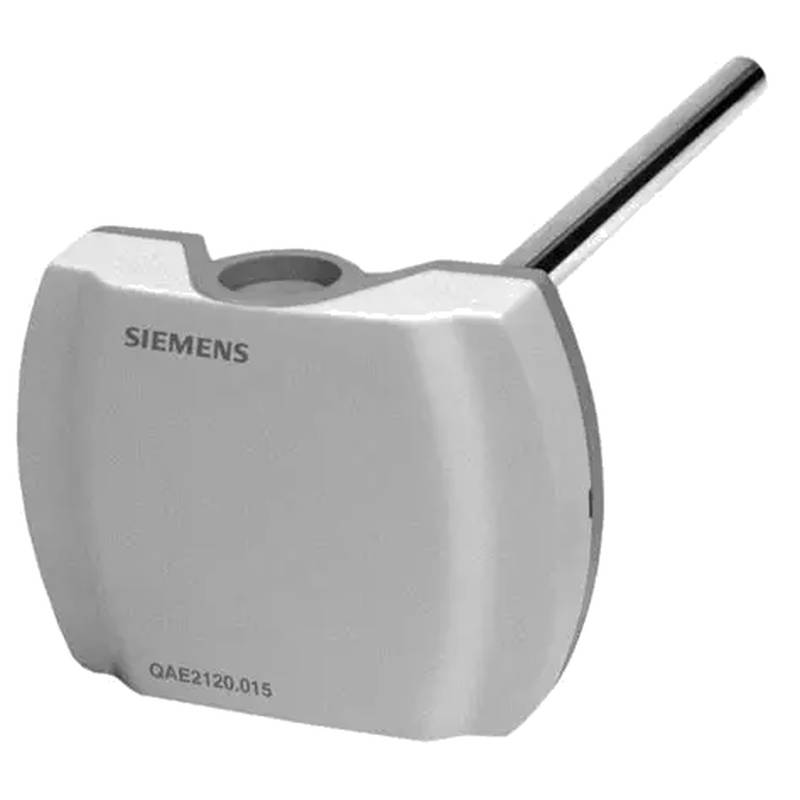
SIEMENS QAE2111.015 Immersion Temperature Sensor 1.5m Cable


The SIEMENS QAE2111.015 immersion temperature sensor, equipped with a 1.5m cable, is a critical component for precise temperature monitoring in HVAC and industrial automation systems. This sensor excels due to its rapid response time, robust construction, and compatibility with various SIEMENS control systems, making it a preferred choice for accurate and reliable temperature sensing in liquid and gaseous media. Its core technical specifications include a measuring range of -50 to +150 °C, an accuracy of ±0.5 K at 0 to 70 °C, and a measuring element of Pt1000. The immersion length is 150 mm with a diameter of 6 mm, featuring an IP65 ingress protection rating for enhanced durability in demanding environments.
Product Specifications
| Specification | Value |
| :-------------------- | :-------------------------- |
| Product Type | Immersion Temperature Sensor |
| Model Number | QAE2111.015 |
| Cable Length | 1.5 m |
| Measuring Range | -50 to +150 °C |
| Accuracy | ±0.5 K (at 0 to 70 °C) |
| Measuring Element | Pt1000 |
| Immersion Length | 150 mm |
| Immersion Diameter | 6 mm |
| Ingress Protection | IP65 |
| Connection Type | Cable |
| Output Signal | Resistance |
| Voltage | 0...10 V (with P/I converter) |
| Housing Material | Stainless steel |
Core Features & Market Positioning
The SIEMENS QAE2111.015 distinguishes itself through its high-quality Pt1000 measuring element, ensuring superior accuracy and stability compared to lower-grade sensors. Its robust stainless-steel construction and IP65 rating provide exceptional resistance to moisture, dust, and corrosive elements, positioning it as a durable solution for challenging industrial settings. The integrated 1.5m cable simplifies installation and reduces the need for additional junction boxes in many applications, offering a cost-effective and streamlined approach to temperature measurement. This focus on accuracy, durability, and ease of integration makes the QAE2111.015 a competitive option in the building automation and industrial process control markets.
Key Application Scenarios
This immersion temperature sensor is extensively utilized in hydronic heating and cooling systems, including solar thermal systems, district heating networks, and building management systems (BMS). Its capacity to accurately measure temperatures in liquids makes it ideal for monitoring boiler water, chilled water loops, and domestic hot water tanks. Industrial applications benefit from its reliability in process fluid temperature control, such as in manufacturing plants, food and beverage production, and chemical processing, where precise temperature is critical for product quality and operational efficiency. The QAE2111.015 is also applied in HVAC systems for measuring supply and return water temperatures in air handling units and heat exchangers.
Practical System Integration Guidance
Integrating the SIEMENS QAE2111.015 into a control system typically involves connecting its resistance-based output to a compatible temperature input module or a PLC. For systems requiring a voltage output, such as 0-10 V, a separate SIEMENS P/I converter (e.g., QXP22.1) is necessary. Ensure the sensor is installed in a thermowell or directly immersed into the fluid flow for optimal thermal contact. The 1.5m cable length should be accounted for during installation planning to avoid strain or damage. For digital control systems, the resistance value will be interpreted by the controller to derive the actual temperature based on the Pt1000 characteristic curve.
Operation and Risk Mitigation
Proper operation of the SIEMENS QAE2111.015 relies on ensuring it is correctly installed and connected to a compatible control system. Avoid exceeding the sensor's specified temperature limits (-50 to +150 °C) to prevent damage or inaccurate readings. Regular visual inspection for any signs of physical damage or corrosion is recommended, especially in aggressive environments. While the sensor itself is robust, incorrect wiring or connection to an incompatible control signal can lead to operational failure. No specific error codes are generated by the sensor; instead, deviations from expected temperature readings or complete signal loss indicate a potential issue with the sensor, wiring, or the connected control system.
Scalability & Long-Term Value
The QAE2111.015 offers excellent scalability due to its compatibility with a wide range of SIEMENS automation platforms, including Desigo and other BACnet or Modbus-based systems. Its standard Pt1000 output ensures interoperability with third-party controllers that support this common sensing technology. Integration into IIoT (Industrial Internet of Things) ecosystems is straightforward by connecting the sensor's output to an edge device or gateway capable of transmitting data to cloud platforms for advanced analytics and predictive maintenance. The durable construction and high-accuracy measuring element contribute to a long operational lifespan, providing sustained value and reliable performance over many years of service.
Frequently Asked Questions
Q1: What is the primary function of the SIEMENS QAE2111.015?
This sensor measures temperature in liquid and gaseous media for automation systems.
It provides precise data for HVAC and industrial process control applications.
Its core purpose is to enable accurate temperature monitoring and regulation.
Q2: What is the measuring range of the SIEMENS QAE2111.015?
The sensor can accurately measure temperatures from -50 to +150 degrees Celsius.
This broad range makes it suitable for both very cold and moderately hot applications.
Operating outside this range may lead to inaccurate readings or sensor damage.
Q3: How is the SIEMENS QAE2111.015 typically installed?
It is designed for immersion into the medium being measured, often in a thermowell.
The 1.5m cable facilitates connection to the control system or a converter.
Proper immersion depth is crucial for accurate thermal response and readings.
Q4: Does the QAE2111.015 require a converter for a 0-10V signal?
Yes, this sensor outputs a resistance signal (Pt1000).
A separate SIEMENS P/I converter is needed for a 0-10V output signal.
Without a converter, it cannot directly provide a voltage output for many controllers.
Q5: What level of protection does the QAE2111.015 offer against environmental factors?
The sensor boasts an IP65 ingress protection rating.
This signifies it is dust-tight and protected against water jets.
It is therefore suitable for use in challenging industrial or outdoor environments.
Q6: What is the accuracy of the SIEMENS QAE2111.015 sensor?
Its accuracy is rated at ±0.5 K within the 0 to 70 °C range.
This high precision is essential for critical temperature control applications.
Higher temperatures may have slightly different, though still reliable, accuracy figures.
Q7: What materials is the QAE2111.015 constructed from?
The immersion probe is made from durable stainless steel for longevity.
This material resists corrosion and withstands various fluid types.
The attached cable is designed for industrial environments.
Q8: Can the QAE2111.015 be used in district heating systems?
Absolutely, its specifications are well-suited for such applications.
It can monitor temperatures in supply and return lines of district heating networks.
Reliable performance in these large-scale thermal distribution systems is a key advantage.
Q9: What are the key advantages of using a Pt1000 measuring element?
Pt1000 offers higher sensitivity and accuracy compared to Pt100.
It provides a more stable and repeatable resistance change with temperature.
This technology is a standard for precise industrial temperature sensing.
Q10: How does the QAE2111.015 contribute to system scalability?
Its standard Pt1000 output ensures compatibility with many controllers.
It integrates seamlessly with SIEMENS building automation platforms.
This sensor is a foundational element for IIoT integration and smart building solutions.