











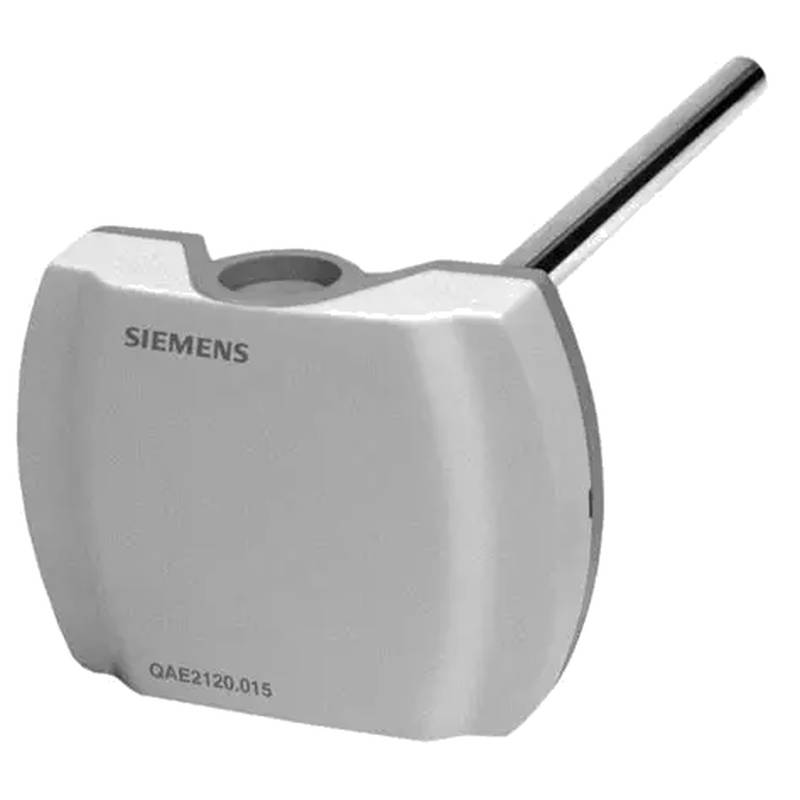
SIEMENS QAE2112.015 Immersion Temperature Sensor 1.5m Cable


The SIEMENS QAE2112.015 Immersion Temperature Sensor, featuring a 1.5m cable, stands as a critical component in modern HVAC and building automation systems, offering precise temperature measurement in liquid and gaseous media. Its core advantages lie in its robust construction, high accuracy, and seamless integration capabilities. Key technical parameters include a measuring range of -50 to 150 °C, an IP65 protection rating for demanding environments, and a rapid response time essential for dynamic process control. This sensor is engineered for reliability and performance, making it an indispensable choice for applications requiring accurate temperature monitoring.
Product Specifications
| Specification | Value |
| :-------------------------- | :-------------------------------------- |
| Product Type | Immersion Temperature Sensor |
| Model Number | QAE2112.015 |
| Manufacturer | Siemens |
| Cable Length | 1.5 meters |
| Measuring Range | -50 to 150 °C |
| Protection Rating | IP65 |
| Output Signal | 0–10 V |
| Sensor Element | NTC 10 kΩ at 25 °C |
| Immersion Length | 150 mm |
| Connection Type | Screw terminals |
| Material (Immersion Tube) | Stainless Steel |
| Operating Voltage | 24 V AC/DC |
| Application Medium | Water, heating/cooling circuits, air |
Core Features & Market Positioning
The SIEMENS QAE2112.015 distinguishes itself through its NTC 10 kΩ sensor element, providing a high degree of accuracy and sensitivity across its specified temperature range. This makes it a preferred choice for applications where even minor temperature fluctuations need to be precisely detected and controlled. Its IP65 rating signifies excellent protection against dust ingress and low-pressure water jets, ensuring operational longevity in industrial settings often exposed to harsh conditions. The 1.5m cable offers flexibility in installation, allowing for optimal placement within complex systems. Siemens' reputation for quality and reliability further solidifies the QAE2112.015's market position as a trusted, high-performance temperature sensing solution for building services and industrial process control.
Key Application Scenarios
This immersion temperature sensor is widely deployed in hydronic heating and cooling systems, monitoring water temperatures in boilers, chillers, and distribution networks to optimize energy efficiency and occupant comfort. It is also crucial for process control applications in various industries, where maintaining specific fluid temperatures is vital for product quality and operational safety. Common use cases include monitoring temperatures in solar thermal systems, geothermal loops, and air handling units to ensure optimal performance and prevent system malfunctions. Its versatility allows for adaptation to diverse media, including water, glycol mixtures, and air, making the SIEMENS QAE2112.015 a flexible solution for a broad spectrum of building automation and industrial monitoring needs.
Practical System Integration Guidance
Integrating the SIEMENS QAE2112.015 into a building automation system typically involves connecting its 0–10 V output signal to a compatible controller, such as a Siemens Desigo or other standard DDC (Direct Digital Control) system. The sensor's immersion tube should be inserted into a thermowell or directly into the fluid stream, ensuring sufficient contact for accurate readings. For optimal performance, the cable should be routed to avoid excessive bending or exposure to damaging elements, utilizing provided glands and conduits. Wiring should follow the controller's input specifications, typically connecting the signal output, power supply (24V AC/DC), and a common ground. Configuration within the building management software will involve assigning the sensor to the correct input channel and calibrating its range if necessary, though the NTC element generally provides a highly stable and predictable output.
Operation and Risk Mitigation
Proper operation of the SIEMENS QAE2112.015 relies on ensuring it is correctly installed and within its specified environmental and media limits. The NTC sensor element is generally robust but can be damaged by extreme temperatures beyond its -50 to 150 °C range, or by incompatible chemical substances if immersed in aggressive media. Regular inspection of the cable and immersion probe for physical damage is recommended to prevent premature failure. Faulty readings might indicate a loose connection, a damaged sensor element, or a discrepancy between the sensor's output and the controller's interpretation. Troubleshooting often involves verifying wiring integrity, checking the controller's input status, and potentially testing the sensor's output voltage against known temperature points.
Scalability & Long-Term Value
The SIEMENS QAE2112.015 offers significant long-term value due to its compatibility with a wide array of Siemens building automation platforms and its adherence to standard 0–10 V analog signaling. This ensures it can be readily integrated into new installations or retrofitted into existing systems, providing a reliable temperature sensing foundation. Its robust construction and Siemens' commitment to quality minimize the need for frequent replacements, contributing to a lower total cost of ownership. While the sensor itself is a point solution, its data can feed into broader IIoT strategies, enabling advanced analytics, predictive maintenance, and optimized energy management when integrated with cloud-based platforms and digital twins.
Frequently Asked Questions (FAQs)
What is the typical application for the SIEMENS QAE2112.015 sensor?
This sensor is primarily used in HVAC and building automation systems. It excels in monitoring temperatures of liquids and gases in heating and cooling circuits.
It's ideal for applications requiring precise temperature control, such as in boilers, chillers, and air handling units. Its robust design also suits industrial process monitoring.
The QAE2112.015 ensures efficient operation and helps maintain optimal conditions for comfort and system longevity.
What is the measuring range of the SIEMENS QAE2112.015?
The sensor can accurately measure temperatures from -50 to 150 degrees Celsius. This wide range makes it versatile for various applications.
It is suitable for both very cold and moderately hot environments commonly found in building services. The NTC element provides reliable data within this spectrum.
Ensuring the monitored medium stays within these limits is crucial for sensor accuracy and lifespan.
What does the IP65 rating signify for the QAE2112.015 sensor?
An IP65 rating means the sensor is protected against dust ingress and water jets. It can withstand moderate exposure to water.
This protection makes it suitable for installation in environments where moisture or dust might be present. It ensures reliable operation in demanding conditions.
The QAE2112.015 can therefore be confidently installed in areas like plant rooms or near potential water sources.
How is the SIEMENS QAE2112.015 connected to a control system?
The sensor outputs a standard 0–10 V analog signal. This signal is typically wired to an analog input on a building automation controller.
Siemens controllers, like those in the Desigo system, readily accept this output. Other compatible DDC systems can also interface with it.
Ensure correct wiring of the signal output, power supply (24V AC/DC), and common ground to the controller's input terminals.
What type of sensor element does the QAE2112.015 use?
It utilizes an NTC (Negative Temperature Coefficient) thermistor as its sensing element. Specifically, it's an NTC 10 kΩ at 25 °C.
NTC sensors offer good accuracy and a fast response time, making them suitable for dynamic temperature monitoring. They are a common choice in building automation.
The characteristic resistance of the NTC element changes predictably with temperature, allowing the controller to calculate the precise temperature.
What are the immersion length and cable length specifications?
The immersion probe has a length of 150 mm for effective heat transfer. The sensor comes with a pre-attached cable that is 1.5 meters long.
This 150mm immersion length ensures sufficient contact with the fluid or gas being measured. The 1.5m cable provides reasonable flexibility for installation.
Users can select mounting locations that provide optimal measurement while ensuring the cable can reach the control panel without excessive strain.
Can this sensor be used in outdoor applications?
Yes, the IP65 rating makes it suitable for certain outdoor applications where protection against dust and water is required. However, direct, prolonged exposure to extreme weather may still pose risks.
Careful consideration should be given to the specific environmental conditions. It's best to protect it from direct sunlight and harsh weather if possible, even with its rating.
The sensor should be installed in a location that offers some shelter while still accurately measuring the ambient or process temperature.
What is the required operating voltage for the QAE2112.015?
The sensor operates on a voltage supply of 24 V AC or 24 V DC. This is a common voltage used in building automation systems.
Ensure your control panel or power supply unit provides a stable 24V AC/DC output for the sensor. Incorrect voltage can lead to malfunction or damage.
When wiring, confirm that the power supply is correctly connected to the designated terminals on the sensor.
How does the 0–10 V output signal work?
The 0–10 V signal is an analog representation of the measured temperature. As the temperature changes, the voltage output varies proportionally within the sensor's range.
Typically, a specific voltage (e.g., 0V) corresponds to the lowest temperature (-50 °C), and another (e.g., 10V) to the highest (150 °C). The controller interprets this voltage to determine the temperature.
This standard signal is easily interfaced with most modern building management systems and controllers for seamless data acquisition and control.
Is the SIEMENS QAE2112.015 compatible with non-Siemens systems?
Yes, because it uses a standard 0–10 V output signal and common NTC sensor technology, it is generally compatible with many third-party building automation systems. Its 24V AC/DC power requirement is also widely standard.
When integrating with a non-Siemens system, ensure the controller's input is configured to accept a 0–10 V signal and that the correct NTC lookup table or calibration is applied.
Always consult the documentation for both the sensor and the third-party control system to confirm compatibility and proper wiring procedures.