











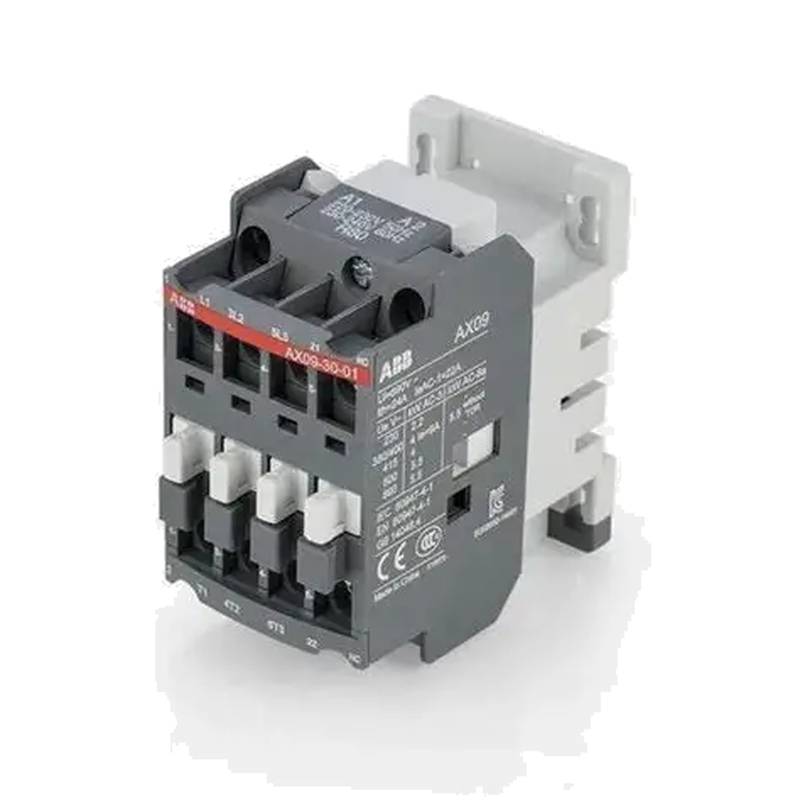
ABB AX40-30-10-80 40A Industrial Contactor 24V AC


The ABB AX40-30-10-80 40A Industrial Contactor, operating at 24V AC, stands as a robust and reliable component for demanding industrial control applications. Its primary advantages lie in its high switching capacity, compact design, and superior durability, ensuring consistent performance in harsh environments. Key technical parameters include a 40A utilization category AC-3 rating, 3 main poles, 1 auxiliary normally open (NO) contact, and 0 auxiliary normally closed (NC) contacts, all within a 24V AC coil voltage. This contactor is engineered for precise motor control and power switching, offering a dependable solution for automation systems.
Product Specifications
| Specification | Value |
| :------------------------ | :---------------------------------------- |
| Manufacturer | ABB |
| Product Series | AX40 |
| Contactor Type | Industrial Contactor |
| Rated operational current (AC-3, 400 V) | 40 A |
| Number of main poles | 3 |
| Auxiliary contacts | 1 NO |
| Coil voltage | 24 V AC |
| Rated impulse withstand voltage | 8 kV |
| Conventional thermal current | 55 °C | 60 A |
| Control circuit voltage type | AC |
| Mounting | DIN rail or screw |
| IP rating | IP20 |
| Operating temperature | -25 to +60 °C |
Core Features & Market Positioning
The ABB AX40-30-10-80 distinguishes itself through its robust construction and adherence to international standards, positioning it as a premium choice for critical control circuits. Its ability to handle significant inductive loads with a 40A AC-3 rating ensures longevity in motor starting applications. The integrated 1 NO auxiliary contact provides essential feedback for control logic, streamlining system design. ABB's reputation for reliability and innovative electrical solutions further solidifies this contactor's market standing, offering peace of mind and reduced maintenance overhead for system integrators and end-users alike.
Key Application Scenarios
This industrial contactor finds extensive use in controlling and switching three-phase motors, such as those found in pumps, fans, compressors, and conveyor systems across various sectors including manufacturing, building automation, and water treatment. Its 24V AC coil voltage is particularly well-suited for control panels powered by standard low-voltage transformer outputs, enhancing safety and ease of integration. The AX40-30-10-80 is ideal for applications requiring frequent switching cycles and reliable operation, such as HVAC systems or industrial process machinery.
Practical System Integration Guidance
Integrating the ABB AX40-30-10-80 into existing control systems is straightforward due to its standard DIN rail mounting capability and clear terminal markings. Wiring the power circuit involves connecting the incoming three-phase power to the main terminals (L1, L2, L3) and the motor or load to the output terminals (T1, T2, T3). The control circuit connects to the coil terminals (A1, A2) for the 24V AC supply. The auxiliary contact (13-14 for NO) can be wired into the control logic for status monitoring or interlocking functions. Always ensure proper torque is applied to the terminals to prevent loose connections.
Operation and Risk Mitigation
Proper operation of the ABB AX40-30-10-80 involves energizing the A1 and A2 coil terminals with the specified 24V AC to close the main power contacts. De-energizing the coil will cause the contacts to open. To mitigate risks, ensure the contactor is correctly rated for the application's load and duty cycle. Avoid exceeding the operational temperature limits to prevent premature failure. In case of persistent issues, verify the coil voltage is stable and that the contacts are not welded shut, which could indicate an overload condition or a fault in the controlled equipment.
Scalability & Long-Term Value
The AX40-30-10-80 offers inherent scalability within ABB's broader automation portfolio. Its compatibility with standard control system components allows for easy integration into larger, more complex automation architectures. For digital integration, considerations can be made for incorporating it into systems managed by PLCs or remote I/O modules, enabling monitoring and control via industrial networks. This foresight in design ensures that the contactor remains a valuable asset even as systems evolve towards greater connectivity and IIoT capabilities.
Frequently Asked Questions
What is the main function of the ABB AX40-30-10-80 industrial contactor?
The ABB AX40-30-10-80 acts as an electrically operated switch for motor control. It safely opens or closes power circuits, enabling remote operation of electrical machinery.
It is designed to handle significant current loads, making it suitable for starting and stopping three-phase motors in industrial settings. The contactor ensures reliable power delivery and disconnection based on control signals.
This device is crucial for automation, allowing motors to be controlled by control systems like PLCs, timers, or manual switches without direct manual intervention.
How do I wire the ABB AX40-30-10-80 contactor for a three-phase motor?
Connect the incoming three-phase power supply lines (L1, L2, L3) to the top main terminals of the contactor. The output terminals (T1, T2, T3) should be connected to the motor's power terminals.
The 24V AC control voltage is applied to the coil terminals, typically labeled A1 and A2. Ensure the correct polarity is observed if applicable to the specific AC coil, though AC coils are generally not polarity sensitive.
The single normally open (NO) auxiliary contact (terminals 13 and 14) can be wired into your control circuit for feedback or interlocking purposes, typically in parallel with the coil for holding circuits.
What are the key advantages of using the ABB AX40-30-10-80 in an industrial control panel?
Its robust construction ensures high reliability and a long operational lifespan, even in challenging industrial environments. The 40A AC-3 rating provides ample capacity for motor starting applications.
The compact size allows for efficient use of space within control panels, facilitating denser and more organized electrical layouts. This makes it ideal for retrofits and new designs with space constraints.
ABB's reputation for quality and safety provides assurance of performance, reducing downtime and maintenance costs. The integrated auxiliary contact simplifies control logic design.
What does the "40A" and "AC-3" rating signify for this ABB contactor?
The "40A" indicates the rated operational current that the contactor can handle continuously under specific conditions. This is the maximum current it can switch reliably.
"AC-3" refers to the utilization category, meaning the contactor is designed for starting squirrel-cage motors and for disconnecting motors during operation. It implies a certain level of electrical endurance for motor loads.
This rating ensures that the contactor can withstand the high starting currents of motors and the associated electrical stresses, providing safe and effective control for motor applications.
Can the ABB AX40-30-10-80 be used with DC motor applications?
The ABB AX40-30-10-80 is specifically designed for AC (Alternating Current) applications, particularly for switching AC motors. Its internal construction and arc suppression are optimized for AC circuits.
Using this AC contactor with DC loads is generally not recommended and can lead to premature failure or unsafe operation. DC circuits have different electrical characteristics, especially regarding arc quenching.
For DC motor applications, you would need to select a contactor specifically rated for DC utilization categories, which have different designs and specifications to handle the continuous DC arc.
What is the purpose of the 1 NO auxiliary contact on the AX40-30-10-80?
The 1 NO (Normally Open) auxiliary contact is a secondary set of contacts that close when the main power contacts of the contactor close. It provides a signal to the control system.
This auxiliary contact is commonly used for status indication, allowing a PLC or control relay to confirm that the main contactor has engaged and power is being supplied to the load.
It can also be employed in control logic for interlocking circuits, ensuring that certain operations can only proceed when the main contactor is in a specific state, enhancing system safety and sequence integrity.
What are the typical failure modes for industrial contactors like the AX40-30-10-80?
Common failures include welding of the main contacts, which occurs when excessive current or a fault condition causes the contacts to fuse together. This prevents them from opening.
Another failure mode is contact wear and erosion due to repeated arcing during switching operations, leading to increased resistance or complete failure to make contact. Coil burnout is also possible if over-voltaged or driven continuously outside its duty cycle.
Mechanical issues, such as a faulty spring or linkage, can prevent proper contact operation. Environmental factors like dust, moisture, or vibration can also contribute to premature wear and failure.
How does the 24V AC coil voltage benefit control panel design?
Using a 24V AC coil voltage enhances safety within control panels, as it is a lower, more manageable voltage compared to mains voltage, reducing the risk of electrical shock.
This voltage is commonly available from control transformers within panels, simplifying power distribution for control circuits and ensuring compatibility with many control devices like PLCs and relays.
It also helps in reducing the required insulation levels and component ratings for the control circuit wiring and components, potentially lowering overall panel costs and complexity.
What is the significance of the IP20 rating for this contactor?
The IP20 rating indicates that the contactor is protected against solid objects greater than 12.5 mm in diameter, such as a finger. However, it offers no protection against water.
This means the contactor is suitable for installation inside enclosed control panels where it is protected from direct contact and environmental ingress. It is not designed for exposed outdoor or wet environments.
Proper enclosure of the contactor, as implied by the IP20 rating, is crucial for both operator safety and the longevity of the device by preventing accidental bridging of terminals or ingress of debris.
How can I ensure the longevity of the ABB AX40-30-10-80 in my application?
Ensure the contactor is correctly selected for the specific load type (e.g., motor, resistive) and duty cycle (frequency of switching). Avoid overloading it beyond its rated capacity.
Install the contactor in an environment that stays within its specified operating temperature range and is free from excessive dust or moisture. Proper ventilation of the control panel is important.
Regularly inspect the contactor for signs of wear, such as discoloration of contacts or damage to the coil. Periodically test the auxiliary contacts and ensure the coil voltage is stable and within specifications.