











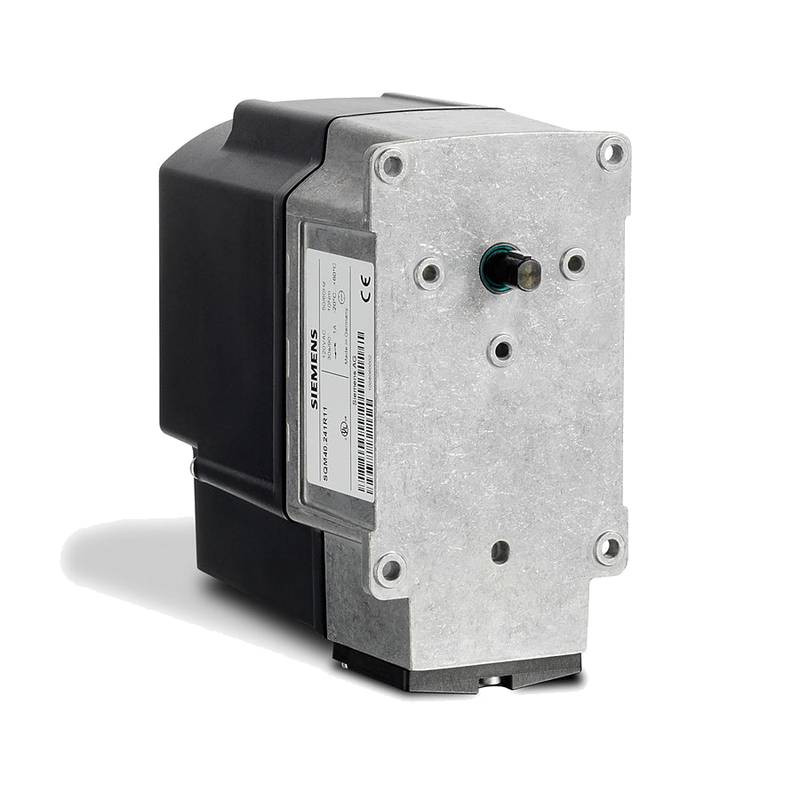
Siemens SQM40.165A20 High Efficiency Burner Actuator


The Siemens SQM40.165A20 High Efficiency Burner Actuator stands as a pinnacle of combustion control technology, engineered for demanding industrial applications where precision, reliability, and efficiency are paramount. This actuator offers superior performance through its advanced design, ensuring optimal fuel-air ratio management for a wide range of burners. Key advantages include its robust construction, high torque output for reliable damper control, and precise positioning capabilities, all contributing to reduced energy consumption and emissions. Technical specifications highlight its operating voltage of AC 24 V, a substantial torque of 165 Nm, and an impressive rotational angle of 90°/95°, coupled with an IP54 degree of protection for enhanced durability in harsh environments.
Product Specifications
| Feature | Specification |
| :------------------ | :---------------------------------- |
| Model | SQM40.165A20 |
| Type | High Efficiency Burner Actuator |
| Operating Voltage | AC 24 V |
| Torque | 165 Nm |
| Rotational Angle | 90° / 95° |
| Degree of Protection| IP54 |
| Application | Gas, oil, and dual-fuel burners |
| Control Signal | 3-point (floating) |
| Auxiliary Switches | Up to 2 |
| Power Consumption | 25 VA |
| Ambient Temperature | -20 to +60 °C |
Core Features & Market Positioning
The Siemens SQM40.165A20 differentiates itself in the market through its exceptional torque-to-size ratio, allowing for the control of larger combustion air dampers with a compact footprint. Its high-efficiency operation is a direct result of precise digital control algorithms and robust mechanical engineering, translating into significant operational cost savings for end-users through optimized fuel combustion and reduced flue gas losses. Industry reviews frequently commend its reliability and longevity, positioning it as a preferred choice for critical industrial combustion systems where downtime is unacceptable. The integration of adjustable end-stop and counter-flange mechanisms further simplifies installation and ensures optimal setup for diverse burner configurations.
Key Application Scenarios
This high-performance burner actuator finds its primary utility in a broad spectrum of industrial heating applications. It is extensively employed in large-scale industrial boilers, process heaters, and furnaces where precise control over the combustion air supply is essential for maintaining optimal thermal efficiency and meeting stringent environmental regulations. Specific use cases include managing air dampers in power generation facilities, chemical processing plants, and large commercial heating systems. The SQM40.165A20 is particularly well-suited for applications requiring rapid response times and stable operation under fluctuating load conditions, such as in batch processing or fluctuating energy demand scenarios. Its robust design also makes it ideal for environments with elevated temperatures or dust, common in manufacturing and heavy industry.
Practical System Integration Guidance
Integrating the Siemens SQM40.165A20 into an existing combustion control system is streamlined by its standardized mounting flange and electrical connections. The actuator accepts a 3-point floating control signal, enabling seamless integration with most common burner management systems and PLCs. Wiring involves connecting the power supply (AC 24 V), the control signal wires, and any auxiliary switches used for end-of-travel indication or interlocking. For precise setup, the mechanical end stops must be carefully adjusted to match the required damper travel (90° or 95°), typically facilitated by accessible adjustment screws. Ensuring correct phasing for the 3-point control signal is critical for proper operation, with ‘open’ and ‘close’ signals dictating damper movement.
Operation and Risk Mitigation
During operation, the SQM40.165A20 precisely modulates the combustion air damper based on signals from the burner control system, ensuring an optimal air-to-fuel ratio for efficient and safe combustion. Critical risks in burner operation, such as fuel-rich or fuel-lean conditions leading to incomplete combustion or flame instability, are mitigated by the actuator's accurate positioning. The actuator is equipped with internal logic to respond to control signals, and its robust construction minimizes mechanical failure risks. In the event of a fault, diagnostic indicators or auxiliary switches can provide feedback to the control system, allowing for timely intervention. Regular maintenance, including lubrication of moving parts and verification of electrical connections, is recommended to prevent potential operational issues and ensure continued reliability.
Scalability & Long-Term Value
The Siemens SQM40.165A20 offers significant long-term value through its compatibility with Siemens' broader industrial automation ecosystem. Its robust build quality and inherent reliability contribute to a long operational lifespan, reducing the total cost of ownership. While not directly upgradeable in terms of firmware, its modular design allows for straightforward replacement, minimizing downtime should a unit eventually require servicing. Integration with modern Industrial Internet of Things (IIoT) platforms is achievable via the burner management system or PLC it is connected to, allowing for remote monitoring of actuator status, operational efficiency, and predictive maintenance insights, thereby enhancing the overall digital strategy of the facility.
Frequently Asked Questions
What is the typical lifespan of a Siemens SQM40.165A20 actuator?
The operational lifespan of the Siemens SQM40.165A20 burner actuator is generally quite long, often exceeding 10-15 years in typical industrial settings with proper installation and regular maintenance. Factors influencing longevity include the frequency of operation, environmental conditions, and adherence to recommended service intervals.
Regular preventative maintenance, such as checking for wear on mechanical components and ensuring clean electrical connections, can significantly extend the actuator's service life. Understanding the operational parameters and avoiding continuous high-cycle use beyond its design specifications will also contribute to its durability.
When the time eventually comes for replacement, the SQM40.165A20's standardized mounting and connection interfaces ensure a quick and efficient swap, minimizing system downtime and associated costs.
How does the SQM40.165A20 ensure fuel efficiency?
This actuator ensures fuel efficiency by precisely controlling the combustion air damper to maintain the optimal air-to-fuel ratio. Precise control leads to more complete combustion, reducing wasted fuel and minimizing harmful emissions.
The SQM40.165A20's high-resolution positioning capabilities allow for fine-tuning of the air supply, adapting to varying fuel inputs and load demands. This dynamic adjustment prevents over- or under-supplying air, both of which lead to inefficient combustion.
By maintaining this precise balance, the actuator directly contributes to reduced energy consumption, lower operating costs, and a smaller environmental footprint for the industrial process.
What safety features are built into the SQM40.165A20?
While the SQM40.165A20 is primarily a positioning device, its safe operation is inherent in its precise control of combustion air. It integrates with burner management systems that implement safety interlocks.
The actuator's reliable positioning prevents conditions that could lead to unsafe combustion, such as fuel-rich or fuel-lean environments, which can cause flameouts or explosions. Its robust construction also minimizes the risk of mechanical failure during operation.
Its auxiliary switches can be wired into safety circuits to signal end-of-travel positions, providing essential feedback to the burner control system for safe sequencing and shutdown procedures if needed.
Can the SQM40.165A20 be used with natural gas and oil burners?
Yes, the Siemens SQM40.165A20 is designed for versatility and can be used with a wide range of burner types, including those firing on natural gas, oil, and dual-fuel configurations. Its robust torque and precise control make it suitable for various fuel sources and combustion air requirements.
The actuator's ability to handle 165 Nm of torque allows it to effectively manage the larger air dampers often associated with industrial gas and oil burners, ensuring consistent air delivery. Its compatibility with 3-point control signals means it can integrate seamlessly into control loops for these different fuel types.
Regardless of the fuel source, the primary function remains to precisely regulate the combustion air, which is critical for achieving efficient and safe combustion whether burning gaseous or liquid fuels.
What is the significance of the IP54 rating for this actuator?
The IP54 rating indicates that the Siemens SQM40.165A20 actuator offers a significant level of protection against environmental ingress. The '5' signifies protection against dust, meaning it is dust-protected, and the '4' indicates protection against splashing water from any direction.
This rating is crucial for industrial environments where dust accumulation and potential water spray are common occurrences, such as in boiler rooms, manufacturing plants, or areas with cleaning processes. The protection ensures that internal components remain shielded, preventing damage and maintaining operational reliability.
By being rated IP54, the SQM40.165A20 can be confidently installed in a wider range of challenging locations without requiring additional protective enclosures, simplifying installation and reducing overall system costs.
How is the SQM40.165A20 installed and wired?
Installation involves mounting the actuator onto the burner's air damper mechanism using the standardized flange, ensuring a secure and aligned fit. Wiring connects the AC 24 V power supply, the 3-point floating control signal wires from the burner management system, and any auxiliary switches for end-of-travel feedback.
The mechanical end stops for the desired angle of rotation (90° or 95°) must be precisely adjusted using the integrated adjustment screws to match the damper's physical limits. Correct phasing of the control signal wires is critical for the actuator to respond correctly to open and close commands.
Always refer to the official Siemens installation manual for detailed wiring diagrams and specific mounting instructions pertinent to your application to ensure safe and correct integration.
What are the main advantages of using a 3-point floating control signal?
A 3-point floating control signal offers a robust and relatively simple method for actuating devices like the SQM40.165A20. It uses two signal wires for control (open/close) and does not require continuous power to maintain position, only while changing it.
This type of control is highly reliable in industrial settings as it reduces the complexity of wiring and control logic compared to proportional or 4-20mA signals. The actuator moves to the commanded position and stays there until a new command is received.
The floating action simplifies integration with many standard controllers and burner management systems, making it a widely adopted standard for damper control applications like those involving the SQM40.165A20.
What does the torque rating of 165 Nm signify for this actuator?
The 165 Nm (Newton-meters) torque rating indicates the maximum rotational force the Siemens SQM40.165A20 actuator can deliver to move the connected damper. This is a significant torque value for its size.
A higher torque rating allows the actuator to overcome greater resistance from the damper, such as friction, air pressure, or stiffness in the linkage, ensuring reliable movement even with larger or heavier dampers. It also means the actuator can maintain its position against these forces.
For industrial burners, adequate torque is essential to ensure that the combustion air damper can be accurately positioned under all operating conditions, which is fundamental for maintaining efficient and safe combustion.
How can the SQM40.165A20 be integrated with IIoT platforms?
Integration with IIoT platforms is typically achieved indirectly through the plant's existing control system, such as a PLC or DCS, that is already connected to the SQM40.165A20. The actuator's operational status and position can be read by the controller.
The PLC or DCS then acts as the gateway, transmitting relevant data points from the SQM40.165A20 (e.g., damper position, operational hours, fault signals) to an IIoT platform or cloud-based analytics system. This allows for remote monitoring and analysis.
This data can then be used for advanced diagnostics, performance optimization, predictive maintenance scheduling, and overall process improvement, leveraging the actuator's reliable performance within a digitized industrial environment.
What are the typical failure modes of burner actuators like the SQM40.165A20?
Common failure modes for burner actuators can include mechanical wear on gears or bearings due to prolonged use, electrical issues such as damaged wiring or internal component failure, and control signal reception problems. Environmental factors like extreme temperatures or dust can also contribute to wear.
Over time, the internal motor or control electronics may degrade, leading to erratic movement or a complete loss of functionality. Auxiliary switch failures, if equipped, can also occur, disrupting feedback to the control system.
Regular preventative maintenance, including lubrication and inspection of mechanical and electrical components, is crucial for mitigating these risks and ensuring the continued reliable operation of the SQM40.165A20.