











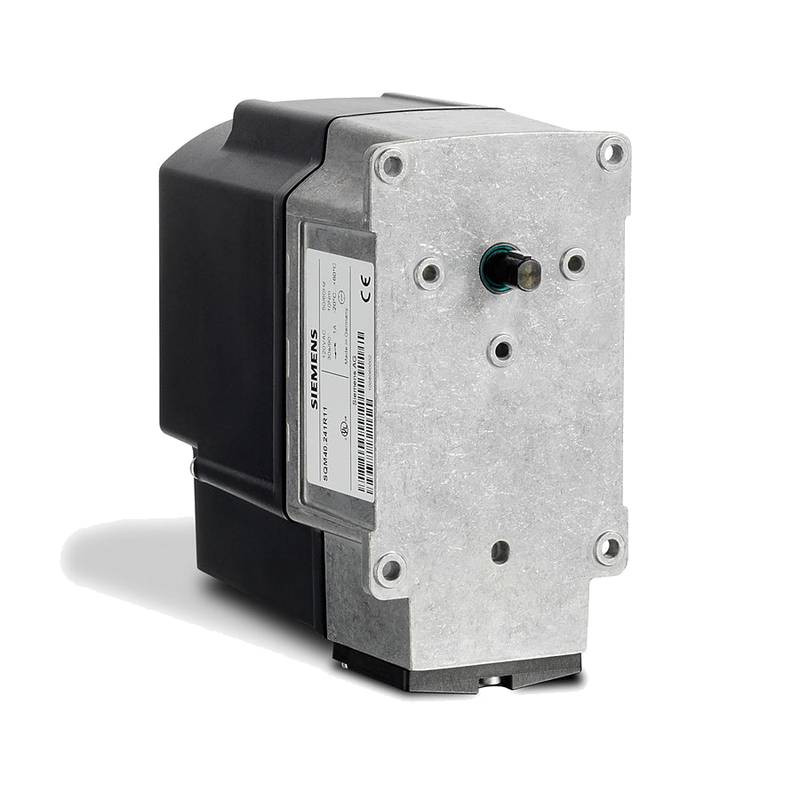
Siemens SQM40.317A23 Actuator for Large Industrial Furnaces


The Siemens SQM40.317A23 actuator is engineered for precision control in large industrial furnaces, offering robust performance and reliability. This actuator boasts a high torque output, rapid response times, and exceptional durability, making it ideal for demanding applications. Its technical specifications include an operating voltage of 24V AC, a torque of 300 Nm, and a rotation angle of 90 degrees, with an IP54 protection rating. These attributes ensure consistent and efficient operation within complex combustion systems.
Core Features & Market Positioning
The Siemens SQM40.317A23 actuator distinguishes itself through its advanced direct-coupled design, simplifying installation and reducing potential points of failure. Its integrated safety functions, including internal limit and auxiliary switches, provide critical operational feedback and enhance system safety. Market positioning is solidified by Siemens' reputation for quality and the actuator's compatibility with various control systems, offering a competitive edge in terms of integration flexibility and long-term operational efficiency for industrial heating processes.
Key Application Scenarios
This actuator is prominently featured in applications requiring precise modulation of fuel and air flow within large industrial furnaces. It is a critical component in systems such as power generation boilers, ceramic kilns, and metal heat treatment furnaces, where exact temperature control is paramount. Its robust construction ensures reliable performance under harsh conditions, facilitating efficient combustion and reducing energy consumption in these high-demand environments.
Practical System Integration Guidance
Integrating the Siemens SQM40.317A23 actuator involves direct mounting onto the damper shaft, utilizing its integrated coupling. Wiring connections are typically made to terminals for power (24V AC) and control signals, often integrated with a burner control system or PLC. The auxiliary switches provide feedback on damper position, which is crucial for safe startup and operation sequences. Careful attention to the electrical wiring diagram and ensuring proper mechanical alignment will optimize performance and longevity.
Operation and Risk Mitigation
Operation of the SQM40.317A23 actuator is managed through its integrated control logic or an external control system that dictates its positioning based on furnace load requirements. Risk mitigation is primarily achieved through its inherent safety features, such as internal end-stop mechanisms and electrical limit switches that prevent over-rotation and ensure the damper returns to a safe position in case of power failure or control signal loss. Regular inspection of the actuator and its connected linkages for wear or damage is recommended to prevent operational failures.
Scalability & Long-Term Value
The SQM40.317A23 actuator offers significant long-term value due to its robust design and compatibility with a wide range of control platforms. Its integration with modern industrial control systems, including those supporting IIoT initiatives, allows for enhanced data collection and remote monitoring capabilities. This facilitates predictive maintenance and process optimization, extending the useful life of the actuator and the furnace system it controls, thereby providing a scalable solution for evolving industrial needs.
Frequently Asked Questions
What is the primary function of the Siemens SQM40.317A23 actuator?
It precisely controls fuel and air dampers in large industrial furnaces. This ensures optimal combustion and temperature regulation for various industrial processes. Its robust design handles demanding environments.
How does the SQM40.317A23 ensure operational safety?
It features integrated safety switches and end-stops. These prevent over-rotation and manage damper position during power loss. Feedback from these switches is critical for safe startup sequences.
What are the key technical specifications of the SQM40.317A23?
It operates at 24V AC, provides 300 Nm torque, and has a 90-degree rotation. The actuator offers IP54 protection against dust and water ingress. Its direct-coupled design simplifies installation.
In which industrial applications is the SQM40.317A23 commonly used?
It is found in power plant boilers and large industrial heating systems. It's also vital for ceramic kilns and metal treatment furnaces. These applications demand precise temperature control.
What torque rating does the SQM40.317A23 actuator offer?
The actuator delivers a substantial torque of 300 Nm. This high torque is essential for accurately positioning large dampers in industrial furnaces. It ensures responsive control under load.
What is the typical voltage requirement for the SQM40.317A23?
This actuator is designed to operate on a 24V AC power supply. This voltage is common in industrial control circuits and ensures compatibility. Proper power supply is crucial for reliable operation.
How is the SQM40.317A23 installed in a furnace system?
Installation involves direct mounting onto the damper shaft via its integrated coupling. This direct-drive design minimizes mechanical complexity. Ensure proper alignment for optimal performance.
What kind of protection rating does the SQM40.317A23 have?
It features an IP54 protection rating. This means it is protected against dust ingress and splashing water. This robustness is suitable for industrial environments.
Can the SQM40.317A23 be integrated with modern digital control systems?
Yes, it can integrate with modern PLCs and IIoT platforms. This allows for remote monitoring and data acquisition. It supports advanced process control strategies.
What is the rotation angle of the SQM40.317A23 actuator?
The actuator provides a 90-degree rotation angle. This range is standard for modulating damper control in combustion systems. It allows for precise adjustment of air and fuel flow.