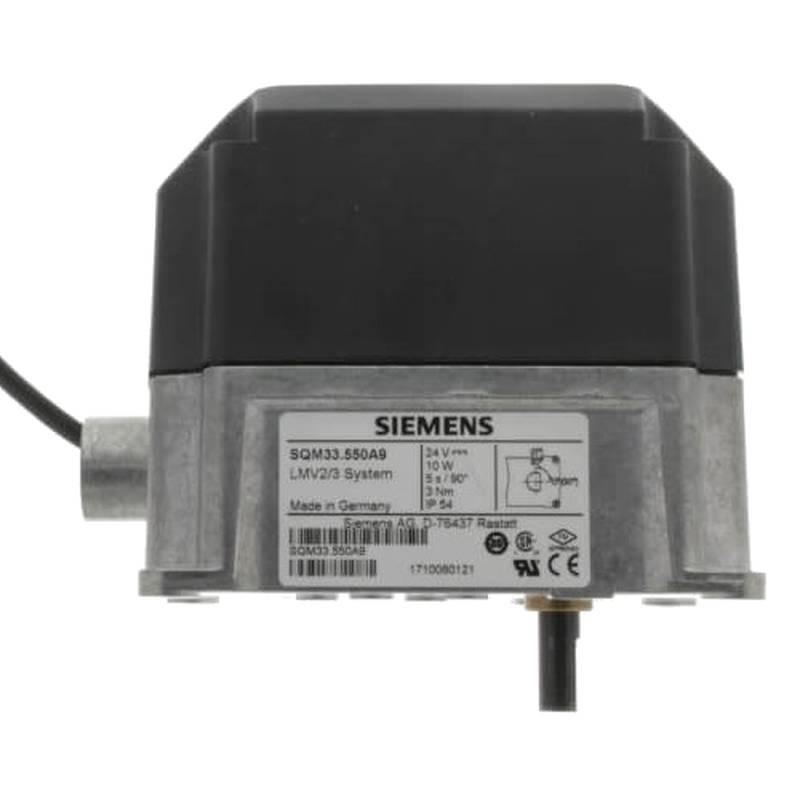













Siemens SQN30.111A2700 Proportional Control Actuator


The Siemens SQN30.111A2700 proportional control actuator is a robust and precise solution designed for demanding HVAC and industrial applications. This actuator excels in delivering accurate positioning of dampers and valves, ensuring optimal system performance and energy efficiency. Its core advantages lie in its high reliability, precise proportional control, and straightforward integration into existing automation systems. Key technical parameters include a nominal torque of 15 Nm, a stroke of 20 mm, and a control signal range of 0-10V, making it suitable for a wide array of control tasks.
Product Specifications
| Parameter | Specification |
| :------------------ | :------------------------- |
| Nominal Torque | 15 Nm |
| Stroke | 20 mm |
| Control Signal | 0-10 V DC |
| Power Supply | 24 V AC |
| Operating Temperature | -20 to +50 °C |
| Protection Class | IP54 |
| Ambient Humidity | 5 to 95% RH (non-condensing) |
| Actuator Type | Proportional |
| Cable Entry | M20 x 1.5 |
| Manual Override | Yes |
Core Features & Market Positioning
The Siemens SQN30.111A2700 distinguishes itself through its direct-mount design, simplifying installation and reducing mechanical linkages, which enhances reliability and minimizes potential failure points. Its proportional control capability, utilizing a 0-10VDC signal, allows for precise modulation of air dampers or water valves, critical for maintaining optimal environmental conditions and minimizing energy waste in building management systems. This precision positioning is a key differentiator, positioning the SQN30.111A2700 as a premium choice for applications where tight control is paramount, outperforming simpler on/off or three-point control mechanisms in dynamic response and stability. The robust construction and Siemens' reputation for industrial automation excellence further solidify its market position as a dependable, long-term solution.
Key Application Scenarios
This proportional control actuator is ideally suited for modulating control of air handling units (AHUs) and fan coil units (FCUs) in commercial buildings, ensuring precise airflow regulation for occupant comfort and ventilation compliance. It is also frequently employed in industrial process control for precise regulation of fluid flow in heating, cooling, and ventilation systems where accurate temperature or pressure maintenance is critical. Building automation systems (BAS) and energy management systems widely adopt the SQN30.111A2700 for its ability to integrate seamlessly and provide granular control, contributing to significant energy savings and operational efficiency. Its application extends to controlling combustion air dampers in boilers and furnaces, optimizing fuel efficiency and emissions.
Practical System Integration Guidance
Integrating the Siemens SQN30.111A2700 involves straightforward wiring to the control system's output signal terminals and the actuator's power supply. Ensure the control signal (0-10VDC) is correctly connected to the designated input terminals. The power supply (24V AC) must be robust and free from significant voltage fluctuations. For optimal performance, the actuator's mechanical linkage to the damper or valve should be properly aligned and free from binding; a manual override is available for initial setup or in emergency situations. Commissioning typically involves calibrating the stroke to match the physical travel of the controlled device, ensuring that the 0-10V range corresponds precisely to the desired minimum and maximum positions. Referencing the installation manual for specific wiring diagrams based on your control system's output type is crucial for successful implementation.
Operation and Risk Mitigation
During operation, the Siemens SQN30.111A2700 continuously adjusts its position based on the incoming 0-10VDC control signal. It is essential to ensure the control signal remains within its specified range to prevent actuator malfunction. Over-voltage or incorrect signal types can damage the internal electronics. Regular inspection of the mechanical linkage for wear or obstruction is recommended to prevent operational issues. Faults are often indicated by the actuator's inability to reach its commanded position or by erratic movement. Common troubleshooting steps include verifying the control signal voltage and ensuring adequate power supply. Electrical protection, such as fuses or circuit breakers, should be installed in the power supply circuit to mitigate risks associated with short circuits or overloads.
Scalability & Long-Term Value
The SQN30.111A2700 offers significant long-term value due to its compatibility with a wide range of Siemens automation platforms and third-party building management systems that support standard analog control signals. Its durable design ensures a long operational lifespan, minimizing replacement costs. While this specific model is a dedicated proportional actuator, it integrates seamlessly into larger, scalable automation architectures. For future IIoT integration, it can be connected to gateways or PLCs that provide digital connectivity, allowing for remote monitoring, diagnostics, and data logging, thereby enhancing its value within a smart building ecosystem and supporting predictive maintenance strategies.
FAQs
1. What is the primary function of the Siemens SQN30.111A2700 actuator?
This actuator precisely positions dampers and valves. It utilizes a 0-10VDC signal for proportional control. It is vital for maintaining system efficiency.
Its main role is accurate modulation of airflow or fluid. This ensures optimal environmental conditions and energy savings. It is a core component in HVAC and industrial automation.
The actuator's proportional action allows for fine-tuning control. This is crucial for applications requiring stable setpoints. It prevents system oscillations common with simpler control methods.
2. What are the typical applications for the SQN30.111A2700?
It's commonly used in air handling units (AHUs). It precisely controls dampers for airflow regulation. This ensures occupant comfort and ventilation.
Industrial processes also benefit from its precise modulation. It controls valves in heating and cooling loops. This maintains critical temperature and pressure setpoints.
Building automation systems (BAS) leverage it for energy management. It integrates into control strategies for efficiency. It is also found in boiler and furnace applications for combustion air.
3. How is the SQN30.111A2700 installed and commissioned?
Installation involves direct mounting to dampers or valves. Proper mechanical linkage alignment is essential. Wiring connects the control signal and power supply.
Commissioning requires calibrating the stroke. This ensures the 0-10VDC signal matches device travel. Manual override assists in setup.
Always consult the official installation manual. This provides specific wiring diagrams and procedures. Correct installation ensures reliable and accurate operation.
4. What power supply voltage does the SQN30.111A2700 require?
The actuator operates on a 24V AC power supply. It is crucial to use a stable and reliable source. Fluctuations can affect performance and lifespan.
Ensure the power source meets the actuator's specifications. Incorrect voltage can lead to damage or malfunction. Protection measures like fuses are recommended.
The 24V AC supply powers the internal motor and electronics. Proper connection to the control panel or transformer is necessary. Always verify polarity if applicable for your specific setup.
5. Can the SQN30.111A2700 be used with a 4-20mA control signal?
No, the SQN30.111A2700 is designed exclusively for a 0-10VDC control signal. It cannot directly accept a 4-20mA signal. Using an incompatible signal will result in incorrect operation.
To integrate with a 4-20mA system, a signal converter is required. This device translates the current signal to the appropriate voltage signal. Consult your system integrator for options.
Always verify the control signal type specified by your BMS or controller. The SQN30.111A2700's specifications clearly state 0-10VDC input.
6. What is the torque rating of the SQN30.111A2700?
The actuator provides a nominal torque of 15 Nm. This rating indicates its capacity to move connected loads. It is suitable for many standard damper and valve sizes.
This torque is sufficient for most HVAC applications. It ensures reliable positioning even with some back pressure. For larger or stiffer actuators, a higher torque model might be necessary.
Always ensure the required torque of your damper or valve is within the actuator's capability. Exceeding this limit can cause motor strain and failure. Check application-specific requirements.
7. Does the SQN30.111A2700 have a manual override function?
Yes, the Siemens SQN30.111A2700 includes a manual override. This allows for manual positioning of the connected damper or valve. It is useful during installation or maintenance.
The manual override is typically operated via a button or lever on the actuator. It disengages the motor for manual adjustment. It re-engages automatically or requires a reset to resume automated control.
Using the manual override is straightforward but should be done with care. Ensure no conflict with automated control signals when using it. Always refer to the manual for specific operation.
8. What is the stroke length of the SQN30.111A2700?
This actuator has a stroke length of 20 mm. This defines the maximum linear travel of the connected linkage. It is important for matching with the controlled device's movement.
The 20 mm stroke is suitable for many standard damper and valve actuators. Ensure the damper or valve requires this specific travel for its full operation range.
Confirming the stroke length is critical during system design. It ensures the actuator can achieve the required flow or air position. Mismatched stroke lengths will lead to poor control.
9. What is the protection rating (IP code) of the SQN30.111A2700?
The actuator has an IP54 protection rating. This means it is protected against dust ingress. It is also protected against splashing water from any direction.
This rating makes it suitable for many industrial environments. It can withstand moderate dust and moisture. However, it is not intended for submersion or high-pressure water jets.
Ensure the installation environment aligns with the IP54 rating. Avoid areas with excessive moisture, corrosive elements, or heavy dust accumulation to maintain longevity.
10. Can the SQN30.111A2700 be used in outdoor applications?
The IP54 rating offers some protection against environmental factors. It is generally suitable for protected outdoor installations. Avoid direct exposure to harsh weather conditions.
For applications with extreme temperatures or direct precipitation, consider additional enclosures. Outdoor use requires careful evaluation of the specific environmental conditions.
Siemens offers other actuator models with higher IP ratings for more demanding outdoor scenarios. Always check the product's environmental specifications for suitability.