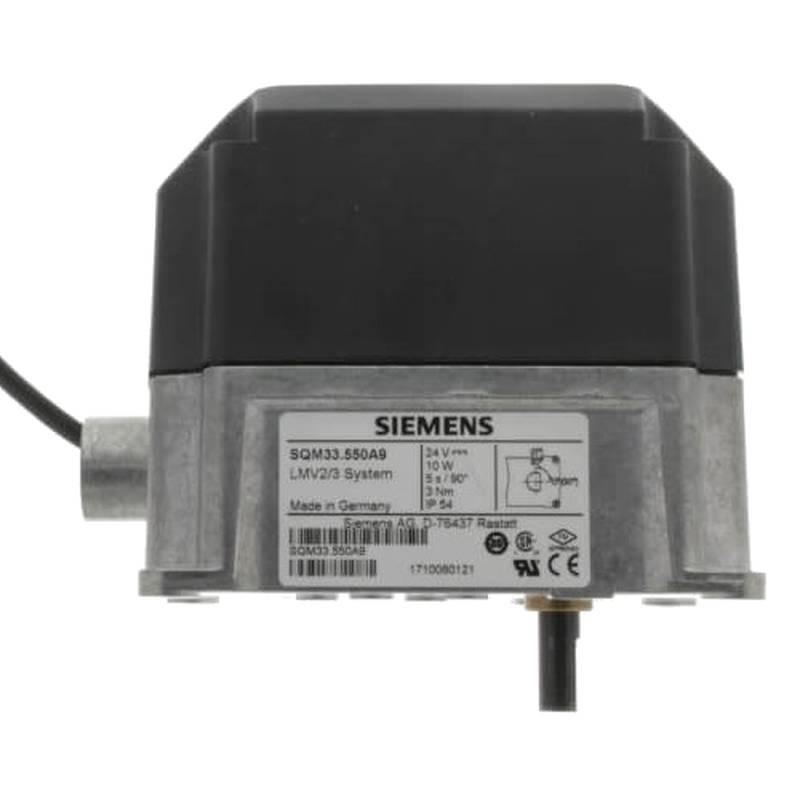
Siemens SQM33.411A9 Actuator for Burner Damper Control


The Siemens SQM33.411A9 actuator is engineered for precise and reliable burner damper control, offering significant advantages in operational efficiency, safety, and system integration for industrial combustion applications. This advanced actuator boasts a high torque output, rapid response time, and robust construction, ensuring dependable performance even in demanding environments. Its core features include self-diagnostic capabilities, flexible mounting options, and compatibility with various control systems, positioning it as a leading solution for optimizing fuel-air ratios and enhancing combustion safety. Key technical parameters include an operating voltage of AC 100...240 V, a torque of 150 Nm, and a rotation angle of 90°, making it suitable for a wide range of damper sizes and control requirements.
Product Specifications
| Feature | Specification |
| :------------------- | :--------------------------------- |
| Model | SQM33.411A9 |
| Application | Burner Damper Control |
| Operating Voltage | AC 100...240 V |
| Torque | 150 Nm |
| Rotation Angle | 90° |
| Ambient Temperature | -20...+60 °C |
| Protection Class | IP54 |
| Control Signal | 3-point step (Open/Close) |
| Manual Override | Yes |
| Auxiliary Switches | 2 x adjustable |
| Cable Entry | PG 16 |
| Dimensions (W x H x D) | 207 x 300 x 147 mm |
| Weight | Approx. 4.5 kg |
Core Features & Market Positioning
The Siemens SQM33.411A9 actuator distinguishes itself through its superior torque of 150 Nm, enabling precise control of larger dampers and ensuring optimal air-fuel ratios across diverse burner types. Its robust design and IP54 protection class signify exceptional durability, making it a preferred choice for industrial settings where reliability is paramount. The integrated auxiliary switches provide valuable feedback on damper position, crucial for interlocking safety systems and enhancing overall combustion process management. This combination of power, reliability, and integrated functionality positions the SQM33.411A9 as a premium, high-performance actuator in the competitive burner control market, favored by engineers prioritizing long-term operational integrity and efficiency.
Key Application Scenarios
This actuator is ideally suited for a broad spectrum of industrial combustion applications, including firing systems in power plants, industrial furnaces, boilers, and incinerators. Its 90° rotation angle and 150 Nm torque are particularly effective in applications requiring precise modulation of air intake for optimal combustion efficiency and emissions control. The SQM33.411A9 is frequently specified for retrofitting older systems to enhance performance and safety, as well as for new installations demanding robust and reliable damper positioning. It is a critical component in ensuring stable flame conditions and preventing combustion instabilities in systems where accurate air supply is essential.
Practical System Integration Guidance
Integrating the Siemens SQM33.411A9 into existing combustion control systems is streamlined due to its standard 3-point step control (Open/Close) and versatile AC 100-240 V operating voltage. Installation typically involves securely mounting the actuator to the damper shaft and connecting the power and control wiring via the PG 16 cable entry. The adjustable auxiliary switches can be readily configured to signal damper end positions or intermediate states to the burner management system, facilitating crucial safety interlocks. Commissioning involves verifying correct rotation direction and setting the end stops, ensuring the actuator accurately moves the damper throughout its full operational range.
Operation and Risk Mitigation
The SQM33.411A9 operates by receiving a 3-point step signal to position the burner damper, precisely controlling airflow to the combustion chamber. To mitigate risks, it is essential to ensure proper installation, including correct wiring and mechanical linkage. The actuator's manual override feature is critical for emergency operation or maintenance, allowing for direct damper positioning without power. While specific fault codes are not extensively documented publicly, common troubleshooting for such actuators involves checking power supply, control signals, and mechanical binding of the damper or actuator linkage, ensuring uninterrupted and safe burner operation.
Scalability & Long-Term Value
The Siemens SQM33.411A9 actuator offers excellent long-term value through its robust construction and compatibility with a wide array of burner management systems. Its design facilitates integration into both traditional control architectures and modern digital platforms, supporting the evolution towards smarter industrial processes. While not a direct digital control device itself, its reliable feedback via auxiliary switches enables seamless integration with Programmable Logic Controllers (PLCs) and Distributed Control Systems (DCS) that manage IIoT-enabled combustion solutions. This ensures that facilities can upgrade their control strategies without necessarily replacing the foundational actuator hardware, preserving investment.
Frequently Asked Questions
1. What is the primary function of the Siemens SQM33.411A9 actuator?
The Siemens SQM33.411A9 is designed to precisely control burner dampers. It modulates airflow for optimal combustion. This ensures efficient fuel usage and reduces emissions.
This actuator is vital for maintaining stable flame conditions. It prevents combustion instabilities in industrial furnaces. Its torque of 150 Nm allows for precise air-fuel ratio adjustments.
Its robust design ensures reliability in demanding industrial environments. It is a key component in burner management systems. It contributes to overall operational safety and efficiency.
2. What are the key technical specifications of the SQM33.411A9?
This actuator operates on AC 100-240 V and provides a substantial 150 Nm of torque. It offers a 90° rotation angle for damper positioning. The operating temperature range is -20 to +60 °C.
It features an IP54 protection class, safeguarding against dust and water ingress. The unit weighs approximately 4.5 kg and has dimensions of 207 x 300 x 147 mm. Cable entry is facilitated by PG 16.
Additional features include 2 adjustable auxiliary switches for feedback and a manual override function. These specifications highlight its suitability for robust industrial applications.
3. In which types of industrial applications is the Siemens SQM33.411A9 commonly used?
The SQM33.411A9 is prevalent in power generation and industrial heating applications. It is also found in boilers, furnaces, and incinerator burner systems. These applications require precise air control.
Its primary role is to optimize the air-fuel mixture for efficient combustion. This leads to improved energy efficiency and reduced pollutant emissions. It is crucial for maintaining consistent combustion quality.
The actuator is suitable for both new installations and retrofitting older systems. Its reliability makes it a preferred choice for critical combustion processes.
4. How does the SQM33.411A9 ensure reliable burner damper control?
The actuator's high torque (150 Nm) ensures positive and stable positioning of even large dampers. Its robust construction and IP54 rating provide resilience against harsh industrial conditions. The 3-point step control offers accurate positioning commands.
Self-diagnostic features, inherent in Siemens combustion components, contribute to early fault detection. The manual override offers a failsafe mechanism for operational continuity. These elements collectively guarantee dependable performance.
Precise control of airflow is fundamental to burner safety and efficiency. The SQM33.411A9’s design prioritizes this accuracy, minimizing operational risks.
5. What are the advantages of using the SQM33.411A9 over other actuators?
Its combination of high torque (150 Nm) and a compact design is a significant advantage. The IP54 protection class ensures durability in demanding environments. It also offers integrated auxiliary switches for system feedback.
The Siemens brand is associated with high quality and reliability in industrial automation. This translates to longer service life and reduced maintenance costs. Its compatibility with various control systems simplifies integration.
The actuator’s precise positioning capabilities contribute directly to improved combustion efficiency and reduced emissions. This offers a strong return on investment for industrial users.
6. How is the SQM33.411A9 installed and commissioned?
Installation involves securely mounting the actuator to the damper shaft and connecting the power and control wiring via the PG 16 gland. Mechanical linkage must be free to move. End stop adjustments are critical during setup.
Commissioning requires verifying the correct direction of rotation. The auxiliary switches should be set to signal damper positions accurately to the burner management system. Power supply and control signal integrity must be confirmed.
Proper installation is key to achieving optimal performance and longevity. Referencing the manufacturer's installation manual is highly recommended. This ensures all steps are followed correctly.
7. Can the SQM33.411A9 be integrated with modern IIoT or digital control systems?
Yes, the actuator can be integrated with modern systems. Its auxiliary switches provide essential positional feedback to PLCs or DCS. These systems often form the backbone of IIoT solutions.
While the SQM33.411A9 itself uses traditional 3-point control, it is a reliable component. It can be part of a larger, digitally managed combustion process. Data from its operation can be logged and analyzed.
This integration allows for remote monitoring and control capabilities. It enhances predictive maintenance strategies. It contributes to overall plant digitalization efforts.
8. What are common troubleshooting steps for the Siemens SQM33.411A9?
Check the power supply voltage (AC 100-240 V) and ensure it is stable. Verify the 3-point control signals are correctly wired and functioning. Inspect the mechanical linkage for any binding or obstruction.
Ensure the damper is not seized and moves freely. Check the auxiliary switch settings and their connections to the control system. Listen for any unusual noises from the actuator motor.
If issues persist, consult the Siemens technical documentation or contact support. Overheating or erratic movement can indicate internal motor or gearing problems requiring professional attention.
9. What is the role of the auxiliary switches on the SQM33.411A9?
The two adjustable auxiliary switches provide crucial positional feedback to the burner management system. They can signal when the damper reaches its fully open or fully closed positions. This information is vital for burner sequencing and safety interlocks.
These switches can also be set to indicate intermediate damper positions. This allows for more sophisticated control strategies and performance monitoring. They enhance the overall safety and operational awareness of the combustion process.
By providing reliable end-of-travel and intermediate position signals, these switches ensure the burner control system knows the exact state of the damper. This prevents incorrect operational sequences and potential hazards.
10. What is the expected lifespan and maintenance for this actuator?
The SQM33.411A9 is built for industrial durability, offering a long operational lifespan. Routine maintenance typically involves visual inspections for wear and tear. Periodic checks of the mechanical linkage for smooth operation are advisable.
Ensure electrical connections remain secure and free from corrosion. Lubrication is generally not required for the internal gearing under normal operating conditions. However, following specific manufacturer guidelines for inspection is always best practice.
While designed for low maintenance, any signs of reduced performance or unusual noise should be investigated promptly. Addressing minor issues early can prevent major failures and extend the actuator’s service life significantly.