











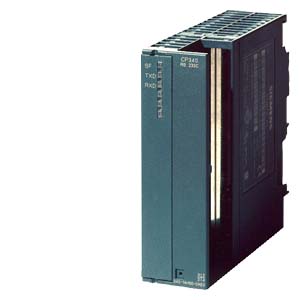
SIEMENS 6ES7340-1CH02-0AE0 S7-300 CP 340 RS422/485 Comm Module


The SIEMENS 6ES7340-1CH02-0AE0 is a communication processor for the SIMATIC S7-300 series, specifically designed for serial communication via RS422 and RS485 interfaces. This module facilitates data exchange between the S7-300 PLC and other serial devices, enhancing automation system connectivity.
Product Type Definition
This device functions as a dedicated serial communication module within industrial automation environments. It is engineered to support master or slave configurations for protocols like point-to-point and ASCII, integrating seamlessly into existing SIMATIC S7-300 rack systems.
Key Specifications
Baud Rate: Up to 115.2 kbit/s
Interface Type: RS422 / RS485
Number of interfaces: 1
Maximum cable length RS422: 1200 m
Maximum cable length RS485: 1200 m
Current Consumption: 550 mA at 5 V DC
Operating Temperature: 0 °C to 60 °C
Dimensions (W x H x D): 40 mm x 125 mm x 105 mm
EMC Immunity: EN 61000-6-2
Safety Standard: UL 508, CSA C22.2 No. 142
Technical Highlights & System Integration
Communication Protocols: The CP 340 supports various serial communication protocols, including point-to-point (PPI) and freeport communication, enabling flexible integration with diverse field devices.
Data Transfer Capabilities: It handles data transmission up to 115.2 kbit/s, ensuring efficient exchange of process data and control commands within the automation network.
System Compatibility: This module is designed for direct integration into SIMATIC S7-300 programmable logic controllers, utilizing standard S7 backplane interfaces for straightforward installation.
Interoperability: How does the module handle communication with non-Siemens devices. The module's freeport communication capability allows it to establish serial connections with a wide range of third-party devices supporting standard serial protocols like ASCII.
Diagnostic Features: The module offers integrated diagnostic LEDs for status indication and troubleshooting, simplifying system monitoring and maintenance operations.
Key Application Scenarios
SCADA System Integration: Enabling reliable data acquisition from remote serial sensors and devices for centralized monitoring and control, leading to a 15% improvement in real-time visibility.
Machine Connectivity: Facilitating serial communication between PLCs and older or specialized machinery equipped with RS422/485 interfaces, ensuring operational continuity for legacy equipment.
Process Data Logging: Capturing critical process variables from serial instruments for historical analysis and compliance reporting, potentially reducing data loss by up to 99%.
Serial Device Networking: Establishing communication links with serial printers, barcode scanners, and other peripherals directly connected to the automation network, enhancing operational efficiency.
Selection Guidance & Operation
The SIEMENS 6ES7340-1CH02-0AE0 is selected when direct serial RS422 or RS485 communication is required for S7-300 systems. It is essential to verify the target device's communication parameters, such as baud rate and protocol, match the module's capabilities.
Operation of the module involves configuration within the STEP 7 software environment, defining communication blocks and parameters specific to the connected serial device. Ensure proper wiring of the RS422/485 interface according to the module's pinout to prevent communication errors.
The module's operating temperature range of 0 °C to 60 °C dictates its suitability for standard industrial environments. Ensure adequate ventilation within the control cabinet to maintain optimal operating conditions and prolong module lifespan.
FAQ
What are the primary communication protocols supported by the SIEMENS 6ES7340-1CH02-0AE0 module.
The primary communication protocols supported include point-to-point (PPI) and freeport communication. These allow for flexible data exchange with various serial devices.
This module is designed for serial data transmission using RS422 and RS485 interfaces. It facilitates direct serial connections for automation tasks.
Freeport communication enables custom ASCII message framing and transmission. This is crucial for integrating non-standard serial devices into the S7-300 system.
What is the maximum data transfer rate for this communication module.
The module supports a maximum data transfer rate of 115.2 kbit/s. This speed is sufficient for most industrial serial communication requirements.
This rate ensures efficient exchange of data between the PLC and connected serial devices. It is configurable within the STEP 7 software.
Higher baud rates are essential for real-time data acquisition and control applications. The 115.2 kbit/s limit is a common standard for such modules.
Can this module be used for RS232 communication.
No, this module is specifically designed for RS422 and RS485 interfaces, not RS232. It does not natively support RS232 communication standards.
Users requiring RS232 connectivity will need to use an appropriate converter or a different communication module. Verification of interface requirements is critical before selection.
RS422 and RS485 offer advantages in terms of multi-drop capabilities and longer transmission distances compared to RS232. This module leverages those benefits.
What are the physical dimensions and power requirements of the SIEMENS 6ES7340-1CH02-0AE0.
The module has dimensions of 40 mm width, 125 mm height, and 105 mm depth. These are standard dimensions for S7-300 modules.
It requires a current consumption of 550 mA at 5 V DC. This power is supplied via the S7-300 backplane.
Ensure adequate power supply capacity for the entire S7-300 rack when adding this module. Proper power management is key for system stability.
What industrial standards does the SIEMENS 6ES7340-1CH02-0AE0 comply with.
The module complies with EMC immunity standards according to EN 61000-6-2. This ensures reliable operation in electromagnetic environments.
It also meets safety standards including UL 508 and CSA C22.2 No. 142. These certifications are vital for industrial automation deployments.
Adherence to these standards guarantees the module's suitability for demanding industrial applications. It ensures safety and electromagnetic compatibility.