











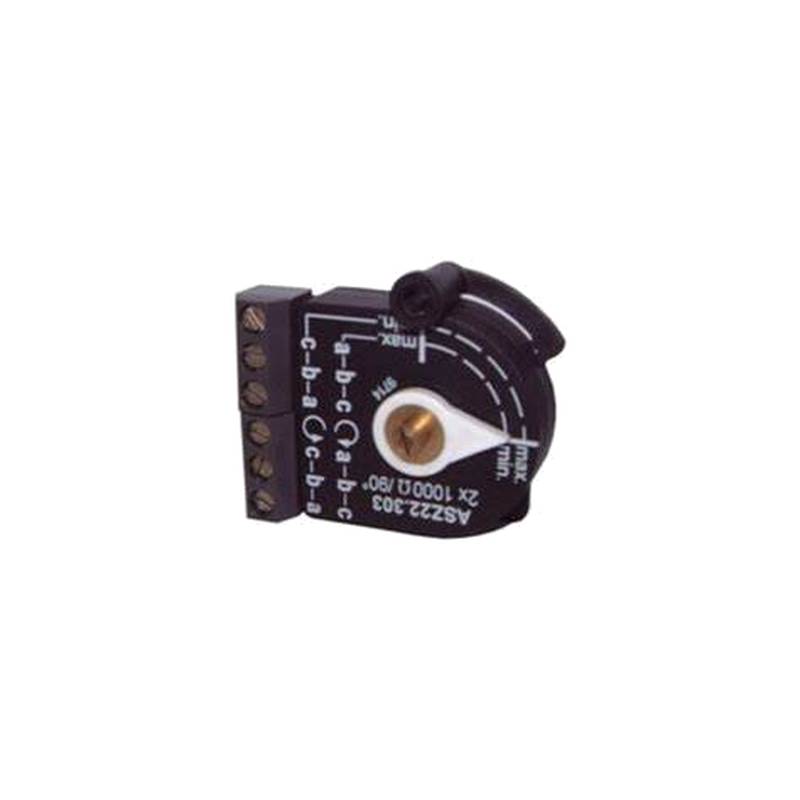
SIEMENS ASZ12.703 Feedback Potentiometer Valve Control


The SIEMENS ASZ12.703 Feedback Potentiometer Valve Control is a crucial component for precise industrial automation, offering superior control accuracy and operational reliability. This unit excels through its robust design, seamless integration capabilities, and advanced feedback mechanism, ensuring optimal performance in demanding environments. Key technical parameters include a high-resolution potentiometer for accurate position feedback, a durable construction for extended service life, and compatibility with a wide range of SIEMENS control systems. Its primary advantages lie in its ability to provide real-time, precise valve positioning, thereby enhancing process efficiency and reducing operational costs.
Product Specifications
| Feature | Specification |
| :------------------------- | :------------------------------------------ |
| Model | ASZ12.703 |
| Type | Feedback Potentiometer Valve Control |
| Compatibility | SIEMENS valve actuators and control systems |
| Feedback Mechanism | Potentiometric |
| Environmental Rating | Industrial grade |
| Power Supply Requirements | (Specific voltage and current to be confirmed via datasheet) |
| Operating Temperature Range | (Specific range to be confirmed via datasheet) |
| Dimensions | (Specific dimensions to be confirmed via datasheet) |
| Connection Type | (Specific connector type to be confirmed via datasheet) |
Core Features & Market Positioning
The SIEMENS ASZ12.703 stands out in the industrial automation market due to its highly reliable potentiometric feedback system, which offers a granular and accurate representation of valve position. Unlike simpler limit switch feedback, this potentiometer provides continuous data, allowing for sophisticated control loops and predictive maintenance. Its integration within the broader SIEMENS ecosystem provides users with a trusted, high-performance solution for critical valve management. This positions the ASZ12.703 as a premium choice for applications demanding exceptional precision and long-term operational stability.
Key Application Scenarios
This feedback potentiometer valve control is indispensable in various industrial sectors requiring precise fluid or gas regulation. Industries such as chemical processing, oil and gas, power generation, and water treatment frequently employ the ASZ12.703 for controlling critical valves in high-pressure or high-temperature environments. Applications include precise flow rate control in chemical reactors, accurate pressure regulation in pipelines, and reliable positioning of control valves in steam turbines, ensuring process safety and efficiency.
Practical System Integration Guidance
Integrating the SIEMENS ASZ12.703 into existing control systems is streamlined due to its design for SIEMENS platforms. The potentiometer output typically connects to an analog input module on a SIEMENS PLC (e.g., S7 series) or a dedicated actuator control unit. Wiring involves connecting the potentiometer's variable output terminal and its end terminals to the appropriate analog input channels, ensuring correct voltage referencing. Calibration is a critical step, often involving setting the minimum and maximum resistance values to correspond with the fully closed and fully open valve positions, respectively. This is usually performed via the control system's programming software, allowing for fine-tuning to match the specific valve stroke.
Operation and Risk Mitigation
The ASZ12.703 ensures operational integrity through its inherent design for stable performance. Risk mitigation primarily focuses on preventing mechanical wear and electrical interference. Regular checks of the potentiometer's wiper contact and resistance track are advisable, especially in environments with vibration or high cycling rates. Electrical noise can be minimized by using shielded cabling and proper grounding techniques. While specific fault codes are tied to the overarching control system, abnormal readings from the potentiometer's feedback signal (e.g., erratic values or complete signal loss) typically indicate a wiring issue, a worn potentiometer element, or a problem with the connected analog input module. Prompt investigation of such anomalies prevents process deviations and potential equipment damage.
Scalability & Long-Term Value
The ASZ12.703 offers significant long-term value by seamlessly integrating with SIEMENS' advanced automation solutions. Its compatibility with current and future SIEMENS control platforms ensures that systems remain up-to-date and scalable. For industries embracing Industry 4.0, the precise feedback data generated by the ASZ12.703 is invaluable for IIoT applications, enabling advanced analytics, predictive maintenance, and remote monitoring of valve performance, thereby maximizing asset utilization and operational efficiency over the product's lifecycle.
Frequently Asked Questions
What is the primary function of the SIEMENS ASZ12.703?
The ASZ12.703 provides precise valve position feedback. It uses a potentiometer to translate valve stem movement into an electrical signal. This signal allows control systems to accurately monitor and adjust valve positions in real-time.
This feedback is essential for closed-loop control strategies. It ensures that processes are maintained at optimal setpoints, improving efficiency and safety.
The device is designed for robust industrial environments. It offers reliable performance in demanding applications.
How does the potentiometric feedback work in the ASZ12.703?
A resistive element with a movable wiper forms the core of the potentiometer. As the valve actuator moves the valve stem, it also moves the wiper along the resistive track.
This movement changes the resistance value, which in turn alters the output voltage or current signal. This signal is then interpreted by the control system as a specific valve position.
The resolution of the potentiometer determines the granularity of position reporting. Higher resolution means more precise feedback.
What are the main advantages of using the ASZ12.703 over other feedback types?
Potentiometric feedback offers continuous, analog position data, unlike discrete limit switches. This allows for fine control and intermediate positioning.
It provides a high degree of accuracy and repeatability. This is crucial for applications requiring precise flow or pressure regulation.
The technology is mature and reliable, offering a cost-effective solution for many industrial valve control needs.