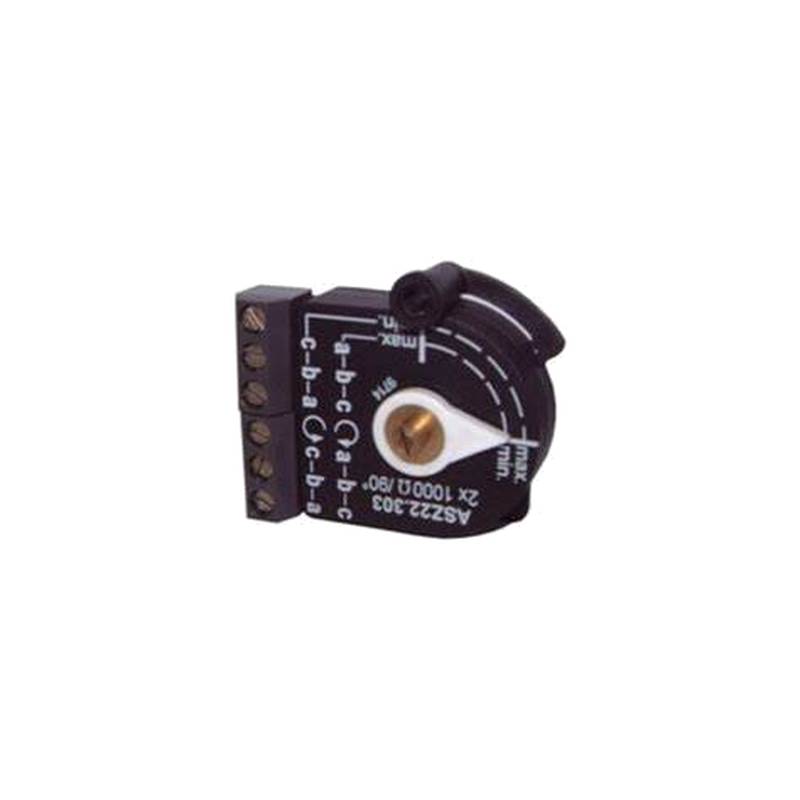
SIEMENS ASZ16.733 Valve Position Sensor ASZ16 Potentiometer


The SIEMENS ASZ16.733 Valve Position Sensor ASZ16 Potentiometer is a critical component in industrial automation, engineered for precise and reliable valve position feedback. This sensor excels in providing accurate analog output signals, crucial for advanced process control systems. Its robust design ensures consistent performance even in demanding environments, making it a preferred choice for applications requiring high reliability and accuracy. Key technical parameters include its potentiometer-based sensing technology, which offers excellent resolution and linearity, and its suitability for a wide range of industrial valve types and operating conditions.
| Feature | Specification |
| :------------------ | :-------------------------------------------------- |
| Product Type | Potentiometer Valve Position Sensor |
| Model Number | ASZ16.733 |
| Manufacturer | SIEMENS |
| Output Signal | Analog (Potentiometric) |
| Housing Material | Durable Industrial Grade |
| Environmental Rating| Designed for Industrial Environments |
| Power Requirement | Varies based on specific model configuration |
| Connection Type | Terminal block or specific industrial connector |
| Mounting Type | Designed for direct or bracket mounting on valve actuators |
The SIEMENS ASZ16.733 distinguishes itself through its inherent simplicity and dependable analog output, a cornerstone for many legacy and modern industrial control loops. Unlike digital encoders, its potentiometric nature provides continuous, stepless feedback of the valve’s exact position, facilitating fine-tuned process adjustments. This direct conversion of mechanical position to an electrical resistance value translates into highly accurate and responsive data for PLCs and DCS systems, reducing the reliance on complex signal processing. Its market positioning is firmly rooted in applications where absolute reliability and straightforward integration are paramount, often favored over more complex sensor technologies where simpler, robust solutions suffice.
Key application scenarios for the SIEMENS ASZ16.733 Valve Position Sensor ASZ16 Potentiometer include its widespread use in the chemical processing industry, oil and gas, power generation, and water treatment facilities. It is integral to the control of control valves, butterfly valves, and ball valves where precise throttling or endpoint detection is required. Operators utilize these sensors to ensure accurate flow rates, pressure levels, and temperature regulation by providing real-time feedback on the valve's operational status. Its ability to withstand vibration and fluctuating environmental conditions makes it ideal for installation directly on valve actuators in diverse plant settings.
Practical system integration of the SIEMENS ASZ16.733 involves direct connection to the valve stem or actuator mechanism, translating its rotary or linear motion into a variable resistance. Wiring typically involves connecting the sensor's output terminals to the appropriate analog input channels on a PLC or remote I/O module. Calibration is often a straightforward process, involving setting the zero and span points to correspond with the fully closed and fully open positions of the valve, respectively. For systems requiring specific voltage or current outputs, signal conditioning modules may be integrated, though the inherent potentiometric output often simplifies integration.
Operation of the SIEMENS ASZ16.733 is designed for long-term, maintenance-free performance. However, potential operational risks include mechanical wear on the resistive track over extended periods of extreme cycling, which can lead to signal drift or intermittent output. Electrical connection integrity is also critical; loose wiring can cause signal loss or erratic readings. Troubleshooting typically begins with verifying power supply to the sensor and checking the continuity and resistance values across its terminals when the valve is moved through its full range. Ensuring proper sealing against environmental ingress will mitigate many common failure modes.
Scalability and long-term value are inherent in the SIEMENS ASZ16.733's design, particularly when integrated into a broader Siemens automation architecture. Its analog output is compatible with a vast array of SIEMENS PLCs (e.g., S7 series) and HMIs, facilitating seamless integration into existing or new control systems. For facilities moving towards IIoT and digital transformation, the analog signal from the ASZ16.733 can be digitized and transmitted to edge devices or cloud platforms for advanced analytics, predictive maintenance, and remote monitoring, offering a cost-effective pathway to enhanced plant intelligence without necessarily replacing the foundational sensor hardware.
FAQs
What is the primary function of the SIEMENS ASZ16.733 Valve Position Sensor?
It provides precise analog feedback on valve positions to control systems. This enables accurate process regulation and monitoring.
It translates mechanical valve movement into an electrical resistance signal. This ensures continuous, stepless position data.
Its core role is to enhance automation by offering reliable valve status information for PLCs and DCS. This aids in process optimization.
How does the SIEMENS ASZ16.733 ASZ16 Potentiometer work?
It utilizes a resistive track that varies resistance with shaft rotation. This resistance change directly correlates to the valve's position.
A wiper arm moves across the resistive element as the valve actuator turns. This movement creates a variable voltage or current output.
The potentiometric principle offers a simple, robust method for continuous position sensing without complex digital encoding. It's highly reliable.
What are the key technical specifications of the SIEMENS ASZ16.733?
It is a potentiometer-based sensor offering analog output for valve position. Its model number is ASZ16.733, manufactured by SIEMENS.
The sensor is built with durable industrial-grade materials to withstand harsh environments. Specific output signals are analog potentiometric.
Its mounting and connection types are designed for standard industrial valve actuators and control cabinets, ensuring ease of integration. Power requirements vary.
Where are SIEMENS ASZ16.733 Valve Position Sensors typically used?
They are extensively used in process industries like chemical, oil, and gas. Applications include precise control of various valve types.
Common scenarios involve flow, pressure, and temperature regulation in power generation and water treatment plants. Accuracy is paramount here.
Its robust nature suits installation on actuators in demanding plant environments where reliable feedback is crucial. It ensures operational integrity.
How do you install and wire the SIEMENS ASZ16.733?
Mount the sensor directly onto the valve actuator, ensuring the shaft connection is secure. Connect output wires to analog input channels on a PLC.
Properly terminate all connections to prevent signal interference or loss. Consult the specific datasheet for exact wiring diagrams.
Calibration involves setting the sensor's output to represent the valve's fully closed and fully open positions accurately. This ensures correct process control signals.
What are common troubleshooting steps for the ASZ16.733?
Verify the sensor is receiving the correct power supply as per specifications. Check for loose or damaged wiring connections.
Measure the resistance across the sensor terminals while manually moving the valve to check for continuity and consistent signal variation. This identifies potential mechanical issues.
Inspect the sensor for any signs of mechanical wear or environmental contamination that could impede its operation. Address any faults with appropriate repair or replacement.
How does the SIEMENS ASZ16.733 integrate with SIEMENS automation systems?
Its analog output is directly compatible with SIEMENS S7 PLCs and other automation hardware. This ensures seamless data flow.
Integration is straightforward due to standardized industrial interfaces and SIEMENS' comprehensive ecosystem. It leverages existing infrastructure.
The sensor’s data can be easily processed for control, monitoring, and diagnostics within the SIEMENS TIA Portal environment or similar platforms. This enhances system efficiency.
Can the SIEMENS ASZ16.733 support IIoT and digital transformation initiatives?
Yes, its analog output can be digitized for IIoT integration and advanced analytics. This enables remote monitoring capabilities.
The sensor data can feed into edge computing devices or cloud platforms for predictive maintenance and performance optimization. It provides valuable data streams.
Upgrading systems to incorporate the ASZ16.733 provides a foundation for future digital enhancements without full sensor replacement. This offers long-term value.
What is the expected lifespan and maintenance for this sensor?
The ASZ16.733 is designed for robust industrial use with a long operational lifespan. Regular inspection can preempt issues.
Maintenance is minimal, typically involving ensuring electrical connections are secure and the unit is free from external contaminants. Periodic checks are recommended.
While generally reliable, extreme cycling rates or harsh conditions may necessitate eventual replacement of the resistive element due to wear. Monitoring is key.
What are the advantages of a potentiometer-based position sensor like the ASZ16.733?
Potentiometers offer a simple, cost-effective solution for analog position feedback. They are highly reliable and easy to understand.
They provide continuous, stepless output, allowing for very precise valve positioning and control. This is crucial for many processes.
The technology is mature and proven, making it a dependable choice for many industrial applications where absolute accuracy and robustness are needed. It is a proven performer.