











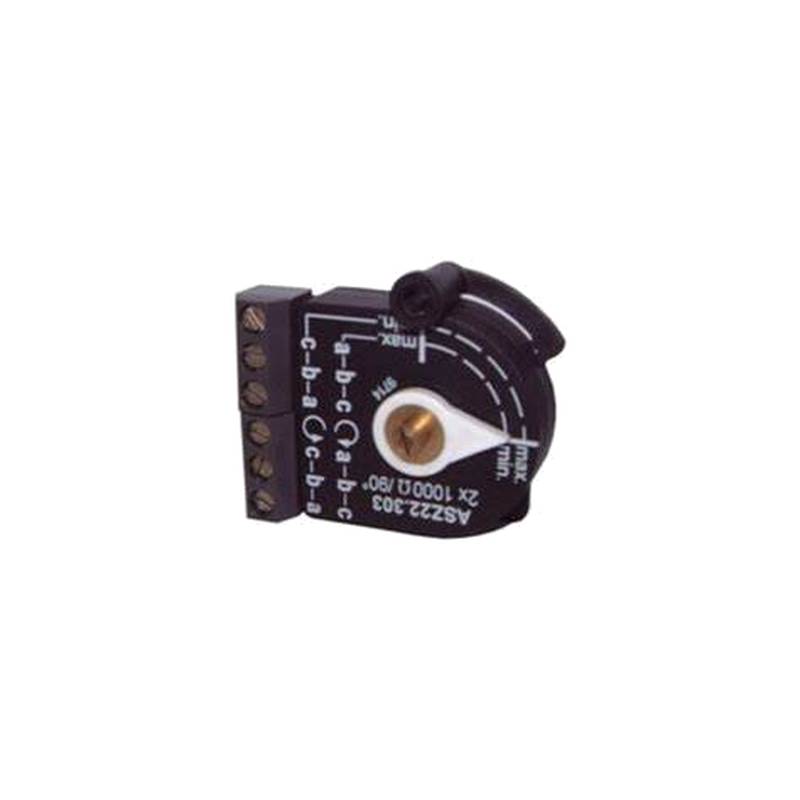
SIEMENS ASZ22.33 ASZ22 Series Auxiliary Potentiometer


The Siemens ASZ22.33 ASZ22 Series Auxiliary Potentiometer is a crucial component for precise position feedback and indication within industrial automation systems, particularly in conjunction with Siemens SQM and SQN actuators. This double potentiometer features a conductive plastic construction, offering enhanced durability and a longer operational life compared to wire potentiometers. With a resistance of 2x1000Ω and a generous 135° angular rotation, the ASZ22.33 facilitates fine-tuned control and detailed position monitoring. Its primary advantage lies in its ability to provide a reliable feedback signal, ensuring accurate control loop performance and system safety. For applications involving electronic fuel/air ratio control systems or specific SQM5 actuators with AGA56 electronic function modules, the conductive plastic design of the ASZ22.33 is not merely recommended but mandatory, guaranteeing superior resolution and longevity.
Product Specifications
| Feature | Specification |
| :-------------------- | :-------------------------------------------- |
| Product Series | ASZ22 Series |
| Model Number | ASZ22.33 |
| Type | Double Potentiometer |
| Construction Material | Conductive Plastic |
| Resistance | 2 x 1000 Ω |
| Angular Rotation | 135° |
| Application | Position indication and feedback for SQM/SQN actuators |
Core Features & Market Positioning
The Siemens ASZ22.33 distinguishes itself in the industrial automation market through its robust conductive plastic design, offering a significant advantage in terms of longevity and resistance to wear over traditional wire potentiometers. This durability translates to reduced maintenance costs and increased system uptime, positioning it as a reliable choice for demanding industrial environments. The precise 2x1000Ω resistance across a 135° rotation angle provides a high-resolution feedback signal, critical for applications requiring accurate positioning, such as in burner management systems and process control loops. Its direct integration with Siemens SQM and SQN actuators further solidifies its market position as a purpose-built solution within a comprehensive Siemens automation ecosystem.
Key Application Scenarios
The Siemens ASZ22.33 auxiliary potentiometer finds its most critical applications in providing precise position feedback for Siemens SQM and SQN series actuators. This is particularly vital in burner control systems, where accurate positioning of fuel and air dampers directly impacts combustion efficiency and safety. It is also integral to process control loops in various manufacturing sectors, ensuring that actuators are positioned precisely as commanded by the control system. Furthermore, its use is mandatory in conjunction with electronic fuel/air ratio control systems and specific SQM5 actuators paired with AGA56 electronic modules, where its conductive plastic construction offers the necessary resolution and extended lifespan for reliable operation.
Practical System Integration Guidance
Integrating the Siemens ASZ22.33 potentiometer into existing systems involves direct mechanical coupling to the drive shaft of compatible SQM or SQN actuators. Electrically, double potentiometers like the ASZ22.33 utilize two 3-pole screw terminal strips for connection. The operating voltage should be applied between terminals "a" and "c" to avoid damage to the conductive plastic elements; applying voltage between "a" and "b" or "b" and "c" can lead to destruction of the potentiometer. It is essential to ensure the potentiometer operates within its specified 135° angular rotation; operating outside this range can result in an interrupted circuit and invalid signals. Detailed wiring diagrams and specific integration procedures are typically found within the technical instructions for the associated SQM/SQN actuators.
Operation and Risk Mitigation
Proper operation of the Siemens ASZ22.33 auxiliary potentiometer is paramount to ensure system integrity and prevent potential damage. The conductive plastic track is sensitive to improper voltage application; applying operating voltage across "a" to "b" or "b" to "c" can cause permanent failure. Additionally, the potentiometer has no mechanical limitation on angular rotation, meaning it can be turned beyond its effective range. If a 90° potentiometer is operated outside its 90° effective range, an open circuit occurs, preventing a valid signal. The ASZ22.33, with its 135° rotation, must also be kept within its intended operational arc to guarantee a reliable feedback signal. Proper installation, ensuring the potentiometer is correctly coupled to the actuator shaft and operates within its design parameters, is the primary method of risk mitigation.
Scalability & Long-Term Value
The Siemens ASZ22.33, as part of the ASZ series, offers long-term value through its durable conductive plastic construction, which ensures a significantly extended operational life compared to older technologies. Its compatibility is tightly linked to Siemens SQM and SQN actuators, providing a clear upgrade path within the Siemens automation platform. For systems evolving towards more sophisticated control strategies or integration with IIoT and digital solutions, the high-resolution feedback signal provided by the ASZ22.33 can be readily interpreted by modern controllers and data acquisition systems. While the potentiometer itself is a discrete component, its role in providing accurate positional data makes it a foundational element for more advanced, scalable automation architectures.
Frequently Asked Questions
What is the primary function of the Siemens ASZ22.33 auxiliary potentiometer?
The Siemens ASZ22.33 primarily serves as a position feedback device. It accurately reports the angular position of the actuator's drive shaft to the control system. This feedback is crucial for precise control in applications like burner management and process automation.
This precise reporting ensures that the system knows the exact state of the actuator. It enables closed-loop control, allowing for adjustments to maintain desired setpoints. Without this feedback, the system would operate in an open-loop manner, reducing accuracy and potentially causing inefficiencies or safety issues.
The ASZ22.33 is designed to integrate seamlessly with Siemens SQM and SQN actuators. This ensures reliable and accurate data transmission for optimal system performance and safety.
What are the key technical specifications of the Siemens ASZ22.33?
The ASZ22.33 is a double potentiometer featuring conductive plastic construction for enhanced durability. It offers a resistance of 2 x 1000 Ohms and a 135° angular rotation.
This specification allows for a wide range of precise adjustments. The conductive plastic material ensures a longer lifespan and better resolution than wire potentiometers.
These technical parameters make it ideal for applications demanding accurate position sensing and reliable feedback signals in industrial environments.
How does the Siemens ASZ22.33 differ from other potentiometers in the ASZ series?
The ASZ22.33 is a double potentiometer with a 135° angular rotation and conductive plastic construction. Other ASZ series potentiometers may be single or double, with different resistance values or angular rotations (e.g., 90°).
Some ASZ models utilize wire or cermet construction, which may be suitable for general use but lack the longevity and resolution of conductive plastic. The ASZ22.33 is specifically recommended for fuel/air ratio control systems.
The choice between different ASZ models depends on the specific actuator compatibility, required feedback precision, environmental conditions, and lifespan expectations for the application.
What are the advantages of using conductive plastic over wire potentiometers for the ASZ22.33?
Conductive plastic potentiometers offer superior durability and a significantly longer operational life than wire-wound potentiometers. They also provide better resolution for more precise feedback signals.
This enhanced longevity reduces maintenance requirements and associated downtime. The higher resolution ensures more accurate positioning control for critical applications.
For demanding applications like electronic fuel/air ratio control, conductive plastic is often mandatory due to these performance advantages.
In which industrial applications is the Siemens ASZ22.33 typically used?
The ASZ22.33 is commonly used in conjunction with Siemens SQM and SQN actuators for position indication and feedback. It is vital in burner control systems for accurate damper positioning.
It also plays a role in industrial process control, ensuring precise actuator movements. Its use is mandated for certain fuel/air ratio control systems and specific SQM5 actuators.
The precise feedback it provides is critical for efficiency, safety, and optimal performance in these varied industrial settings.
What are the essential integration requirements for the Siemens ASZ22.33?
Integration requires mechanical coupling to the drive shaft of compatible Siemens SQM or SQN actuators. Electrical connection uses two 3-pole screw terminal strips.
Crucially, operating voltage must be applied between terminals "a" and "c" to prevent damage. Exceeding the 135° angular rotation can lead to signal interruption.
Correct installation ensures reliable position feedback and prevents potentiometer damage, vital for system integrity.
What are common troubleshooting issues with the Siemens ASZ22.33?
A common issue is receiving no valid signal, often due to operating the potentiometer outside its specified angular rotation. Incorrect voltage application can also destroy the conductive plastic element.
Ensure the potentiometer is correctly coupled to the actuator shaft and that the control system is configured for its resistance and rotation range. Check wiring for loose connections.
Refer to the actuator's technical instructions for specific diagnostic procedures and fault code interpretation related to potentiometer feedback.
How does the ASZ22.33 contribute to system scalability and long-term value?
Its durable conductive plastic construction ensures a long service life, reducing replacement frequency and long-term costs. This inherent reliability supports stable system operation.
The high-resolution feedback signal is compatible with modern digital control systems and IIoT platforms, facilitating integration into advanced automation strategies.
By providing accurate and reliable positional data, it acts as a foundational component for scalable automation architectures, supporting future system upgrades and expansions.
Is the Siemens ASZ22.33 compatible with actuators other than Siemens SQM and SQN series?
The ASZ22.33 is specifically designed for integration with Siemens SQM and SQN series actuators. Its mechanical interface and electrical characteristics are optimized for these specific actuator models.
While theoretically adaptable to other systems with similar mechanical coupling and electrical interfaces, direct compatibility is limited to the intended Siemens actuators. Using it with non-specified actuators may void warranties and lead to performance issues.
Always consult the actuator's documentation and Siemens specifications to confirm compatibility before attempting integration with non-Siemens equipment.
What are the disposal requirements for the Siemens ASZ22.33?
The ASZ22.33 contains electrical and electronic components and must not be disposed of with general household waste. Local regulations for electronic waste disposal must be strictly followed.
Recycling or designated electronic waste disposal facilities are the appropriate channels for its end-of-life management. This ensures environmental protection and compliance with legislation.
Proper disposal prevents hazardous materials from entering the environment and promotes the recovery of valuable components.