











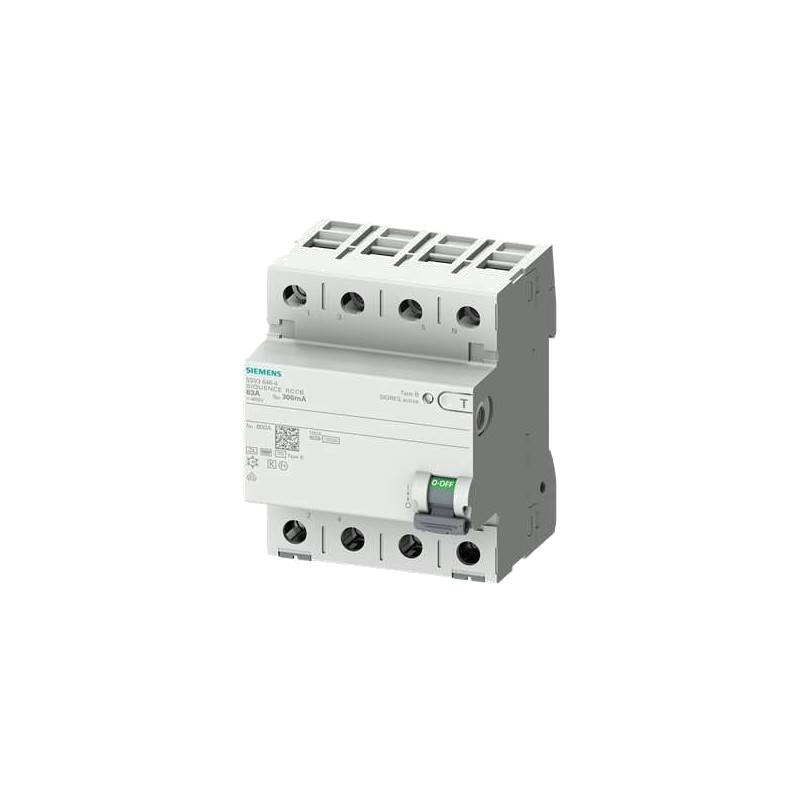
Siemens 5SV3647-4 Miniature Circuit Breaker 4P 80A 300mA


The Siemens 5SV3647-4 Miniature Circuit Breaker (MCB) is a robust 4-pole, 80A device designed for advanced residual current protection. It features a 300mA sensitivity, providing critical safety for personnel and property against electrical shock and fire hazards. This unit is engineered for short-time delayed tripping, which enhances system stability by preventing nuisance trips caused by transient earth leakage currents. The 5SV3 series, including the 5SV3647-4, is part of Siemens' SENTRON protective devices, known for their reliability and comprehensive safety solutions in demanding electrical installations.
Product Specifications
| Parameter | Value |
| :---------------------------- | :---------------------------------------------- |
| Manufacturer | Siemens |
| Model | 5SV3647-4 |
| Type | Residual Current Circuit Breaker (RCCB) |
| Number of Poles | 4 |
| Rated Current (In) | 80 A |
| Rated Fault Current (IΔn) | 300 mA (0.3 A) |
| Rated Voltage (Un AC) | 400 V |
| Fault Current Type | B |
| Tripping Type | Short-time delayed |
| Mounting Method | DIN rail |
| Rated Impulse Withstand Voltage | 6 kV |
| Rated Insulation Voltage (Ui) | 2000 V |
| Power Loss | 7.5 W |
| Width (Number of Modular Spacings) | 4 |
| Frequency | 50/60 Hz |
| Surge Current Resistance | 3 kA |
| Short-circuit Strength (Icw) | 10 kA |
| Degree of Protection (IP) | IP20 |
| Ambient Temperature | -25 °C to 45 °C |
| Connectable Conductor Cross Section (Solid/Stranded) | 0.75 mm² to 35 mm² |
Core Features & Market Positioning
The Siemens 5SV3647-4 stands out in the market due to its Type B tripping characteristic, which offers superior protection against both AC and pulsating DC residual currents, as well as smooth DC residual currents. This capability is crucial for modern installations that utilize electronic equipment prone to generating such fault currents. Its short-time delayed functionality (Type B, short-time delayed) provides an enhanced level of selectivity and operational continuity, preventing unwarranted shutdowns often experienced with instantaneous tripping devices when dealing with transient surges. Positioned as a premium safety component within the Siemens SENTRON portfolio, the 5SV3 series embodies the brand's commitment to robust protection, high reliability, and advanced features designed for industrial and demanding commercial applications. The inclusion of features like touch protection and easy DIN rail mounting further solidifies its value proposition for installers and end-users.
Key Application Scenarios
The Siemens 5SV3647-4 is ideally suited for applications requiring comprehensive protection against residual currents, particularly in three-phase systems. Its 4-pole configuration is essential for fully protecting circuits that include a neutral conductor, making it a prime choice for industrial machinery, commercial distribution boards, and complex building installations. Specific use cases include protecting equipment with power electronics, variable speed drives, IT power supplies, and other sensitive electronic loads that may generate pulsating DC or smooth DC leakage currents. Furthermore, its short-time delayed characteristic makes it effective in installations where coordination with downstream instantaneous devices is necessary, or where temporary earth faults might occur without posing an immediate danger. This makes it highly valuable in sectors such as manufacturing, data centers, and advanced building management systems.
Practical System Integration Guidance
Integrating the Siemens 5SV3647-4 into an electrical system is streamlined due to its DIN rail mounting capability, a standard in control cabinets and distribution boards. The device accepts a wide range of conductor cross-sections, from 0.75 mm² to 35 mm², accommodating various wiring requirements. For installation, qualified electricians must ensure proper termination of all four poles and the earth connection, adhering to local electrical codes and Siemens' installation guidelines. The unit's design allows for flexible infeed at either the top or bottom terminals, simplifying wiring layouts. The clear ON/OFF and trip indication on the toggle lever provides immediate status feedback. For systems requiring advanced monitoring or remote signaling, the 5SV3647-4 is compatible with various Siemens system accessories, such as auxiliary switches and fault signal contacts, which can be easily attached to the modular system.
Operation and Risk Mitigation
Safe operation of the Siemens 5SV3647-4 relies on understanding its protective functions and adhering to safety protocols. As an RCCB, it provides essential protection against indirect contact (fault protection) and direct contact (enhanced protection with 30mA sensitivity, though this model is 300mA for line protection). The Type B characteristic is critical for detecting a broader spectrum of fault currents than Type AC or A devices. Regular testing of the residual current function, typically via a built-in test button, is paramount to ensure its operational readiness. While specific fault codes are not typically associated with RCCBs, a persistent tripping indicates an earth fault on the protected circuit, necessitating immediate investigation and rectification by a qualified electrician. Proper utilization, in conjunction with miniature circuit breakers for overcurrent protection, forms a comprehensive safety system. Compliance with installation standards and manufacturer guidelines is crucial to mitigate risks associated with electrical installations.
Scalability & Long-Term Value
The Siemens 5SV3647-4 offers significant long-term value through its integration into the broader Siemens SENTRON system. Its modular design allows for the straightforward addition of accessories, such as auxiliary switches, fault signal contacts, or shunt trips, enabling system expansion and adaptation to evolving operational requirements without needing to replace the core protective device. This compatibility with a wide range of system components ensures that the 5SV3647-4 can be part of sophisticated electrical protection schemes, including integration with Building Management Systems (BMS) or Industrial Internet of Things (IIoT) platforms via appropriate signaling accessories. The inherent quality and durability of Siemens components contribute to a long operational lifespan, minimizing the total cost of ownership. Furthermore, Siemens' commitment to backward and forward compatibility within its product lines ensures that future upgrades or system expansions will likely remain seamless.
Frequently Asked Questions
What is the primary function of the Siemens 5SV3647-4?
The Siemens 5SV3647-4 is primarily a residual current circuit breaker (RCCB). Its main function is to protect electrical circuits from earth leakage currents. It detects imbalances between the live and neutral conductors. This rapid detection and interruption of current prevents electric shock to personnel and mitigates fire hazards caused by electrical faults.
This device is specifically designed for 4-pole applications, ensuring comprehensive protection in three-phase systems. Its 80A rating makes it suitable for higher current loads. The 300mA sensitivity is ideal for line and fire protection rather than direct personnel protection, which typically uses 30mA devices.
The short-time delayed tripping characteristic is a key feature, preventing nuisance tripping from transient surges while still ensuring safety. This makes it valuable in industrial settings with sensitive electronics.
What type of fault currents can the Siemens 5SV3647-4 detect?
The Siemens 5SV3647-4, being a Type B RCCB, can detect a wider range of fault currents compared to Type AC or Type A devices. It is sensitive to sinusoidal AC residual currents, pulsating DC residual currents, and importantly, smooth DC residual currents. This capability is crucial for modern electrical installations that utilize electronic equipment such as variable speed drives, IT power supplies, and inverters.
These electronic devices can generate DC components in fault currents, which can blind or desensitize standard Type AC or Type A RCCBs. The Type B characteristic ensures reliable tripping even in the presence of these more complex fault current waveforms.
This advanced detection capability significantly enhances safety and operational reliability in complex industrial and commercial environments where such equipment is prevalent.
Where is the Siemens 5SV3647-4 typically installed?
The Siemens 5SV3647-4 is typically installed in main distribution boards or sub-distribution boards within industrial facilities, commercial buildings, and complex residential complexes. Its 4-pole configuration is suited for protecting three-phase loads, including motors, machinery, and HVAC systems. The 80A current rating signifies its use in circuits with substantial power demands.
Due to its Type B tripping characteristic and 300mA sensitivity, it is often employed to protect sensitive electronic equipment or to provide line and fire protection in areas where the risk of smooth DC fault currents exists. This could include areas with VFDs, modern control systems, or charging infrastructure for electric vehicles.
Installation involves mounting on a standard 35mm DIN rail. It is designed for easy wiring, with terminals capable of accepting a broad range of conductor sizes, and provides clear visual indication of its operational status (ON/OFF/TRIPPED).
What are the key advantages of the Type B tripping characteristic in this breaker?
The primary advantage of the Type B tripping characteristic in the Siemens 5SV3647-4 is its enhanced sensitivity to a wider spectrum of fault currents. Unlike Type AC or Type A breakers, Type B is designed to detect not only AC and pulsating DC residual currents but also smooth DC residual currents. This is critical in environments with modern electronic equipment that can generate DC fault currents, such as variable frequency drives (VFDs), UPS systems, and certain types of power supplies.
This comprehensive detection capability ensures reliable protection and prevents nuisance tripping that might occur with less sensitive breaker types when encountering mixed-frequency or DC fault currents. It significantly increases the safety and operational continuity of electrical systems.
By offering protection against a broader range of fault types, the Type B characteristic provides a higher level of safety and reliability, making the 5SV3647-4 a superior choice for advanced industrial and commercial applications where such fault currents are a possibility.
What does "short-time delayed" tripping mean for the 5SV3647-4?
"Short-time delayed" tripping refers to a specific tripping characteristic that intentionally introduces a slight delay before the residual current protection operates. This is a crucial feature designed to improve system selectivity and prevent unnecessary shutdowns in situations where transient earth leakage currents occur briefly. For instance, when certain inductive loads are switched on, they can momentarily generate small, harmless earth leakage currents.
An instantaneous tripping device might react to these transients, causing an unwanted shutdown. The short-time delay in the 5SV3647-4 allows these brief surges to pass without tripping, thereby increasing the overall availability and stability of the electrical system.
This delay is precisely calibrated and does not compromise safety, as it is still designed to trip well within established safety limits for sustained or significant earth faults. This makes the breaker particularly well-suited for industrial applications with complex loads and the need for high operational uptime.
How does the 5SV3647-4 integrate with other electrical components?
The Siemens 5SV3647-4 is designed for seamless integration within the Siemens SENTRON system and broader electrical infrastructure. It features standard DIN rail mounting, allowing for easy installation in most electrical enclosures. The device is compatible with a wide range of conductor sizes, facilitating flexible wiring.
Furthermore, the 5SV3647-4 can be expanded with various accessories, such as auxiliary switches, fault signal contacts, and shunt trips. These accessories can be easily mounted, allowing for remote monitoring, signaling, or integrated control functions, thus enhancing system intelligence and manageability.
Its robust design and adherence to international standards (like IEC) ensure compatibility with other appropriately rated components from Siemens and potentially other reputable manufacturers, provided they meet the required specifications. This modularity and compatibility contribute to its long-term value and adaptability in evolving electrical systems.
What is the significance of the 300mA rated residual current?
A rated residual current of 300mA (0.3A) for the Siemens 5SV3647-4 indicates its primary role in providing enhanced protection against fire hazards and for equipment, rather than the immediate protection of human life against direct contact. Residual Current Devices (RCDs) with lower sensitivities, such as 10mA or 30mA, are typically specified for direct personnel protection, as they trip at currents low enough to prevent severe electric shock.
The 300mA sensitivity is generally used for indirect protection, preventing damage to equipment and mitigating the risk of fire initiation due to sustained earth faults. It is often installed upstream in a distribution system to provide selectivity, ensuring that faults in specific circuits do not unnecessarily trip the main protective device.
Therefore, the 300mA rating signifies that this particular breaker is optimized for higher-level protection scenarios, such as safeguarding entire installations or specific high-power circuits from fire risks stemming from persistent earth leakage.
Is this breaker suitable for residential or solely industrial use?
While the Siemens 5SV3647-4 is a highly capable device, its specific characteristics—4-pole, 80A, Type B, and 300mA sensitivity—point towards its primary suitability for industrial and demanding commercial applications. The 4-pole configuration is common in three-phase industrial settings. The 80A rating is for higher current loads typically found in industrial machinery.
The Type B tripping characteristic, designed to detect smooth DC residual currents, is particularly relevant in environments with modern electronic equipment common in industrial automation and commercial facilities, such as variable speed drives and IT systems. The 300mA sensitivity is more aligned with fire and equipment protection rather than direct personnel safety, which is usually addressed with 30mA devices in residential settings.
However, in advanced residential complexes or high-end smart homes that utilize significant three-phase power or specialized equipment (like EV charging stations that can introduce DC fault currents), this breaker might find application, though typically 30mA RCCBs would be used for personal safety circuits.
How does the 5SV3647-4 contribute to system reliability?
The Siemens 5SV3647-4 enhances system reliability through several key features. Firstly, its short-time delayed tripping characteristic prevents nuisance tripping caused by transient surges or brief earth leakage currents, which can occur during the energization of certain inductive loads. This ensures continuous operation of essential equipment.
Secondly, the Type B tripping capability ensures reliable detection of a wider range of fault currents, including smooth DC components, which can blind or desensitize less advanced RCDs. By accurately detecting and interrupting hazardous fault currents, it protects equipment from damage and prevents system failures.
Finally, being a Siemens product, it benefits from high-quality manufacturing and robust design, leading to a long operational life and dependable performance. Its compatibility with system accessories also allows for enhanced monitoring and diagnostics, enabling proactive maintenance and minimizing unexpected downtime.
What maintenance is required for the Siemens 5SV3647-4?
The primary maintenance requirement for the Siemens 5SV3647-4, like all residual current devices, is periodic testing of its tripping function. This is typically performed using the integrated test button on the front of the device. This test should be conducted regularly, often recommended monthly or quarterly, to ensure the device is still operational and able to detect earth faults.
Beyond functional testing, visual inspections for any signs of physical damage, corrosion, or overheating at the terminals are advisable. Ensuring the connections are clean and tightly secured is crucial for reliable operation and to prevent excessive voltage drop or arcing.
While the device itself is designed for long life with typically over 10,000 switching cycles, it is a protective device that may need replacement if it trips frequently (indicating a persistent fault on the circuit) or if it fails a test. Always ensure that any maintenance or testing is performed by a qualified electrician.