











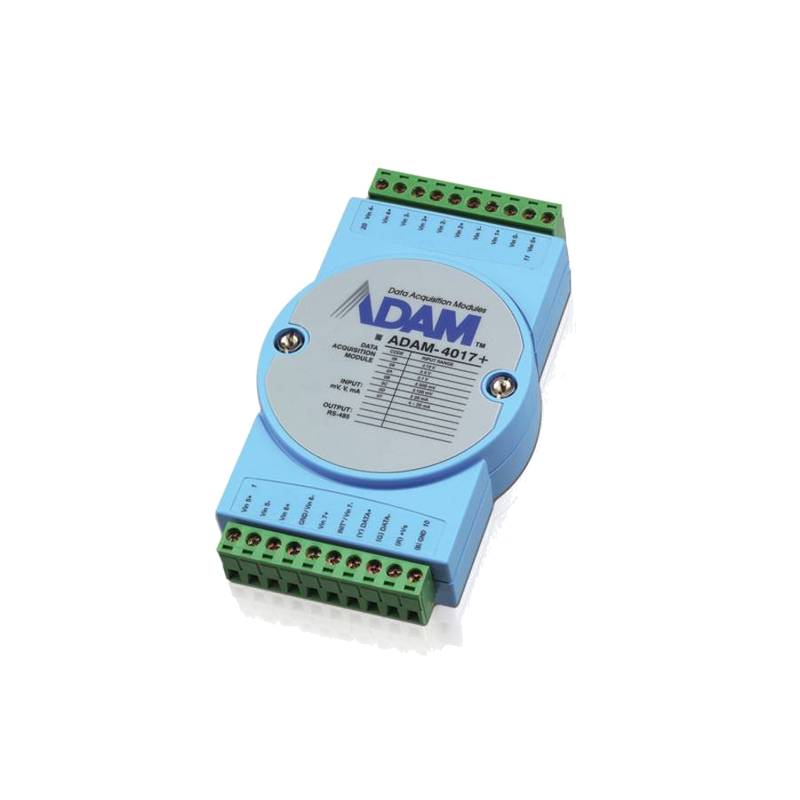
Advantech ADAM-4060-F 4-Channel Relay Digital Output Module


The Advantech ADAM-4060-F 4-Channel Relay Digital Output Module offers robust industrial automation control with its reliable relay outputs and versatile functionality. Designed for demanding environments, this module boasts four Form A (SPST) relay outputs, capable of handling up to 250VAC/5A or 30VDC/5A per channel. Its DIN-rail mountable design simplifies installation, while its wide operating temperature range of -20°C to 70°C ensures dependable performance. With features like LED indicators for status monitoring and a robust RS-485 communication interface supporting Modbus RTU protocol, the ADAM-4060-F is a premier choice for integrating digital control into complex industrial systems.
Product Specifications
| Feature | Specification |
| :------------------ | :------------------------------------------ |
| Digital Outputs | 4 x Form A (SPST) Relays |
| Max. AC Load | 250 VAC @ 5 A |
| Max. DC Load | 30 VDC @ 5 A |
| Isolation Voltage | 2500 VDC |
| Power Consumption | 1.2 W @ 24 VDC |
| Communication | RS-485, Modbus RTU |
| Operating Temp. | -20°C to 70°C |
| Dimensions | 148 mm x 78 mm x 37 mm |
| Mounting | DIN-rail |
| Indicators | LEDs for Power, Communication, Output Status |
Core Features & Market Positioning
The Advantech ADAM-4060-F distinguishes itself in the industrial automation market through its combination of high-power relay switching capabilities and robust construction. Unlike modules with lower current ratings or less durable relay types, the ADAM-4060-F's Form A relays provide reliable actuation for a variety of industrial loads, from motor control to lighting systems. Its inherent RS-485 communication, a standard in industrial environments, ensures broad compatibility and ease of integration with existing SCADA systems and PLCs. This focus on reliable, high-capacity switching in a compact, industrial-grade form factor positions it as a go-to solution for engineers requiring dependable digital output control.
Key Application Scenarios
The Advantech ADAM-4060-F finds critical applications in scenarios demanding precise on/off control of industrial equipment. It is frequently deployed in building automation systems for HVAC control, managing fans, pumps, and solenoid valves. In manufacturing, it serves as a vital component for controlling conveyor belts, actuators, and warning lights, ensuring efficient production workflows. Furthermore, its suitability for harsh environments makes it ideal for water treatment plants, managing pumps and automated gate operations, and in the energy sector for controlling power distribution or monitoring status of remote equipment.
Practical System Integration Guidance
Integrating the Advantech ADAM-4060-F module into an industrial control system is straightforward, typically involving RS-485 communication. Connect the module to the RS-485 bus using a shielded twisted-pair cable, ensuring correct termination of the bus. Power is supplied via a 24 VDC source, with terminals clearly marked for input. For communication, the module uses the Modbus RTU protocol, requiring configuration of its unique slave ID and baud rate. Programming examples often involve sending specific Modbus commands to read status or set relay states, commonly implemented using function codes 01 (Read Coils) and 05 (Write Single Coil) or 15 (Write Multiple Coils) within development environments like C++, Python, or dedicated PLC programming software. Proper wiring of the relay outputs to the controlled devices, respecting the maximum current and voltage ratings, is paramount for safe and reliable operation.
Operation and Risk Mitigation
Operating the ADAM-4060-F involves careful adherence to its specified electrical limits to prevent damage or safety hazards. Ensure that the load connected to each relay does not exceed the 5A current or the 250VAC/30VDC voltage rating. When wiring, always disconnect power before making connections to avoid electrical shock. The module's inherent isolation provides a degree of protection, but good grounding practices for the entire system are essential. Troubleshooting typically begins with checking power supply stability and communication integrity; LED indicators on the module provide immediate visual feedback on power, communication activity, and individual relay status, aiding in rapid diagnostics. For instance, a steady power LED indicates a valid power supply, while blinking communication LEDs suggest data exchange.
Scalability & Long-Term Value
The Advantech ADAM-4060-F offers significant long-term value through its scalability and compatibility with modern industrial trends, including the Industrial Internet of Things (IIoT). Multiple ADAM-4060-F modules can be daisy-chained on the same RS-485 bus, allowing for easy expansion of digital output channels as system requirements grow. Its Modbus RTU protocol ensures interoperability with a vast array of PLCs, HMIs, and SCADA systems from various manufacturers, protecting investment in existing infrastructure. By integrating this module into an IIoT-ready architecture, data from its relay outputs can be collected and analyzed remotely, enabling predictive maintenance and enhanced operational efficiency, thereby future-proofing industrial automation strategies.
Frequently Asked Questions
What is the maximum load capacity of the Advantech ADAM-4060-F?
The Advantech ADAM-4060-F is designed to handle significant loads for industrial applications. Each of its four Form A relay outputs can switch a maximum of 5 Amperes. This capacity applies to both AC and DC loads, up to a voltage limit of 250 VAC or 30 VDC, respectively.
Can the ADAM-4060-F be used for controlling high-power motors?
Yes, the ADAM-4060-F can be utilized for controlling moderate-power motors, provided their current draw does not exceed the 5A limit per channel. For higher-power motors, the relays would typically be used to switch contactors that then manage the motor's power supply.
What communication protocol does the ADAM-4060-F use for integration?
The ADAM-4060-F utilizes the widely adopted Modbus RTU protocol over an RS-485 serial communication interface. This standard protocol ensures broad compatibility with various industrial control systems, PLCs, and SCADA software platforms, simplifying integration into existing or new automation architectures.
How are the digital outputs of the ADAM-4060-F configured?
The digital outputs of the ADAM-4060-F are configured by sending specific Modbus RTU commands over the RS-485 interface. Engineers can programmatically control each relay to be energized (ON) or de-energized (OFF) using standard Modbus function codes, such as 'Write Single Coil' or 'Write Multiple Coils'.
What type of relays are used in the ADAM-4060-F module?
The Advantech ADAM-4060-F features four Form A (SPST - Single Pole Single Throw) relays. These are commonly referred to as normally open (NO) relays. When the relay is activated, it closes the circuit, allowing current to flow.
How is the ADAM-4060-F powered in an industrial setting?
The ADAM-4060-F requires a DC power supply, typically 24 VDC. This power input is connected to dedicated terminals on the module, ensuring a stable and reliable power source for its operation within industrial control panels and systems.
What is the operating temperature range for this module?
This module is built for demanding industrial environments and operates reliably within a wide temperature range. Specifically, the Advantech ADAM-4060-F can function effectively between -20°C and 70°C (-4°F to 158°F).
Does the ADAM-4060-F support remote monitoring of its output status?
Yes, the ADAM-4060-F supports remote monitoring of its output status. Through the Modbus RTU protocol, the state of each relay (whether it is open or closed) can be queried by a master device, allowing for real-time status feedback in a control system.
What are some common troubleshooting steps for the ADAM-4060-F?
Common troubleshooting involves verifying the 24 VDC power supply is stable and within specifications. Next, check the RS-485 communication wiring for proper termination and verify the module's unique slave ID and baud rate settings match the master configuration.
How can multiple ADAM-4060-F modules be integrated into a single system?
Multiple ADAM-4060-F modules can be integrated into a single system by connecting them to the same RS-485 bus. Each module must be assigned a unique Modbus slave ID to differentiate it on the network, allowing the master controller to address and control each module independently.