











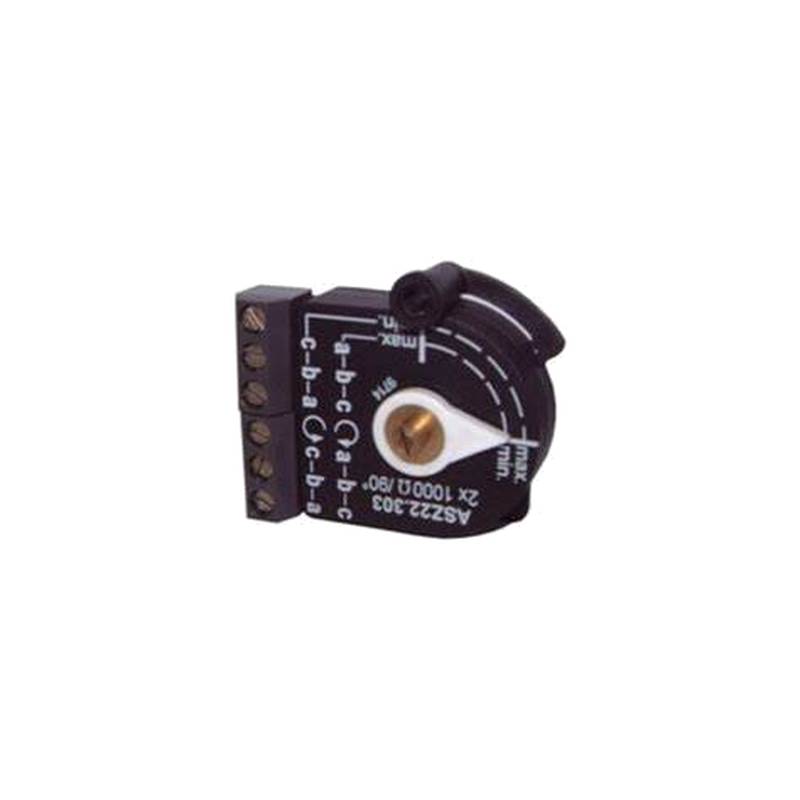
SIEMENS ASZ22.703 Feedback Potentiometer Valve Position


The SIEMENS ASZ22.703 Feedback Potentiometer Valve Positioner is a critical component for precise control in industrial automation systems. This device offers robust performance with a high degree of accuracy, ensuring optimal operation of actuated valves. Its core strengths lie in its reliable feedback mechanism, compact design, and compatibility with various control systems. Key technical parameters include an electrical stroke of 90 mm, a maximum operating temperature of +60°C, and an ingress protection rating of IP65, making it suitable for demanding industrial environments.
Product Specifications
| Parameter | Value |
| :------------------------ | :------------------ |
| Electrical Stroke | 90 mm |
| Max. Operating Temperature | +60°C |
| Ingress Protection | IP65 |
| Potentiometer Resistance | 1 kΩ |
| Linearity | ±1% |
| Supply Voltage | 24 V AC/DC |
| Mechanical Angle | 90° |
| Output Signal | Variable resistance |
Core Features & Market Positioning
The SIEMENS ASZ22.703 distinguishes itself through its direct integration of a potentiometer for valve position feedback, eliminating the need for complex external signal conversion in many applications. This feature simplifies system design and reduces potential points of failure, a significant advantage in process automation where reliability is paramount. Its robust construction and IP65 rating position it as a durable solution for harsh industrial settings, including chemical processing, power generation, and water treatment plants, where resistance to dust and water jets is essential. The ASZ22.703 is engineered for seamless integration within Siemens' broader automation portfolio, offering enhanced interoperability and simplified engineering.
Key Application Scenarios
This feedback potentiometer valve positioner is extensively utilized in applications requiring precise throttling or on/off control of industrial valves. It is particularly well-suited for managing flow rates in chemical dosing systems, controlling steam or water flow in power plants, and regulating wastewater treatment processes. Its ability to provide accurate, real-time position feedback makes it indispensable for complex control loops where maintaining specific process parameters is critical for product quality and operational efficiency. Automation engineers frequently specify the ASZ22.703 for retrofitting older systems or for new installations demanding high reliability and straightforward integration.
Practical System Integration Guidance
Integrating the SIEMENS ASZ22.703 typically involves connecting its output terminals to the input of a programmable logic controller (PLC) or a dedicated digital input module. The potentiometer's variable resistance output directly correlates to the valve's stem position. Wiring requires careful attention to the supply voltage (24 V AC/DC) and ensuring proper grounding for signal integrity. For programming, the PLC's analog input needs to be configured to interpret the resistance values and map them to the 0-100% valve position range. Calibration is straightforward, usually involving setting the end points of the valve stroke within the control system software.
Operation and Risk Mitigation
Safe operation of the SIEMENS ASZ22.703 hinges on adhering to the specified voltage and temperature limits to prevent component damage and ensure accurate feedback. Technicians should always disconnect power before performing any maintenance or wiring adjustments. While robust, potential issues can arise from mechanical wear over extended periods or contamination ingress if the IP65 seal is compromised. Common troubleshooting involves checking for correct supply voltage, verifying potentiometer continuity, and ensuring the mechanical linkage between the valve stem and the ASZ22.703 is free from obstruction. Fault codes are not typically generated by the potentiometer itself; instead, anomalies are detected by the connected control system as deviations from expected position feedback.
Scalability & Long-Term Value
The SIEMENS ASZ22.703 offers significant long-term value due to its compatibility with a wide range of Siemens automation platforms, including SIMATIC PLCs and HMI systems. This ensures that systems incorporating the ASZ22.703 can be easily expanded or upgraded without requiring a complete overhaul of the valve positioning components. Its direct analog feedback mechanism future-proofs its utility, as it can interface with both traditional control systems and newer IIoT-enabled architectures that process analog data. The inherent durability and Siemens' commitment to product longevity mean that the ASZ22.703 provides a reliable foundation for evolving industrial automation strategies.
Frequently Asked Questions
What is the primary function of the SIEMENS ASZ22.703?
The ASZ22.703 provides precise feedback on the exact position of an industrial valve. It uses a potentiometer to translate mechanical stem movement into an electrical signal. This enables closed-loop control systems to accurately monitor and adjust valve positions in real-time.
This feedback is crucial for maintaining desired process parameters like flow rate or pressure. It allows automation systems to make continuous corrections for optimal performance and efficiency in various industrial applications.
The device ensures that control signals sent to the valve are accurately reflected in its physical state. This reliability is essential for safety and product quality in critical processes.
How does the potentiometer in the ASZ22.703 work for valve feedback?
The integrated potentiometer acts as a variable resistor. As the valve stem moves, it rotates a wiper across the resistive element of the potentiometer. This change in wiper position alters the resistance value, providing a continuous analog signal.
This resistance value is directly proportional to the valve's mechanical stroke or angle. The connected control system reads this resistance and converts it into a precise valve position percentage.
The potentiometer's resistance changes linearly with the valve's movement, offering accurate and predictable position data. This analog output simplifies integration compared to digital encoders in many scenarios.
What are the key advantages of using the ASZ22.703 in an industrial setting?
A major advantage is its high degree of integration, combining valve actuation feedback with a single, robust unit. This reduces wiring complexity and potential failure points in the control loop.
The IP65 rating signifies excellent protection against dust and water jets, making it suitable for harsh and demanding industrial environments. Its compact design also simplifies installation in space-constrained applications.
Furthermore, its compatibility with Siemens automation platforms ensures seamless integration and long-term support. This leads to reduced engineering effort and improved system reliability.